Mastering 7th Grade Math: Your Ultimate Final Exam Review Guide
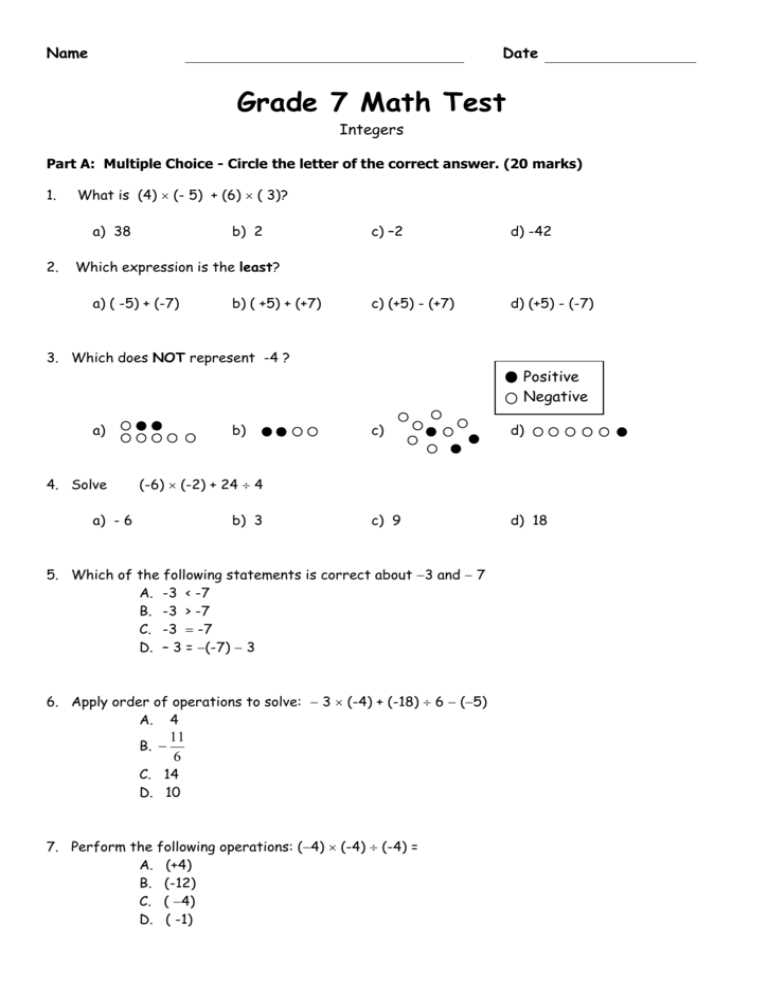
Preparing for a math final exam can be an overwhelming and stressful experience for any student. As a 7th grader, this may be your first encounter with a comprehensive exam that covers all the topics you have learned throughout the year. But fear not, this article is here to help you review and refresh your memory on the key concepts you will need to know for your final exam.
From algebraic equations to geometry theorems, your math final exam will test your understanding of a wide range of topics. It’s important to approach your review in a systematic and organized manner, so you can cover all the necessary material. This article will guide you through the main topics you should focus on and provide some helpful tips and tricks to help you succeed.
One of the key aspects of preparing for any math exam is practicing solving problems. As you work through practice questions and examples, you will be able to identify areas where you are strong and areas where you may need more review. It’s important to spend extra time on those areas and seek additional help if needed. Remember, practice makes perfect!
So, if you are feeling overwhelmed or unsure about what to study for your 7th-grade math final exam, don’t worry. This review article will provide you with all the necessary information and resources to help you succeed. Just take a deep breath, stay organized, and start reviewing one concept at a time. Good luck!
7th Grade Math Final Exam Review
If you are preparing for your 7th-grade math final exam, it is important to review all the topics that have been covered throughout the year. This review will help you refresh your memory and ensure you are prepared for the test. It is always good to start by organizing your notes and creating a study schedule.
One important topic that you should review is integers. Understand how to add, subtract, multiply, and divide integers. Remember the rules for operations with positive and negative numbers. Practice solving problems using integers in real-life situations.
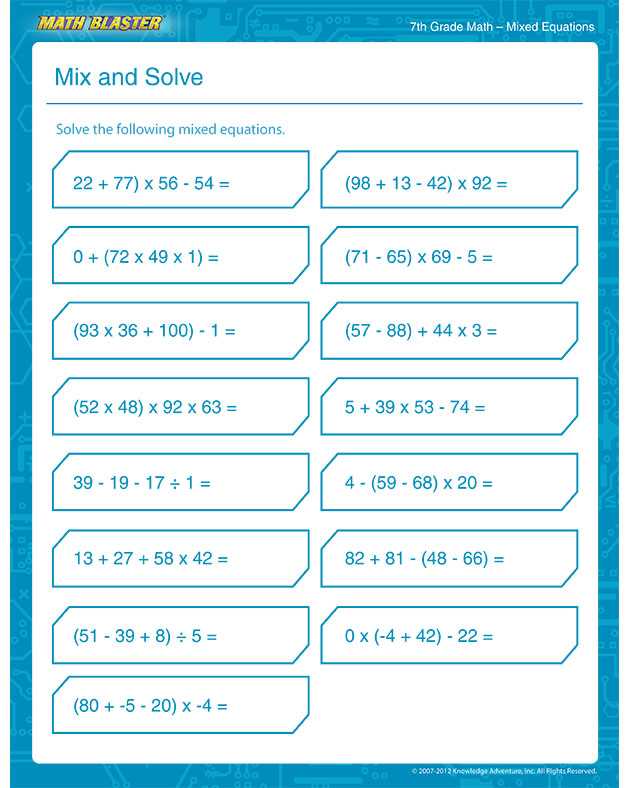
- Review algebraic expressions and equations. Understand how to simplify expressions using the order of operations. Remember the properties of equality and how to solve one-step and two-step equations. Practice writing and solving equations to represent real-world situations.
- Don’t forget about fractions, decimals, and percents. Review how to convert between fractions, decimals, and percents. Practice solving word problems involving fractions, decimals, and percents. Understand how to find a percentage of a number.
- Geometry is another important topic to review. Refresh your memory on the properties of different geometric shapes, such as triangles, quadrilaterals, and circles. Understand how to calculate the perimeter, area, and volume of these shapes. Practice solving problems involving angles, congruence, and similarity.
- Data analysis and probability are also key topics. Review how to collect, organize, and interpret data. Understand how to calculate measures of central tendency, such as mean, median, and mode. Practice calculating probabilities and understanding the concept of independent and dependent events.
Remember to practice solving a variety of problems from each topic and check your answers. If you are unsure about any concept, ask your teacher or classmates for help. It is always better to clarify any doubts before the exam. Good luck with your final exam!
Key concepts for 7th grade math
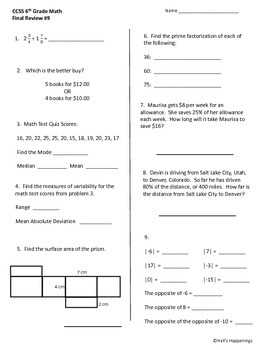
In 7th grade math, students build upon the foundational concepts they learned in earlier years and dive deeper into more complex mathematical ideas. Here are some key concepts that are important to understand in 7th grade math:
1. Integers
Integers are whole numbers, both positive and negative, including zero. In 7th grade math, students learn to perform operations like addition, subtraction, multiplication, and division with integers. They also explore the concept of absolute value and how to represent integers on a number line. Understanding integers is crucial for solving various mathematical problems.
2. Proportional Relationships
A proportional relationship is a relationship between two quantities where the ratio between them remains constant. In 7th grade math, students learn to identify and analyze proportional relationships using tables, graphs, and equations. They also learn to solve problems involving proportional relationships, such as finding the constant of proportionality and determining the value of one variable given the other.
3. Percentages
Percentages are important in many real-life situations, such as calculating discounts, sales tax, and interest rates. In 7th grade math, students learn to work with percentages, including converting between fractions, decimals, and percentages, finding percentages of quantities, and solving problems involving percentages. Understanding percentages is essential for interpreting and analyzing data in various contexts.
4. Geometry
Geometry is the study of shapes, sizes, and properties of figures and spaces. In 7th grade math, students explore various geometric concepts, such as angles, triangles, quadrilaterals, circles, and three-dimensional figures. They learn to classify shapes, calculate area and perimeter, and solve problems involving geometric properties. Geometry helps students develop spatial reasoning skills and apply mathematical concepts to real-world situations.
5. Probability and Statistics
Probability and statistics involve the study of uncertainty and data analysis. In 7th grade math, students learn about basic probability concepts, such as outcomes, events, and the probability of an event occurring. They also learn to analyze and interpret data using measures of central tendency (mean, median, and mode) and measures of variability (range and interquartile range). Probability and statistics play a crucial role in making predictions and drawing conclusions based on data.
These key concepts provide the foundation for further mathematical learning and problem-solving skills. Mastering these concepts in 7th grade math sets the stage for success in more advanced math courses.
Geometry and Measurement
Geometry and measurement are important concepts in seventh grade math. This topic focuses on understanding and applying geometric principles, such as angles, lines, and shapes, as well as measurement units and conversions.
One key concept in geometry is angles. Students learn about different types of angles, including acute angles (less than 90 degrees), obtuse angles (more than 90 degrees), and right angles (exactly 90 degrees). They also learn to identify and measure angles using a protractor.
Another important aspect of geometry is understanding different types of lines. This includes parallel lines, perpendicular lines, and intersecting lines. Students learn to identify these lines and how they relate to angles and shapes.
Geometry also involves studying different shapes and their properties. Students learn about polygons, such as triangles, quadrilaterals, and pentagons, and the characteristics that define them. They also explore concepts like symmetry and congruence.
The measurement component of this topic centers around units and conversions. Students learn about the metric system, including units for length, area, volume, and mass. They also learn to convert between different units, such as kilometers to meters, or milliliters to liters. This skill is essential for solving real-world problems involving measurements.
In conclusion, geometry and measurement play a crucial role in seventh grade math. Understanding angles, lines, shapes, and measurement units is essential for solving math problems and applying mathematical concepts. It is important for students to master these concepts in order to build a strong foundation for future math courses.
Algebraic expressions and equations
Algebraic expressions and equations are fundamental concepts in mathematics that involve variables, operations, and numbers. They allow us to represent and solve mathematical problems in a concise and systematic way.
An algebraic expression is a combination of variables, numbers, and operations such as addition, subtraction, multiplication, and division. It can be a single term or a combination of multiple terms. For example, “3x + 7” and “2y^2 – 5xy + 9” are algebraic expressions. They can be simplified or evaluated by substituting values for the variables.
An equation is a mathematical statement that asserts the equality of two algebraic expressions. It contains an equals sign (=) and consists of a left-hand side and a right-hand side. The goal is to find the value(s) of the variable(s) that satisfy the equation. Equations can be linear or nonlinear, depending on the degree of the variable(s) involved. Solving equations involves isolating the variable to determine its value.
When dealing with algebraic expressions and equations, it is important to follow certain rules and properties of algebra, such as the distributive property, combining like terms, and order of operations. These rules help simplify expressions and solve equations more easily. It is also essential to understand the concept of an unknown variable and the concept of solving for that variable.
In summary, algebraic expressions and equations are powerful tools for representing and solving mathematical problems. They provide a systematic approach to understanding relationships between variables and numbers. By mastering these concepts, students can develop their problem-solving skills and apply them in various real-world scenarios.
Data Analysis and Probability
Data analysis and probability are important concepts in mathematics that allow us to make sense of the world around us. In 7th grade, students will build on their understanding of these topics and develop skills to analyze and interpret data, as well as make predictions based on probabilities.
One key aspect of data analysis is understanding how to collect, organize, and represent data in different ways. Students will learn to create and interpret tables, charts, and graphs to visually represent data. They will also learn to calculate and interpret measures of central tendency, such as mean, median, and mode, to describe and analyze data sets.
Probability is the study of the likelihood of events occurring. Students will learn to calculate probabilities using fractions, decimals, and percentages. They will explore theoretical and experimental probability and use these concepts to solve real-world problems. Students will also learn to represent probabilities using probability models, such as tree diagrams and organized lists.
For example, a student might be asked to determine the probability of rolling a certain number on a fair six-sided die. By understanding the total number of possible outcomes and the number of favorable outcomes, the student can calculate the probability.
- Probability can also be used to analyze and interpret data. For example, students might analyze the probability of different outcomes in a survey or experiment.
- Students will also learn about compound events, such as the probability of rolling two dice and getting a certain sum. They will use probability to make predictions and decisions based on data.
- Data analysis and probability are important skills that extend beyond the math classroom. They are used in various fields, such as science, business, and sports, to analyze trends, make predictions, and inform decision-making.
In conclusion, data analysis and probability are essential concepts that provide students with the skills to analyze and interpret data, as well as make predictions based on probabilities. These skills are valuable not only in math but also in various real-life scenarios.
Number Sense and Operations
In the field of mathematics, number sense and operations are fundamental concepts that form the basis for understanding and solving mathematical problems. Number sense refers to a person’s understanding of numbers and their relationships, while operations involve the manipulation and calculation of numbers through various mathematical operations.
A strong number sense is crucial for students as it helps them make sense of numbers, estimate quantities, and compare values. It allows students to develop a deeper understanding of mathematical concepts and helps them apply these concepts in real-world situations. Moreover, number sense enables students to make connections between different mathematical ideas, making it easier for them to learn and solve complex problems.
Within number sense, students learn key concepts such as place value, rounding, and the properties of numbers. They also learn various operations such as addition, subtraction, multiplication, and division. These operations are essential for performing calculations and solving mathematical problems across different domains, including algebra, geometry, and probability.
To develop strong number sense and operations skills, students must engage in hands-on activities, problem-solving tasks, and real-world applications. They need opportunities to explore and manipulate numbers, analyze patterns, and apply their understanding in different contexts. By practicing and mastering these skills, students can gain confidence in their mathematical abilities and become proficient problem solvers.
Key Topics in Number Sense and Operations:
- Place value
- Rounding
- Comparing and ordering numbers
- Addition and subtraction
- Multiplication and division
- Fractions, decimals, and percentages
By focusing on number sense and operations, students can develop a solid foundation in mathematics and become equipped to tackle more advanced mathematical concepts in higher grades. It is essential for teachers and parents to provide ample opportunities for students to build their number sense skills through meaningful and engaging activities.
Conclusion
Problem-solving strategies are essential tools for success in mathematics, and they are especially important for 7th graders preparing for their final exams. By utilizing the strategies outlined in this article, students can approach math problems with confidence and efficiency.
First, it is crucial for students to understand the problem and identify what is being asked. This helps them break down the problem into smaller, manageable parts and determine the appropriate mathematical operations or concepts required to solve it.
Secondly, students should make use of visual aids, such as diagrams and charts, to represent the problem visually and gain a better understanding of the relationships between different elements. This visual approach can make complex problems more accessible and enable students to see patterns and connections that may not be immediately apparent.
Additionally, it is important for students to develop a systematic approach to problem-solving. This involves creating a plan, executing it step by step, and evaluating the solution to ensure it is correct and reasonable. By following this systematic process, students can avoid errors and find solutions more efficiently.
Lastly, it is vital for students to practice problem-solving regularly. The more problems they attempt, the more familiar they become with various problem-solving techniques and strategies. With practice, students can enhance their problem-solving skills and become more adept at applying these strategies to a wide range of mathematical problems.
In summary, problem-solving strategies are powerful tools that can help 7th graders excel in their final exams and beyond. By understanding the problem, utilizing visual aids, employing a systematic approach, and practicing regularly, students can become proficient problem-solvers and achieve success in their math studies.
Q&A:
What are problem-solving strategies?
Problem-solving strategies are techniques or approaches people use to solve problems or overcome challenges.
What are some common problem-solving strategies?
Some common problem-solving strategies include trial and error, breaking the problem down into smaller parts, brainstorming, and using logical reasoning.
How can trial and error help with problem-solving?
Trial and error involves trying different solutions until the problem is solved. It can be useful when the problem has multiple possible solutions and the best approach is uncertain.
Why is brainstorming an effective problem-solving strategy?
Brainstorming is effective because it encourages the generation of multiple ideas and possibilities. It allows for creative thinking and can lead to innovative solutions.
What is the importance of problem-solving strategies?
Problem-solving strategies are important because they help individuals and teams find solutions and make decisions. They can lead to more efficient processes, increased productivity, and improved problem-solving skills.
What are problem-solving strategies?
Problem-solving strategies are a set of approaches and techniques used to find solutions to various problems or challenges. These strategies involve analyzing the problem, identifying possible solutions, evaluating the potential outcomes, and choosing the most effective course of action.