The Importance of Accuracy and Precision in Lab Experiments: Unlocking the Answer Key

Accuracy and precision are two important concepts in scientific measurements. In the field of chemistry, these terms refer to the closeness of a measured value to the true value and the closeness of a set of measured values to each other, respectively. In order to understand these concepts better, students often participate in accuracy and precision labs.
In an accuracy and precision lab, students are given various measuring instruments and asked to perform a series of measurements. These measurements could include determining the volume of a liquid using a graduated cylinder, weighing various objects using a balance, or measuring the length of an object using a ruler. The goal of the lab is for students to understand the importance of accurate and precise measurements in scientific experiments.
To analyze the accuracy and precision of their measurements, students are usually asked to calculate the percent error and the standard deviation. Percent error is a measure of accuracy and is calculated by subtracting the accepted value from the measured value, dividing that difference by the accepted value, and then multiplying by 100. Standard deviation, on the other hand, is a measure of precision and is calculated by finding the square root of the average of the squared differences between each measured value and the mean value.
By analyzing the percent error and standard deviation of their measurements, students can determine if their measurements were accurate and precise. If the percent error is low and the standard deviation is small, then the measurements are considered to be accurate and precise. However, if the percent error is high and the standard deviation is large, then the measurements are considered to be inaccurate and imprecise.
What is accuracy and precision?
Accuracy and precision are terms commonly used in the field of science and measurement to describe the quality of a measurement or experimental result. While they are related concepts, accuracy and precision have distinct meanings.
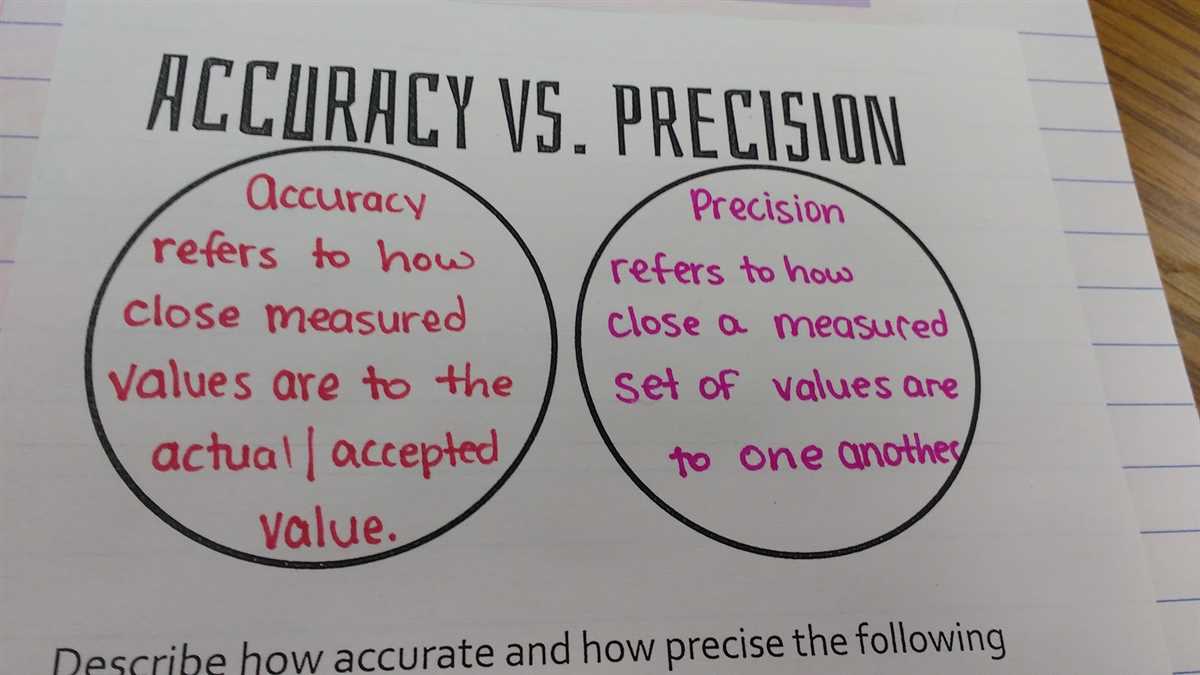
Accuracy refers to how close a measured value is to the true or accepted value. It is a measure of how well a measurement represents the true value of what is being measured. In other words, accuracy tells us how correct our measurements are. When a measurement is accurate, it means that there is minimal error or deviation from the true value. For example, if a scale reads 10 grams for an object with a true weight of 10 grams, the measurement is considered accurate.
Precision, on the other hand, refers to the degree of reproducibility or consistency in a set of measurements. It is a measure of the level of detail or exactness in a measurement. Precision tells us how well the measurements are clustered or clustered together. When a measurement is precise, it means that there is minimal variability or spread among the repeated measurements. For example, if a series of measurements of an object’s weight consistently yields results of 9.95 grams, 9.96 grams, and 9.97 grams, the measurements are considered precise.
In summary, accuracy relates to the correctness of a measurement, while precision relates to the consistency or reproducibility of a set of measurements. Accuracy can be affected by systematic errors, such as calibration issues or biases, while precision can be affected by random errors, such as fluctuations in experimental conditions or measurement technique. Achieving both accuracy and precision is important in scientific research and experimentation to ensure reliable and valid results.
Importance of accuracy and precision in the lab
The accuracy and precision of measurements in the lab are of paramount importance for obtaining reliable and valid results. Accuracy refers to the closeness of a measurement to the true value, while precision refers to the repeatability and consistency of a measurement. Both accuracy and precision are crucial in ensuring the validity and reliability of scientific experiments and research.
Accurate measurements are essential because they provide an indication of how close a measurement is to the true value. In the lab, accurate measurements help scientists make informed decisions and draw accurate conclusions. For example, accurate measurements in the field of medicine can help determine the correct dosage of a drug for a patient, while in environmental science, accurate measurements of pollutants can inform policy decisions.
Precision is equally important in the lab because it ensures that measurements can be repeated consistently. Precise measurements allow scientists to detect small changes or trends over time, and enable comparisons between different experiments or samples. Without precision, it would be difficult to determine the reliability of the results or assess the significance of any observed changes.
When conducting experiments, it is important to minimize any sources of error and strive for both accuracy and precision. This can be achieved through careful calibration of instruments, maintaining consistent experimental conditions, and repeating measurements. Additionally, appropriate statistical analysis can help quantify the accuracy and precision of measurements and provide a measure of confidence in the results.
In conclusion, accuracy and precision are vital in the lab as they ensure the reliability, validity, and significance of scientific measurements. By striving for accurate and precise measurements, scientists can confidently draw conclusions, make informed decisions, and contribute to the advancement of knowledge in their respective fields.
Accurate measurements ensure reliability
Accurate measurements are crucial in many fields, as they determine the reliability of the data collected and the validity of any conclusions drawn from it. Whether in scientific experiments, engineering design, or medical diagnostics, accuracy in measurements ensures that the results obtained are both precise and reliable.
When conducting experiments, researchers need accurate measurements to ensure that the variables they are studying are being properly controlled and manipulated. Any inaccuracies in measurements can introduce errors that may skew the results and lead to incorrect conclusions. For example, in a chemistry experiment, the accurate measurement of reactant quantities can determine the yield and quality of the product.
Accurate measurements are also essential in engineering design and construction. Whether it is calculating the dimensions of a building, ensuring the proper alignment of components in a machine, or determining the load-bearing capabilities of a structure, accuracy is paramount. A slight miscalculation or deviation from accurate measurements can have catastrophic consequences, jeopardizing the safety and functionality of the designed system.
In the field of medicine, accurate measurements are instrumental in diagnosis and patient care. From measuring vital signs such as blood pressure and heart rate to determining the dosage of medication, precision in measurements ensures accurate diagnosis and proper treatment. Inaccurate measurements can lead to incorrect diagnoses and inappropriate medical interventions, potentially endangering the patient’s health.
In summary, accurate measurements are essential in various disciplines to ensure reliability and validity. They play a critical role in scientific research, engineering design, and medical diagnostics, among other fields. With accurate measurements, researchers and professionals can confidently draw conclusions, make informed decisions, and provide accurate information for further analysis and evaluation.
Precise measurements provide consistency
In the world of scientific research and experimentation, consistency is key. Precise measurements play a crucial role in achieving this consistency. When we talk about precision, we are referring to the level of detail and accuracy in our measurements. The more precise our measurements are, the more consistent our results will be.
By using precise measurements, scientists can ensure that their experiments are repeatable and reproducible. This is especially important in fields such as chemistry, physics, and biology, where small variations can have significant impacts on the outcome. For example, if a scientist is measuring the concentration of a particular substance in a solution, a slight variation in measurement could lead to completely different results.
The use of precise measurements also allows scientists to compare and analyze data more effectively. When the measurements are consistent and precise, it becomes easier to spot trends, identify patterns, and draw accurate conclusions. Precise measurements provide a solid foundation for scientific research, allowing for more reliable and trustworthy findings.
- Accuracy and precision lab answer key: The answer key for an accuracy and precision lab might include precise measurements and calculations that demonstrate consistent results.
- Precision and accuracy in science: Both precision and accuracy are important in scientific research, and precise measurements contribute to both.
- Importance of precise measurements: Precise measurements ensure consistency, reproducibility, and accuracy in scientific experiments, leading to more reliable results.
- Consistency and reliability: Precise measurements provide consistency, which contributes to the reliability of scientific findings.
Difference between accuracy and precision
Accuracy and precision are two important concepts in the field of measurements and data analysis. While they are related, they have distinct meanings and implications.
Accuracy
Accuracy refers to how close a measured value is to the true or accepted value. It measures the correctness or trueness of the measurement. A measurement can be said to be accurate if it is close to the true value, regardless of how precise the measurement is. For example, if a thermometer consistently reads the correct temperature, it is considered accurate.
Precision
Precision, on the other hand, refers to the level of consistency or reproducibility of a set of measurements. It measures the degree of agreement between repeated measurements of the same quantity. A measurement can be precise if it yields similar results when performed multiple times, even if those results are not necessarily close to the true value. For example, if a scale consistently shows the same weight for an object, it is considered precise.
In summary, accuracy focuses on correctness and closeness to the true value, while precision focuses on consistency and agreement between measurements. It is possible for a measurement to be accurate but not precise, precise but not accurate, both accurate and precise, or neither accurate nor precise. Understanding the difference between accuracy and precision is crucial for making reliable and valid measurements and drawing accurate conclusions from data analysis.
How to Improve Accuracy and Precision in the Lab
Accuracy and precision are essential factors in any laboratory setting as they directly impact the reliability and validity of experimental results. Here are some key strategies that can be employed to improve accuracy and precision in the lab:
1. Calibration
Regularly calibrating laboratory equipment is crucial for ensuring accurate measurements. Equipment such as balances, pipettes, thermometers, and pH meters should be calibrated according to manufacturer’s instructions or using standard calibration solutions. This helps eliminate potential systematic errors and enhances the accuracy of the measurements.
2. Proper Technique
Using proper technique is vital for obtaining precise and accurate results. Laboratory personnel should receive appropriate training and follow standardized procedures to minimize human errors. This includes properly handling and operating equipment, adhering to measurement protocols, and ensuring proper sample handling and preparation.
3. Quality Control
Implementing a robust quality control process can help identify and correct errors in the lab. This involves regularly running control samples or reference materials alongside experimental samples to check for accuracy and precision. By comparing the results obtained from control samples to expected values, any errors or inconsistencies can be identified and addressed in a timely manner.
4. Maintenance and Upkeep
Regular maintenance and upkeep of laboratory equipment is essential for ensuring accurate and precise measurements. This includes routine cleaning, inspection, and repair of equipment to prevent any degradation or malfunction. Additionally, proper storage and handling of reagents and chemicals can help maintain their integrity and prevent contamination.
5. Replication and Statistical Analysis
To improve precision, conducting multiple replicates of an experiment and performing statistical analysis on the data can help identify and minimize random errors. By calculating measures such as standard deviation and confidence intervals, researchers can determine the range of values within which the true value is likely to lie, thus increasing the reliability of the results.
Implementing these strategies in the lab can significantly improve the accuracy and precision of experimental measurements. By minimizing systematic and random errors, researchers can obtain reliable and reproducible results, enhancing the overall quality of their scientific work.
Calibrating instruments regularly
Calibrating instruments regularly is crucial for maintaining accurate and precise measurements in various scientific and industrial applications. Inaccurate measurements can lead to faulty data, incorrect analysis, and potentially dangerous situations. By calibrating instruments, we ensure that they are providing accurate readings and are aligned with the known standards.
Calibration process: Typically, calibration involves comparing the measurements of an instrument to a known reference or standard. The instrument is adjusted or calibrated to match the reference measurements, ensuring accuracy. This process may involve making minor adjustments, such as zeroing or adjusting the sensitivity of the instrument, or more involved adjustments to correct for non-linear responses.
It is important to calibrate instruments regularly to account for any drift or changes that may occur over time. Factors such as temperature, humidity, vibration, and normal wear and tear can affect the performance of instruments. Regular calibration helps to identify and correct for these factors, ensuring that the instrument remains accurate and precise.
Benefits of regular calibration:
- Quality assurance: Regular calibration ensures that the measurements obtained from instruments meet the required quality standards. This is especially crucial in industries where precision is critical, such as pharmaceuticals, aerospace, and manufacturing.
- Compliance: Many regulated industries require regular calibration as part of their quality control and compliance processes. Calibration certificates provide evidence of compliance with industry standards and regulations.
- Safety: In some applications, inaccurate measurements can pose a safety risk. Regular calibration helps mitigate these risks by ensuring that instruments accurately measure parameters such as temperature, pressure, or voltage.
- Cost savings: Regular calibration can help identify potential problems or malfunctions in instruments before they become more serious and costly to repair or replace. It also minimizes the need for rework, waste, and potential product recalls.
In conclusion, calibrating instruments regularly is essential for maintaining accurate and precise measurements. It ensures quality, compliance, safety, and cost savings. By following a proper calibration process, we can rely on the measurements obtained from instruments to make informed decisions and ensure the success of various scientific and industrial applications.
Using proper techniques and procedures
Accurate and precise measurements in the lab are crucial for obtaining reliable data. To ensure accuracy and precision, it is important to follow proper techniques and procedures.
Calibrating and maintaining equipment: Regular calibration of lab equipment is essential for accuracy. Follow the manufacturer’s instructions for calibration and ensure that equipment is maintained properly. This includes cleaning and storing equipment correctly to prevent any contamination or damage.
Using appropriate measuring tools: Choose the right measuring tool for the desired measurement. For example, use a graduated cylinder for liquids, a ruler for length, or a balance for mass. Ensure that the measuring tool is clean and dry before use.
Eliminating parallax errors: When taking measurements with a scale or ruler, always ensure that you are looking at the measurement from a 90-degree angle and that your eye is directly in line with the measurement mark. This will help avoid parallax errors, which can lead to inaccurate readings.
Taking multiple measurements: To improve precision, it is important to take multiple measurements and calculate an average. This helps to reduce the impact of any random errors and increases the reliability of the data obtained.
Recording measurements accurately: When recording measurements, be sure to include the appropriate units and significant figures. This helps to ensure that the data is precise and can be easily understood and analyzed by others.
Regularly reviewing and practicing techniques: It is valuable to regularly review and practice lab techniques to ensure accuracy and precision. This includes understanding the proper use of equipment, handling of chemicals, and following safety protocols. Continual practice will help to improve skills and reduce the potential for errors.
In conclusion, using proper techniques and procedures in the lab is vital for obtaining accurate and precise measurements. By calibrating and maintaining equipment, using appropriate measuring tools, eliminating parallax errors, taking multiple measurements, and recording measurements accurately, researchers can ensure reliable data. Regular review and practice of techniques will further enhance accuracy and precision in the lab.