The Comprehensive Guide to Understanding ‘An Occurrence at Owl Creek Bridge’: Questions and Answers PDF

“An Occurrence at Owl Creek Bridge” is a short story written by Ambrose Bierce in 1890. Set during the American Civil War, the story follows the protagonist Peyton Farquhar, a Confederate sympathizer, as he faces execution by hanging for attempting to sabotage a Union railroad bridge. The story is known for its unexpected twist ending, which leaves readers questioning the nature of reality and time.
In this article, we will provide a list of questions and answers related to “An Occurrence at Owl Creek Bridge” in PDF format. These questions cover various aspects of the story, including its themes, characters, and literary techniques. Whether you are a student studying the story or simply a fan of Ambrose Bierce’s work, this PDF will serve as a helpful resource for further understanding and analysis.
Some of the questions covered in this PDF include:
- What is the significance of the title “An Occurrence at Owl Creek Bridge”?
- How does the author create suspense throughout the story?
- What is the symbolism behind the “gray-clad soldier” who visits Peyton Farquhar’s house?
- What is the purpose of the flashback scene in the story?
- What is the overall theme of the story?
These are just a few examples of the questions that will be explored in this PDF. By examining these questions and their corresponding answers, readers can gain a deeper understanding of the story and engage in thoughtful discussions about its themes and literary techniques.
So, if you are looking for a comprehensive resource on “An Occurrence at Owl Creek Bridge,” download this PDF of questions and answers and embark on a journey of analysis and exploration of this classic short story.
An Occurrence at Owl Creek Bridge Questions and Answers PDF
Question 1: What is the main theme of “An Occurrence at Owl Creek Bridge”?
Answer: The main theme of “An Occurrence at Owl Creek Bridge” is the illusion of time and the power of the human mind to create alternative realities. The story explores the protagonist’s experience as he awaits execution on a bridge during the American Civil War. It delves into the concept of time distortion and the idea that moments before death, the mind can create elaborate fantasies.
Question 2: How does the author create suspense in the story?
Answer: The author creates suspense in “An Occurrence at Owl Creek Bridge” through various narrative techniques. One way is by using foreshadowing, such as when the protagonist describes the ticking of his watch and the slowing down of time. This builds anticipation for the mysterious events that will unfold. The author also uses vivid descriptions and sensory details to immerse the reader in the protagonist’s experience, heightening the tension and uncertainty.
Question 3: What is the significance of the twist ending?
Answer: The twist ending of “An Occurrence at Owl Creek Bridge” reveals that the protagonist’s escape and reunion with his family was nothing more than a hallucination as he experiences his final moments of life. This ending emphasizes the fragility of human perception and the power of the mind to create illusions in desperate situations. It also underscores the tragedy of war and the futility of the protagonist’s attempt to escape his fate.
- Question 4: Why is the setting of the story important?
- Answer: The setting of “An Occurrence at Owl Creek Bridge” is important because it contributes to the overall atmosphere and tone of the story. The bridge itself symbolizes a liminal space between life and death, and the surrounding natural landscape adds to the sense of isolation and impending doom. The author’s detailed descriptions of the setting also enhance the reader’s immersion in the story and help to create a vivid and haunting backdrop for the events that unfold.
Question 5: How does the story explore the theme of time?
Answer: “An Occurrence at Owl Creek Bridge” explores the theme of time through the protagonist’s experience of time distortion during his final moments. As he awaits execution, time slows down and the protagonist’s thoughts and perceptions become heightened. The story also plays with the reader’s sense of time by presenting the protagonist’s escape and subsequent events as if they were happening in real time, only to reveal at the end that it was all a fantasy created in his mind.
Overview of “An Occurrence at Owl Creek Bridge”
“An Occurrence at Owl Creek Bridge” is a short story written by Ambrose Bierce and was first published in 1890. The story is set during the American Civil War and follows the protagonist, Peyton Farquhar, as he experiences a series of events leading up to his execution. Bierce’s story explores themes of time, perception, and the brutality of war.
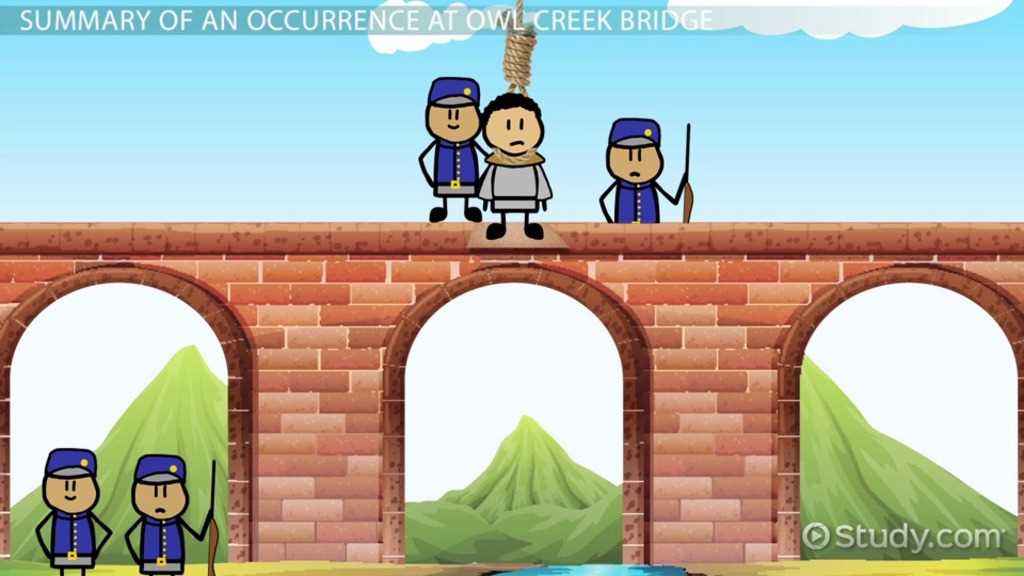
The story begins with Farquhar, a wealthy plantation owner and supporter of the Confederacy, about to be hanged by Union soldiers for attempting to sabotage a railroad bridge. As he awaits his execution, Farquhar reflects on his life and contemplates his impending death. Suddenly, he sees a shimmering light and feels as if time has slowed down. This marks the beginning of a vivid hallucination in which he escapes from his captors and embarks on a treacherous journey back home.
The majority of the story is dedicated to Farquhar’s vivid and detailed escape fantasy. He manages to avoid gunfire, dodge cannonballs, and swim through treacherous waters. As he reaches his home, he is reunited with his wife and experiences a moment of euphoria before abruptly snapping back to reality. It is revealed that his escape was nothing more than a hallucination, and in reality, he is still standing on the bridge, moments away from death.
Bierce’s “An Occurrence at Owl Creek Bridge” is known for its twist ending, which leaves readers questioning what is real and what is imagined. The story raises thought-provoking questions about the nature of perception, the passage of time, and the resilience of the human spirit. Through its exploration of these themes, Bierce’s story continues to captivate readers and serves as a reminder of the horrors and psychological toll of war.
Key Themes and Symbolism in “An Occurrence at Owl Creek Bridge”
“An Occurrence at Owl Creek Bridge” is a short story written by Ambrose Bierce that explores several key themes and makes use of symbolism to convey its message. One of the main themes explored in the story is the illusion of time. The protagonist, Peyton Farquhar, experiences a distorted perception of time as he awaits his execution on the bridge. This theme is highlighted through the use of flashback and vivid descriptions, creating a sense of confusion and suspense for the reader.
The symbolism used in the story also adds depth to its themes. The “Owl Creek Bridge” itself symbolizes the boundary between life and death. It represents the moment of transition and the uncertain space in between. The flowing water beneath the bridge can be seen as a symbol of eternity, suggesting that the protagonist’s journey is not only physical but also metaphysical.
Another key symbol in the story is the noose. The noose represents the inevitability of death and the protagonist’s ultimate fate. Its presence throughout the story serves as a constant reminder of the impending execution and adds to the suspense. The sound of the ticking watch also symbolizes time running out for the protagonist, further emphasizing the theme of the illusion of time.
In conclusion, “An Occurrence at Owl Creek Bridge” explores themes of the illusion of time and uses symbolism to convey its message. The story challenges the reader’s perception of reality and offers a thought-provoking exploration of life, death, and the boundaries between the two.
Analysis of the Main Characters
In Ambrose Bierce’s short story “An Occurrence at Owl Creek Bridge,” there are two main characters that play significant roles in the narrative: Peyton Farquhar and the Federal scout. Both characters contribute to the overall plot and theme of the story, and their actions and motivations are closely examined throughout.
Peyton Farquhar

Peyton Farquhar is the central character of the story, and his perspective is followed closely as the events unfold. Initially portrayed as a wealthy plantation owner and Confederate sympathizer, Farquhar is depicted as adventurous and willing to take risks. He becomes involved in a plot to sabotage the Union army’s plans by attempting to burn down Owl Creek Bridge.
Farquhar’s actions highlight his bravery and determination, as he willingly puts his life at risk for a cause he believes in. However, his true nature and motivations are ultimately called into question when it is revealed that most of his interaction with the Confederate soldier who recruits him is merely a hallucination in the moments leading up to his execution.
The Federal scout
The Federal scout, whose real name is not revealed in the story, is the other main character who plays a crucial role in the plot. He acts as a confidante and advisor to Farquhar, offering him the opportunity to carry out his plan to destroy the bridge. However, it is later revealed that the scout is actually a Union soldier sent to gather intelligence and prevent any sabotage attempts.
The Federal scout’s true identity adds a layer of complexity to the story and raises questions about Farquhar’s true intentions. It also underscores the theme of deception and manipulation, as Farquhar is ultimately tricked into believing that he can successfully carry out his plan. The scout’s presence in the story serves as a reminder of the harsh realities of war and the lengths to which both sides will go to gain the upper hand.
Conclusion
The analysis of the main characters in “An Occurrence at Owl Creek Bridge” reveals the contrasting motivations and perspectives that drive the narrative. Farquhar’s bravery and willingness to fight for his beliefs are juxtaposed with the scout’s deceptive tactics, highlighting the themes of war, deception, and the blurred lines between truth and illusion. Their interactions ultimately lead to a shocking twist at the end of the story, making it a thought-provoking examination of the human condition in times of conflict.
Discussion of the Narrative Structure
In Ambrose Bierce’s short story “An Occurrence at Owl Creek Bridge,” the author employs a unique narrative structure that enhances the storytelling and keeps the readers engaged until the final twist is revealed. This narrative structure consists of three distinct sections: the exposition, the flashback, and the denouement.
The exposition sets the stage for the story by introducing the main character, Peyton Farquhar, who is about to be hanged by Union soldiers during the Civil War. Bierce’s detailed descriptions create a sense of tension and impending doom, immersing the readers into the story’s setting. The author also includes important information about Farquhar’s background, his motivations, and his willingness to help the Confederacy.
The narrative then transitions into a vivid flashback, where Farquhar’s life flashes before his eyes moments before his execution. This flashback is presented in a dream-like manner, with Bierce using poetic language and fragmented thoughts to convey Farquhar’s mental state. The sudden shift in time and perspective adds an element of surprise and allows the readers to experience Farquhar’s thoughts and emotions firsthand.
- This technique also serves to deepen the readers’ sympathy for Farquhar and contributes to their anticipation of his escape.
- However, as the story progresses, subtle hints are dropped that suggest the events of the flashback may not be as they seem.
The narrative structure culminates in a dramatic denouement, where the true nature of the story is revealed. It is revealed that Farquhar’s escape and reunion with his wife were nothing more than hallucinations, as he hangs lifeless from the bridge. This shocking revelation challenges the readers’ assumptions, forcing them to reconsider the events they had just experienced in the flashback. Bierce’s use of a non-linear narrative structure adds depth to the story and creates a lasting impact on the readers.
Exploring the Use of Foreshadowing
Foreshadowing is a literary technique used by authors to hint at or suggest future events in a story. It creates suspense and anticipation in readers by giving them clues about what might happen next. In Ambrose Bierce’s “An Occurrence at Owl Creek Bridge,” foreshadowing is used effectively to build tension and add depth to the narrative.
One example of foreshadowing in the story is when the protagonist, Peyton Farquhar, dreams of escaping and returning home to his family. This dream sequence foreshadows the possibility of Farquhar surviving his hanging and escaping death. The vividness of the dream and Farquhar’s intense desire to be reunited with his loved ones suggest that there may be more to his fate than what initially meets the eye.
Another instance of foreshadowing is the mention of Farquhar’s previous encounters with soldiers. The story reveals that Farquhar had previously attempted to join the Confederate army and was turned away. This foreshadows the irony of his eventual encounter with a soldier, who tricks him into attempting to sabotage Owl Creek Bridge. The fact that Farquhar, who failed to be a part of the war effort, is now unwittingly playing a role in it suggests that his fate is intertwined with the military in some way.
The author also uses foreshadowing through the description of the setting. The story takes place during the American Civil War, a time of great conflict and uncertainty. This creates a sense of foreboding and foreshadows the tragic outcome of Farquhar’s actions. The darkness of the night and the eerie silence of the woods also contribute to the atmosphere of impending doom.
In conclusion, foreshadowing is a powerful tool used by Ambrose Bierce in “An Occurrence at Owl Creek Bridge” to enhance the storytelling and engage readers. Through the use of dreams, character histories, and the setting itself, Bierce builds anticipation and creates a sense of tension that culminates in a shocking and unexpected ending.
Frequently Asked Questions about “An Occurrence at Owl Creek Bridge”
In this section, we will address some frequently asked questions about Ambrose Bierce’s short story, “An Occurrence at Owl Creek Bridge.”
1. What is the story about?
“An Occurrence at Owl Creek Bridge” is a story that follows the protagonist, Peyton Farquhar, who is about to be hanged by Union soldiers during the American Civil War. The story explores Farquhar’s thoughts and reflections as he awaits his execution and his eventual escape and return home.
2. What is the significance of the title?
The title “An Occurrence at Owl Creek Bridge” refers to the setting of the story, where most of the action takes place. The bridge symbolizes the dividing line between life and death, illusion and reality, and the temporary escape from the harsh realities of war.
3. What is the twist in the story?
The twist in the story occurs at the end when it is revealed that Farquhar’s escape and his journey back home were all illusions created by his mind in the split second before his death. The story is a vivid portrayal of the power of the human mind and its ability to create alternate realities.
4. What is the theme of the story?
The main themes explored in “An Occurrence at Owl Creek Bridge” include the illusion of time, the fleeting nature of life, the psychological impact of war, and the power of the human mind to create alternate realities. The story also raises questions about the nature of reality and the thin line between life and death.
5. Is the story based on a true story?
No, “An Occurrence at Owl Creek Bridge” is a work of fiction by Ambrose Bierce. However, Bierce himself was a veteran of the Civil War, and his experiences may have influenced his portrayal of the psychological and emotional aspects of war in the story.
6. What is the significance of the story’s structure?
The story is structured in a way that creates suspense and tension by alternating between various points in the timeline of the narrative. This structure effectively conveys the disorientation and fragmented nature of Farquhar’s thoughts and experiences as he awaits his execution.
7. What is the mood of the story?
The mood of “An Occurrence at Owl Creek Bridge” can be described as tense, eerie, and surreal. The story’s vivid descriptions and the psychological turmoil of the protagonist contribute to the overall sense of unease and uncertainty.
8. What is the message of the story?
The story delivers a powerful message about the fragility of life, the inevitability of death, and the illusory nature of certain human experiences. It suggests that even in the face of certain death, the human mind can create moments of escape and transcendence.
These were some of the frequently asked questions about “An Occurrence at Owl Creek Bridge.” The story continues to captivate readers with its compelling narrative and thought-provoking themes.