The Answers to Angle of Elevation and Depression Worksheet Unveiled
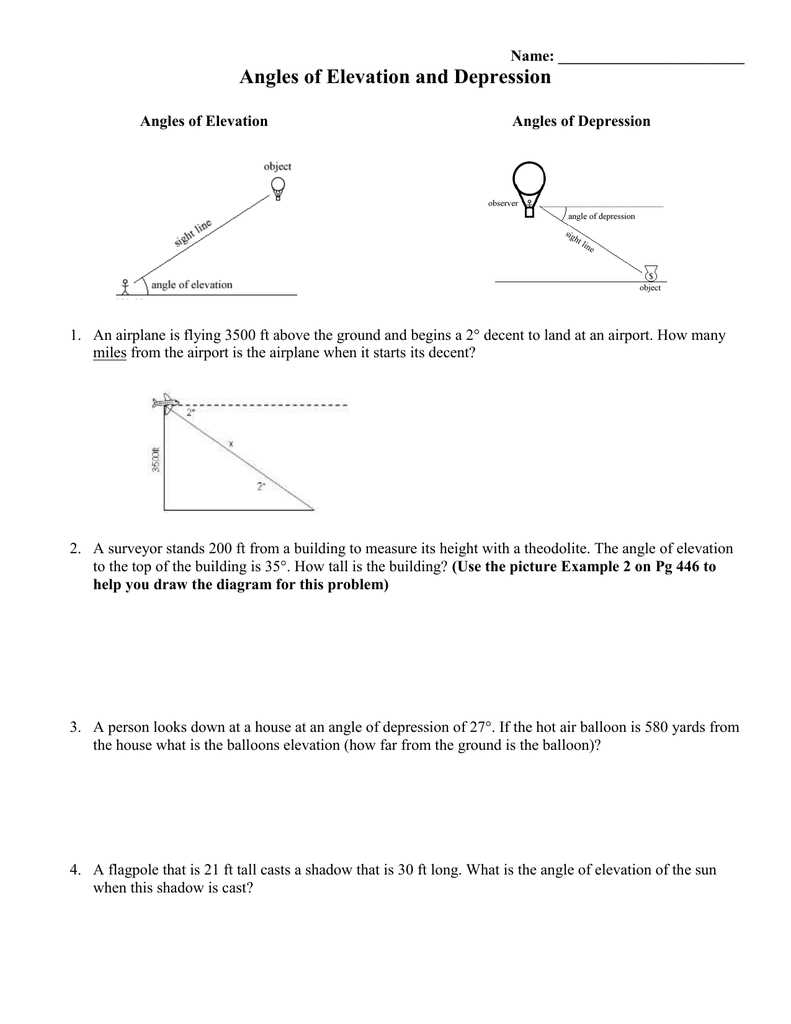
Angles of elevation and depression are important concepts in geometry and trigonometry. They help us understand the relationships between different objects, such as the height of a building or the angle at which an object is viewed. In this worksheet, we will explore various problems related to angles of elevation and depression and provide answers and solutions.
To solve these problems, we need to use trigonometric functions such as sine, cosine, and tangent. These functions allow us to relate the angles of elevation and depression to the distances and heights of objects. By applying these functions correctly, we can calculate unknown values and find the answers we are looking for.
This worksheet provides a series of exercises that involve real-life situations where angles of elevation and depression are used. The questions range from simple problems involving the height of objects to more complex scenarios that involve multiple angles and distances. By practicing these exercises and checking the provided answers, students can improve their understanding of the topic and sharpen their trigonometry skills.
Angle of elevation and depression problems are commonly found in geometry, physics, and engineering. They are used in a variety of fields, such as architecture, surveying, and astronomy. By mastering these concepts and practicing with a worksheet like this, students can gain a solid foundation in trigonometry and apply it to solve real-world problems in their future studies and careers.
What is an Angle of Elevation and Depression?
An angle of elevation is the angle that is formed when a line of sight is tilted upwards from the horizontal plane. It is measured from the horizontal line to the line of sight. When we look up at an object above our eye level, we are essentially measuring the angle of elevation.
An angle of depression, on the other hand, is the angle that is formed when a line of sight is tilted downwards from the horizontal plane. It is measured from the horizontal line to the line of sight. When we look down at an object below our eye level, we are essentially measuring the angle of depression.
The concept of the angle of elevation and depression is important in various fields such as surveying, engineering, and navigation. In surveying, angles of elevation and depression are used to determine the heights and distances of objects. Engineers use these angles to calculate the slopes and inclinations of structures. In navigation, angles of elevation and depression help determine the positions of objects and landmarks.
To measure the angle of elevation or depression, a protractor or an angle-measuring instrument is used. The angle can be measured in degrees or in radians, depending on the unit of measurement being used. It is important to accurately measure the angle to obtain precise calculations and accurate results.
Understanding angles of elevation and depression is crucial in various real-life scenarios. Whether it is determining the height of a building, calculating the slope of a hill, or finding the distance between two objects, the concept of angles of elevation and depression is a fundamental tool in solving practical problems.
Explaining the basics
In the study of angles, one important concept to understand is the angle of elevation and depression. These terms refer to the angles formed when looking up or down at an object from a reference point. The angle of elevation is the angle formed when looking up at an object, while the angle of depression is the angle formed when looking down at an object.
To better visualize these angles, imagine standing on level ground and looking up at a tree. The angle formed between the ground and your line of sight to the top of the tree is the angle of elevation. On the other hand, if you were standing on top of a tall building and looking down at the ground, the angle formed between the horizontal plane and your line of sight to the ground is the angle of depression.
The measurement of these angles is typically done in degrees, with 0 degrees representing a straight line and 90 degrees representing a right angle. In real-world applications, the angle of elevation and depression can be used to solve problems involving various fields such as astronomy, engineering, and navigation.
For example, in surveying, the angle of elevation can be used to determine the height of a building or the distance between two points. In astronomy, it can help determine the altitude of celestial objects. In navigation, the angle of depression can be used to calculate the distance between a ship and a landmark on the coast.
Understanding the basics of angle of elevation and depression is important in various fields and can be applied to solve practical problems involving measurements and distances. By grasping the concepts and knowing how to calculate these angles, one can navigate through mathematical problems and tasks with ease.
How to Determine Angles of Elevation and Depression?
Angles of elevation and depression are important concepts in geometry and trigonometry that help us calculate the height or depth of an object based on the line of sight from a specified point. To determine these angles, we need to understand the basic principles and apply them in various scenarios. Here are the steps to determine angles of elevation and depression:
- Gather information: First, gather all necessary information such as the height of the object, the distance from the object, and the angle of inclination.
- Identify the line of sight: Determine the line of sight between the observer and the object. This is the imaginary line that connects the observer’s eye to the top or bottom of the object.
- Angle of elevation: If the line of sight is going upward from the horizontal, it is called the angle of elevation. To find this angle, use trigonometric ratios such as tangent or sine.
- Angle of depression: If the line of sight is going downward from the horizontal, it is called the angle depression. Similarly, to find this angle, use trigonometric ratios such as tangent or sine.
In real-life situations, angles of elevation and depression play a crucial role in various fields such as architecture, engineering, and navigation. For example, architects use these angles to design buildings and determine the height of structures. Engineers use them to calculate the slope of roads and bridges. Navigators use them to determine the altitude of celestial bodies or to locate distant objects.
Understanding how to determine angles of elevation and depression is essential for solving practical problems and making accurate measurements. By applying mathematical principles and trigonometric functions, we can effectively calculate heights, depths, and distances, providing valuable information for a wide range of applications.
Step-by-step instructions
Angles of elevation and depression are commonly used in trigonometry, geometry, and physics to calculate the heights and distances of objects. To find the answers to an angle of elevation and depression worksheet, follow these step-by-step instructions:
- Read the problem carefully: Begin by carefully reading the given problem or scenario. Take note of all the relevant information provided, such as the height or distance mentioned.
- Identify the angle: Identify whether the problem requires finding the angle of elevation or depression. An angle of elevation is the angle formed when looking up from a horizontal plane, while an angle of depression is the angle formed when looking down from a horizontal plane.
- Set up a diagram: Draw a diagram to represent the given scenario. Label any known heights, distances, and angles. Use right triangles in your diagram, as they are commonly used in trigonometry.
- Apply trigonometric ratios: Use the appropriate trigonometric ratio (sine, cosine, or tangent) based on the given information and the angle you are trying to find. Remember, sine is opposite/hypotenuse, cosine is adjacent/hypotenuse, and tangent is opposite/adjacent.
- Solve for the unknown: Substitute the known values into the trigonometric ratio and solve for the unknown angle or height. Make sure to use the correct units (degrees or radians) as required.
- Check your answer: Once you have calculated the answer, double-check to ensure it makes sense in the context of the problem. Make sure your units are appropriate and your answer is reasonable.
By following these step-by-step instructions, you can successfully solve angle of elevation and depression problems and find the accurate answers to a worksheet or exercise.
Real-life Examples of Angles of Elevation and Depression
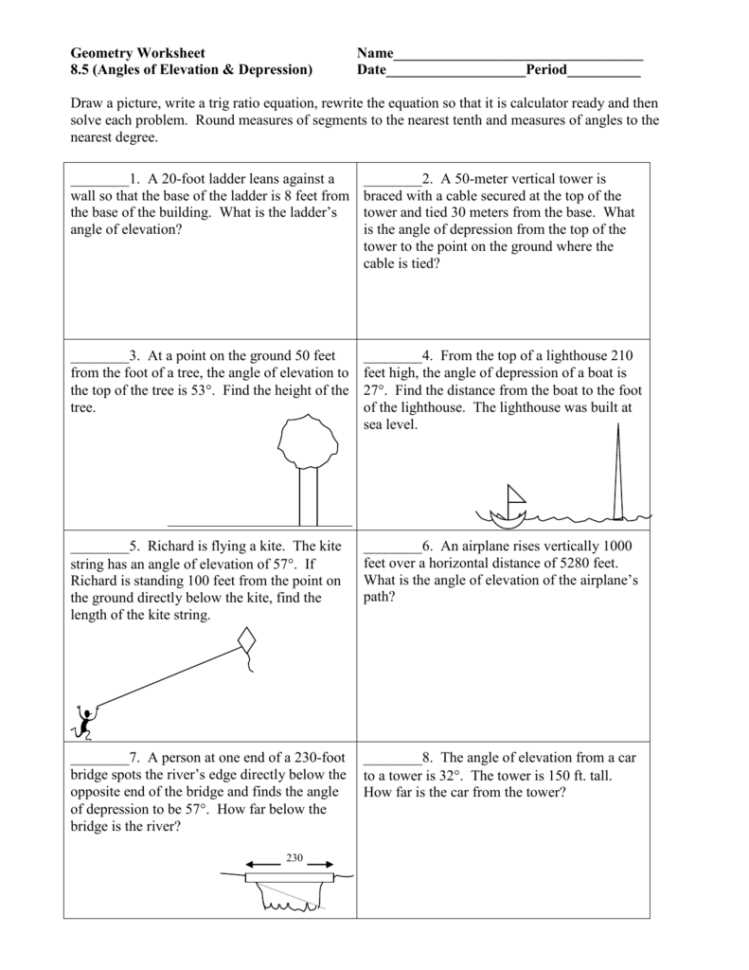
The concept of angles of elevation and depression is not only important in mathematics, but it also has real-life applications in various fields. These angles are used to understand the vertical relationships between objects or points in different situations. Here are some examples:
Architectural Design and Construction
In architectural design and construction, angles of elevation and depression are crucial for determining the heights and distances of various elements. Architects and engineers use these angles to calculate the measurements needed to ensure proper alignment and structural stability. For example, when designing a staircase, the angle of elevation is used to determine the rise of each step, while the angle of depression is used to calculate the distance between floors.
Surveying and Mapping
Angles of elevation and depression play a significant role in surveying and mapping. Surveyors use these angles to measure the heights of different objects or points on the ground. By measuring the angle of elevation from the ground to the top of a landmark, surveyors can estimate its height. Similarly, when creating topographic maps, angles of depression are used to determine the height of various features such as mountains or hills in relation to a reference point.
Astronomy and Navigation
In astronomy and navigation, angles of elevation and depression are essential for celestial observations and determining positions on Earth or in space. Astronomers use these angles to measure the altitude of celestial objects such as stars or planets above the horizon. Navigators also rely on angles of elevation to calculate distances and positions for celestial navigation using tools like sextants.
Sports and Recreation
Angles of elevation and depression can even be found in various sports and recreational activities. In golf, for example, players need to consider the angle of elevation when hitting the ball to determine its trajectory and distance. Similarly, in activities like rock climbing or skiing, angles of depression are crucial for evaluating the steepness of slopes and planning safe routes.
In conclusion, angles of elevation and depression have numerous practical applications in different fields. From architectural design and construction to surveying, astronomy, and even sports, these angles provide valuable insights into the vertical relationships between objects and surroundings.
Showcasing Practical Scenarios
In our everyday lives, we encounter numerous practical scenarios where the concept of angle of elevation and depression comes into play. Understanding this concept allows us to solve real-life problems and make informed decisions.
One common scenario is when we need to determine the height of an object. For example, imagine you are planning to hang a painting on a wall, and you want it to be perfectly centered. By measuring the angle of elevation from your eye level to the top of the painting, you can calculate the height of the wall and ensure precise positioning.
Another practical scenario involves surveying land or buildings. Surveyors often use the angle of depression to measure the height or depth of an object or feature. For instance, in construction, knowing the angle of depression from the top of a hill to the foundation of a building can help engineers determine the optimal slope for the structure and ensure proper drainage.
Furthermore, the concept of angle of elevation and depression is essential in fields like astronomy and navigation. Astronomers use these angles to measure the altitude of celestial bodies, while pilots and navigators rely on them to determine their position and navigate through the air or at sea.
Examples of Practical Scenarios:
- Estimating the height of a tree or a tall building using the angle of elevation.
- Determining the depth of a well or a mine using the angle of depression.
- Calculating the distance between two objects by measuring the angle of elevation from different points.
- Planning the slope of a road or a ramp based on the angle of depression.
- Tracking the movement of a satellite or a spacecraft by measuring its angles of elevation and depression.
By showcasing these practical scenarios, we can better understand the importance of knowing how to calculate and interpret angles of elevation and depression. These concepts have wide-ranging applications in various industries and can greatly enhance our problem-solving abilities.
Angle of Elevation and Depression Worksheet Answers
In geometry, the angle of elevation and depression refers to the angle between a horizontal line and the line of sight when looking up or down at an object. To solve problems involving these angles, it is important to understand the concepts and know how to use trigonometric functions.
When working with angle of elevation and depression problems, it is crucial to carefully read the given information and identify the triangles involved. The angles can be measured in degrees or radians, depending on the problem. It is also important to know the trigonometric ratios, such as sine, cosine, and tangent, which relate the angles and sides of a triangle.
To find the answers to the angle of elevation and depression worksheet, you will need to apply these concepts and trigonometric functions. You may also need to use other geometry skills, such as solving equations or finding missing angles in triangles.
- For example, if the worksheet asks for the angle of elevation of a tower, you can use the tangent function to find the angle. You would set up a right triangle with the height of the tower as the opposite side and the distance from the observer to the tower as the adjacent side.
- Similarly, if the worksheet asks for the angle of depression from an airplane, you can use the tangent function again. You would set up a right triangle with the height of the airplane as the opposite side and the horizontal distance from the airplane to the object on the ground as the adjacent side.
By correctly applying the trigonometric functions and solving the equations, you will be able to find the answers to the angle of elevation and depression worksheet. Remember to double-check your work and make sure your answers make sense in the context of the problem.
Overall, solving angle of elevation and depression problems requires a solid understanding of trigonometry and geometry. By practicing and applying the concepts, you will become more proficient in solving these types of problems and finding the correct answers.
Solving problems with provided answers
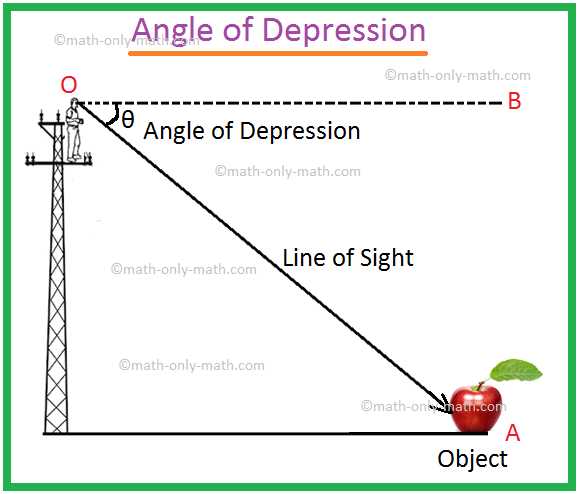
In the study of angle of elevation and depression, it is essential to be able to solve problems using the information given and arrive at the correct answer. This skill is vital in many fields, such as engineering, architecture, and surveying, where accurately calculating angles is necessary. In this section, we will explore how to solve problems using the answers provided.
When given answers to angle of elevation and depression problems, it is crucial to understand the relationship between the angles involved and the given information. By analyzing the given information and the provided answers, we can determine the correct approach to solving the problem.
Example:
A person standing on top of a building sees a flagpole in front of them. The person measures the angle of depression to the base of the flagpole as 40°. The person also knows that the height of the building is 20 meters. The answer choices for the height of the flagpole are: (a) 15 meters, (b) 25 meters, (c) 30 meters, (d) 35 meters.
To solve this problem, we can use the concept of similar triangles. The angle of depression from the person’s viewpoint and the angle of elevation from the base of the flagpole are congruent. We can set up the following proportion:
Height of building / Length from person to building = Height of flagpole / Length from person to flagpole
By substituting the given values, we have:
| Height of building | Length from person to building | Height of flagpole | Length from person to flagpole |
|---|---|---|---|
| 20 m | Unknown | Unknown | Unknown |
Since the given answer choices for the height of the flagpole are in meters, we know that the length from the person to the flagpole will also be in meters.
Now, let’s substitute the lengths into the proportion:
20 / Length from person to building = Height of flagpole / Length from person to flagpole
From the angle of depression, the person is looking down at the base of the flagpole. Therefore, the length from the person to the flagpole is the hypotenuse of a right triangle.
We know that the tangent of the angle of depression is equal to the opposite side length (height of flagpole) divided by the adjacent side length (length from person to flagpole).
Using this information, we can set up the equation:
20 / Length from person to building = height of flagpole / tan(40°)
By cross multiplying and solving for the unknown length, we can determine the correct answer.
In conclusion, solving angle of elevation and depression problems using provided answers requires a thorough understanding of the given information and its relationship to the angles involved. By using geometric concepts and proportions, we can accurately determine the correct answer and solve real-world problems.