The Definitive Guide: Unlocking the Area of Regular Polygons with Answer Key
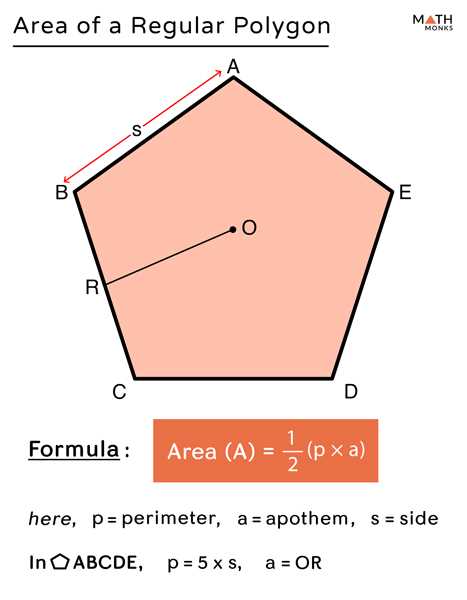
Understanding the area of regular polygons is an essential concept in geometry. Regular polygons are polygons that have congruent sides and congruent angles. They are symmetrical and have equal interior angles, making them a fascinating topic for mathematicians. The area of regular polygons can be calculated using specific formulas, which we will explore in this article.
One way to find the area of a regular polygon is by dividing it into congruent right triangles. By doing so, we can use the formula for calculating the area of a triangle (A = 1/2 * base * height) to determine the area of the individual triangles. Once we know the area of one triangle, we can then multiply it by the number of triangles in the polygon to obtain the total area.
Another formula for finding the area of a regular polygon is by using the apothem and the perimeter. The apothem is the distance from the center of the polygon to any side. To find the area using this method, we can multiply the apothem by half the perimeter (A = 1/2 * apothem * perimeter).
These formulas allow us to calculate the area of regular polygons efficiently. By understanding these concepts, we can apply them to real-life scenarios, such as calculating the area of a regular garden or a geometric shape in architecture. So let’s dive into the world of regular polygons and explore their fascinating properties!
Understanding regular polygons

A regular polygon is a shape with equal sides and equal angles. It is composed of straight line segments connected to form a closed figure. The most common types of regular polygons are triangles, quadrilaterals, pentagons, hexagons, and octagons. These polygons have a fixed number of sides and angles, which makes them easy to identify and analyze.
One key property of regular polygons is that all of their interior angles are equal. This means that if you know the measure of one interior angle, you can easily determine the measure of all the other interior angles. The formula to find the measure of each interior angle of a regular polygon is 180(n-2)/n, where n represents the number of sides in the polygon.
Regular polygons also have a unique property regarding their perimeter and area. The perimeter of a regular polygon can be calculated by multiplying the length of one side by the number of sides. To find the area of a regular polygon, you can use the formula: (1/4)n × s^2 × cot(π/n), where n is the number of sides and s is the length of each side.
In conclusion, understanding regular polygons involves knowing their properties, such as equal sides and angles, as well as formulas to calculate angles, perimeter, and area. Regular polygons are commonly found in various fields of study, from geometry to architecture. By analyzing and working with regular polygons, we can explore their symmetry, structural stability, and aesthetic appeal.
What are regular polygons?

A regular polygon is a two-dimensional shape that has equal sides and equal angles. In other words, all the sides of a regular polygon are of the same length, and all the angles are congruent. Regular polygons are classified by the number of sides they have, such as triangles, quadrilaterals, pentagons, hexagons, and so on.
One of the key properties of regular polygons is symmetry. Each side and angle of a regular polygon can be mapped onto another side or angle by rotating the shape around its center. This means that if you draw lines of symmetry from the center to the vertices of a regular polygon, the resulting lines will divide the shape into congruent parts.
In a regular polygon, the sum of its interior angles can be found using the formula (n-2) * 180, where n represents the number of sides. For example, a pentagon (a regular polygon with 5 sides) has interior angles that sum up to (5-2) * 180 = 540 degrees. Similarly, the exterior angles of a regular polygon can be found using the formula 360 / n.
Regular polygons can be found in various contexts, such as in nature (honeycombs, flowers), art (geometric patterns), and architecture (pyramids, domes). Their regularity and symmetry make them visually pleasing and mathematically intriguing.
Calculating the Area of Regular Polygons
When it comes to calculating the area of regular polygons, it is important to understand the formula and the steps involved. A regular polygon is a polygon with equal sides and equal angles, such as a square, triangle, or hexagon. To find the area of a regular polygon, we use the formula A = (1/2) * ap, where A is the area, a is the apothem (the distance from the center of the polygon to the midpoint of a side), and p is the perimeter of the polygon.
First, we need to find the perimeter of the regular polygon by multiplying the length of one side by the number of sides. For example, if we have a regular hexagon with each side measuring 5 units, the perimeter would be 5 * 6 = 30 units. Once we have the perimeter, we can calculate the apothem by dividing the perimeter by 2 times the tangent of half the central angle.
Let’s say the central angle of our hexagon is 60 degrees. So, the apothem would be (30 / (2 * tan(30))) = 8.66 units. Finally, we can calculate the area by multiplying the apothem by half the perimeter, giving us (8.66 * 30) / 2 = 130 square units. Therefore, the area of our regular hexagon would be 130 square units.
In summary, calculating the area of regular polygons involves finding the perimeter, calculating the apothem, and then multiplying the apothem by half the perimeter. Remember to use the appropriate trigonometric functions to find the apothem. By following these steps, you can find the area of any regular polygon quickly and accurately.
Important formulas for finding the area of regular polygons
When calculating the area of regular polygons, there are some important formulas to keep in mind. Regular polygons are shapes with equal side lengths and equal angles. Here are the formulas for finding their area:
1. Equilateral triangle:
An equilateral triangle is a regular polygon with three sides of equal length. The formula to find its area is:
Area = (s^2 * √3) / 4
Where s is the length of one side of the triangle.
2. Square:
A square is a regular polygon with four sides of equal length and right angles. The formula to find its area is:
Area = s^2
Where s is the length of one side of the square.
3. Pentagon:

A pentagon is a regular polygon with five sides of equal length. The formula to find its area is:
Area = (s^2 * √25 + 10 * √5) / 4
Where s is the length of one side of the pentagon.
4. Hexagon:
A hexagon is a regular polygon with six sides of equal length. The formula to find its area is:
Area = (3 * √3 * s^2) / 2
Where s is the length of one side of the hexagon.
5. Octagon:

An octagon is a regular polygon with eight sides of equal length. The formula to find its area is:
Area = 2 * (1 + √2) * s^2
Where s is the length of one side of the octagon.
These formulas can be useful when finding the area of regular polygons. Remember to substitute the appropriate values for the side length into the formula to calculate the area accurately.
Example Problems with Solutions
Here are some example problems that demonstrate how to find the area of regular polygons:
-
Problem: Find the area of a regular hexagon with a side length of 5 cm.
Solution:
First, calculate the apothem, which is the distance from the center of the hexagon to any of its sides. Since a regular hexagon can be divided into six equilateral triangles, the apothem can be calculated using the formula:
Inradius = (Side Length) / (2 * tan(180° / 6))
Substituting the given values, we get:
Inradius = (5 cm) / (2 * tan(30°))
Inradius ≈ 4.3301 cm
Next, calculate the area of one of the triangles using the formula:
Area of Triangle = (Side Length * Inradius) / 2
Area of Triangle = (5 cm * 4.3301 cm) / 2
Area of Triangle ≈ 10.8252 cm²
Since there are six equilateral triangles in a hexagon, multiply the area of one triangle by 6 to get the area of the hexagon:
Area of Hexagon ≈ 10.8252 cm² * 6 = 64.9512 cm²
Therefore, the area of the regular hexagon is approximately 64.9512 cm².
-
Problem: Find the area of a regular octagon with a side length of 8 cm.
Solution:
Similar to the previous problem, we start by calculating the apothem, which is the distance from the center of the octagon to any of its sides. Since a regular octagon can be divided into eight isosceles triangles, the apothem can be calculated using the formula:
Inradius = (Side Length) / (2 * tan(180° / 8))
Substituting the given values, we get:
Inradius = (8 cm) / (2 * tan(22.5°))
Inradius ≈ 7.1240 cm
Next, calculate the area of one of the triangles using the formula:
Area of Triangle = (Side Length * Inradius) / 2
Area of Triangle = (8 cm * 7.1240 cm) / 2
Area of Triangle ≈ 28.4960 cm²
Since there are eight isosceles triangles in an octagon, multiply the area of one triangle by 8 to get the area of the octagon:
Area of Octagon ≈ 28.4960 cm² * 8 = 227.9680 cm²
Therefore, the area of the regular octagon is approximately 227.9680 cm².
By following the steps outlined in these example problems, you can find the area of regular polygons with ease. Remember to calculate the apothem and then use the appropriate formula to find the area of each individual shape. Finally, multiply the area of the individual shape by the number of shapes in the polygon to obtain the total area. Regular polygons have predictable and symmetrical shapes, making them ideal for solving area problems in geometry.