The Evolution of Atomic Theory: Unveiling the Answers to Timeline Questions via a Comprehensive Rubric

Atomic theory is the scientific understanding of the nature of atoms, the building blocks of matter. Over the centuries, scientists have made significant contributions to the development of atomic theory, refining and expanding our knowledge of the subatomic world. This article explores some of the key questions surrounding atomic theory and provides answers based on a rubric to better understand its historical timeline.
One of the earliest questions in atomic theory was whether matter is composed of indivisible particles. Ancient Greek philosophers such as Democritus proposed that matter is made up of tiny, indivisible units called atoms. However, it wasn’t until the 19th century that John Dalton’s atomic theory provided evidence for the existence of atoms and their properties.
Another important question in atomic theory is related to the structure of atoms themselves. How are atoms arranged and what are their constituent parts? This question was addressed by J.J. Thomson in the late 19th century, who discovered the existence of negatively charged particles called electrons. His plum pudding model proposed that electrons are embedded in a positively charged sphere, like raisins in a plum pudding. However, this model was later replaced by Ernest Rutherford’s nuclear model, which revealed that the atom has a small, dense nucleus at its center and electrons orbiting around it.
Atomic Theory Timeline Questions and Rubric Answers
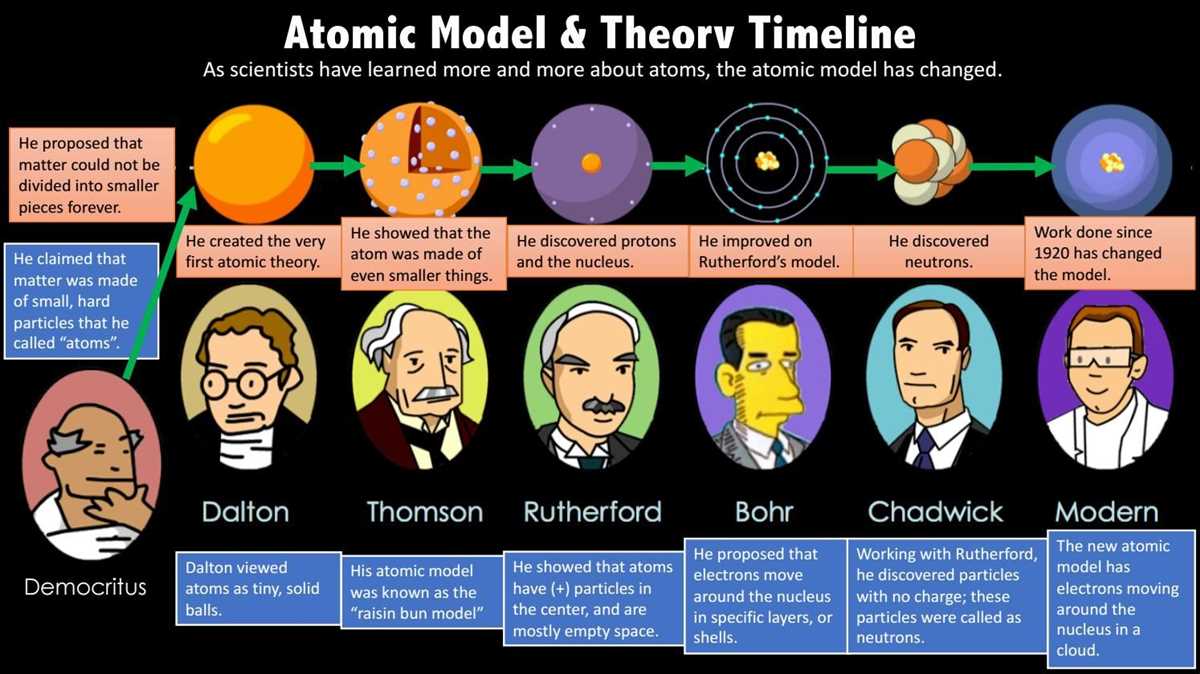
The study of atoms and their behavior has evolved over centuries, with numerous scientists contributing to our understanding of atomic theory. This timeline presents key questions and answers that highlight the major advancements in atomic theory.
1. Who proposed the concept of atoms?
- Democritus, a Greek philosopher, proposed the concept of atoms around 400 BCE. He believed that atoms were indivisible and eternal, forming the building blocks of all matter.
2. What did Dalton’s atomic theory state?
- John Dalton, an English scientist, proposed his atomic theory in the early 19th century. His theory stated that atoms were indivisible and indestructible particles, and that chemical reactions involved the rearrangement of atoms.
3. When was the existence of subatomic particles discovered?

- In the late 19th and early 20th centuries, the existence of subatomic particles was discovered. J.J. Thomson discovered electrons in 1897, while Ernest Rutherford discovered the nucleus and protons in 1911.
4. What did Bohr’s atomic model propose?
- Niels Bohr proposed his atomic model in 1913, which suggested that electrons orbit the nucleus in distinct energy levels or shells. This model explained the stability of atoms and the emission and absorption of light by electrons.
5. When was the discovery of the neutron made?
- The discovery of the neutron was made in 1932 by James Chadwick. The neutron is a subatomic particle found in the nucleus of atoms, carrying no charge but contributing to the mass of the atom.
This timeline and the corresponding answers provide a brief overview of the major advancements in atomic theory. It demonstrates how our understanding of atoms has evolved over time, from the concept of indivisible particles to the discovery of subatomic particles and the development of atomic models. These contributions have paved the way for further scientific discoveries and advancements in various fields.
What is atomic theory and why is it important?
The atomic theory is a scientific model that explains the composition and behavior of matter at the atomic level. It is based on the fundamental understanding that all matter is made up of atoms, which are the smallest units of elements. The atomic theory helps us to understand how atoms interact with each other and how they form different substances. It also provides a framework for explaining various chemical reactions and the properties of different elements and compounds.
Atomic theory has evolved over centuries through the work of many scientists. In the early 19th century, John Dalton proposed his atomic theory, which suggested that atoms are indivisible and that different elements are made up of unique combinations of atoms. Later, other scientists such as J.J. Thomson, Ernest Rutherford, and Niels Bohr made significant contributions by discovering the presence of subatomic particles, the structure of the atom, and the concept of energy levels.
The importance of atomic theory lies in its ability to explain the macroscopic properties of matter based on the behavior of atoms at the microscopic level. It helps us understand why certain substances have specific physical and chemical properties, and how these properties can be manipulated through various processes. Atomic theory is the foundation of modern chemistry and physics, providing a basis for advancements in materials science, medicine, and technology. It also plays a crucial role in fields such as nuclear energy, environmental science, and pharmaceutical research, where understanding atomic interactions is essential.
Key Contributors to the Development of Atomic Theory
The development of atomic theory has been an ongoing process, with contributions from numerous scientists throughout history. These scientists have made significant discoveries and advancements that have shaped our understanding of the atom and its structure.
Democritus: In ancient Greece, Democritus proposed the idea of atoms, suggesting that the universe is made up of indivisible particles. While his ideas were not supported by experimental evidence, he laid the foundation for future atomic theories.
John Dalton: Dalton is often referred to as the father of modern atomic theory. In the early 19th century, he proposed that atoms are indivisible, indestructible particles that combine in whole number ratios to form compounds. His theory also included the concept of atomic masses and conservation of mass.
J.J. Thomson: Thomson is credited with the discovery of the electron. Through his experiments with cathode rays, he concluded that atoms contain negatively charged particles. He proposed the “plum pudding” model of the atom, where electrons were embedded in a positive sphere. This model, although later proven incorrect, marked a significant step in understanding atomic structure.
Ernest Rutherford: Rutherford’s famous gold foil experiment provided evidence for the existence of a dense, positively charged nucleus within the atom. His model of the atom, known as the Rutherford or nuclear model, proposed that most of the mass of the atom is concentrated in the nucleus, while electrons orbit around it.
Niels Bohr: Building on Rutherford’s model, Bohr proposed that electrons orbit the nucleus in specific energy levels or shells. He introduced the idea of quantized energy and explained the stability of these orbits by stating that electrons could only exist in certain fixed energy states.
James Chadwick: Chadwick is credited with the discovery of the neutron. Through his experiments with beryllium, he observed a neutral particle with a mass similar to that of the proton. This discovery completed the picture of the atomic nucleus, with protons and neutrons residing within it.
These key contributors, along with many others, have played an essential role in the development of atomic theory. Their discoveries and theories have formed the foundation of our current understanding of the atom and have paved the way for further advancements in the field of atomic physics.
John Dalton and his atomic theory
John Dalton was a British chemist and physicist who lived in the late 18th and early 19th centuries. He is known for his groundbreaking work in the field of atomic theory, which revolutionized our understanding of the composition of matter. Dalton’s atomic theory proposed that all matter is made up of tiny, indivisible particles called atoms.
In Dalton’s theory, atoms were considered to be solid, indestructible particles that combined in simple ratios to form compounds. He also proposed that atoms of different elements had different masses and properties, and that chemical reactions involved the rearrangement of atoms to form new compounds. This concept of atomic rearrangement laid the foundation for the field of stoichiometry, which deals with the quantitative relationships between reactants and products in chemical reactions.
Dalton’s atomic theory was based on experimental evidence, including his own observations of the behavior of gases and the measurements of the proportions in which elements combine in compounds. Although some aspects of Dalton’s theory have been revised or expanded upon by later scientists, such as the discovery of subatomic particles and the existence of isotopes, his work laid the groundwork for modern atomic theory.
In recognition of his contributions to the field of chemistry, Dalton is often referred to as the “father of modern atomic theory.” His ideas paved the way for advances in understanding the structure and properties of matter, and continue to be fundamental to the study of chemistry today.
J.J. Thomson and the discovery of the electron

J.J. Thomson was a British physicist who made significant contributions to the understanding of the atom. In 1897, he conducted a series of experiments that led to the discovery of the electron, a subatomic particle with a negative charge. Thomson’s work revolutionized the field of physics and laid the foundation for modern atomic theory.
Thomson’s experiments involved the use of cathode rays, which are streams of negatively charged particles that flow from the negative terminal to the positive terminal of a cathode ray tube. By placing magnetic and electric fields in the path of the cathode rays, Thomson was able to determine that they were made up of particles much smaller than atoms. He called these particles “corpuscles,” which are now known as electrons.
One of Thomson’s most famous experiments was the “plum pudding” model of the atom, which he proposed in 1904. According to this model, the atom is composed of a positively charged pudding-like substance with electrons embedded throughout, similar to plums in a pudding. This model helped to explain the behavior of electrons within an atom and was widely accepted at the time.
Thomson’s discovery of the electron paved the way for future scientists to further explore the structure of the atom. It also provided evidence that atoms were not indivisible, as previously believed, but instead composed of smaller particles. This discovery was a crucial step towards the development of atomic theory and led to further advancements in the field of physics.
Ernest Rutherford and the Nuclear Model

Ernest Rutherford was a prominent physicist who made significant contributions to the development of atomic theory. Born in New Zealand in 1871, Rutherford studied at the University of Cambridge under J.J. Thomson, the discoverer of the electron. Rutherford’s groundbreaking experiments and discoveries led to the development of the nuclear model of the atom, which revolutionized our understanding of the microscopic world.
One of Rutherford’s most famous experiments, known as the gold foil experiment, played a crucial role in the development of the nuclear model. In this experiment, Rutherford and his colleagues fired alpha particles at a thin sheet of gold foil. According to the prevailing theory at the time, the alpha particles should have passed through the foil with minimal deflection. However, Rutherford observed that some of the alpha particles were deflected at large angles or even bounced back. This unexpected result led him to propose that the atom must have a tiny, dense, and positively charged nucleus at its center.
To explain his findings, Rutherford proposed the nuclear model of the atom. According to this model, the atom consists of a positively charged nucleus, which contains most of the atom’s mass, surrounded by negatively charged electrons in orbit around the nucleus. Rutherford’s model overturned the previous view of the atom as a uniform, positively charged sphere. Instead, he depicted the atom as mostly empty space, with the positive charge concentrated in a tiny, dense nucleus.
Rutherford’s nuclear model paved the way for further discoveries and advancements in atomic theory. It provided a more accurate understanding of the structure of the atom and explained the observations from his gold foil experiment. Rutherford’s contributions to the field of atomic theory laid the foundation for the development of quantum mechanics and our modern understanding of atomic structure.
Niels Bohr and the Quantum Model of the Atom
Niels Bohr made significant contributions to the field of atomic theory with his development of the quantum model of the atom. Bohr’s model built upon the work of scientists like Rutherford and Planck, and helped to explain the behavior of electrons within atoms.
Bohr proposed that electrons could only exist in specific energy levels or orbits around the nucleus of an atom. These energy levels were quantized, meaning that only certain values were allowed. This idea was a departure from classical physics, which suggested that electrons could occupy any energy level they wanted.
The key points of Bohr’s quantum model are:
- Electrons can only exist in specific, discrete energy levels around the nucleus.
- Electrons can transition between energy levels by absorbing or emitting a specific amount of energy.
- When an electron transitions to a lower energy level, it emits a photon of light with a specific wavelength.
- The energy of an electron is proportional to its distance from the nucleus, with higher energy levels corresponding to greater distances.
Bohr’s model helped to explain the line spectra observed in the emission and absorption of light by atoms. It also provided a framework for understanding the stability and chemical properties of elements.
In conclusion, Niels Bohr’s quantum model of the atom revolutionized our understanding of atomic structure and laid the foundation for modern quantum mechanics. His work highlighted the importance of energy quantization and paved the way for further advancements in atomic theory.