How to Solve Balancing Equations Questions: Step-by-Step Answers

When it comes to chemistry, one of the fundamental skills that students need to master is balancing chemical equations. Balancing equations is the process of ensuring that there is an equal number of atoms on both sides of a chemical equation. It is crucial because it allows chemists to accurately represent the amount of each reactant and product involved in a chemical reaction.
While balancing equations may seem daunting at first, with practice and a solid understanding of the underlying principles, it becomes more manageable. However, students often have questions and encounter difficulties along the way. In this article, we will address some common questions about balancing equations and provide helpful answers to guide you through the process.
Some of the questions we will cover include: What is the purpose of balancing equations? How do you determine the coefficients in a balanced equation? What are some strategies for balancing difficult equations? How can you check if an equation is balanced? By exploring these questions and more, we hope to demystify the process of balancing equations and help you become more proficient in this essential skill.
Balancing Equations Questions and Answers
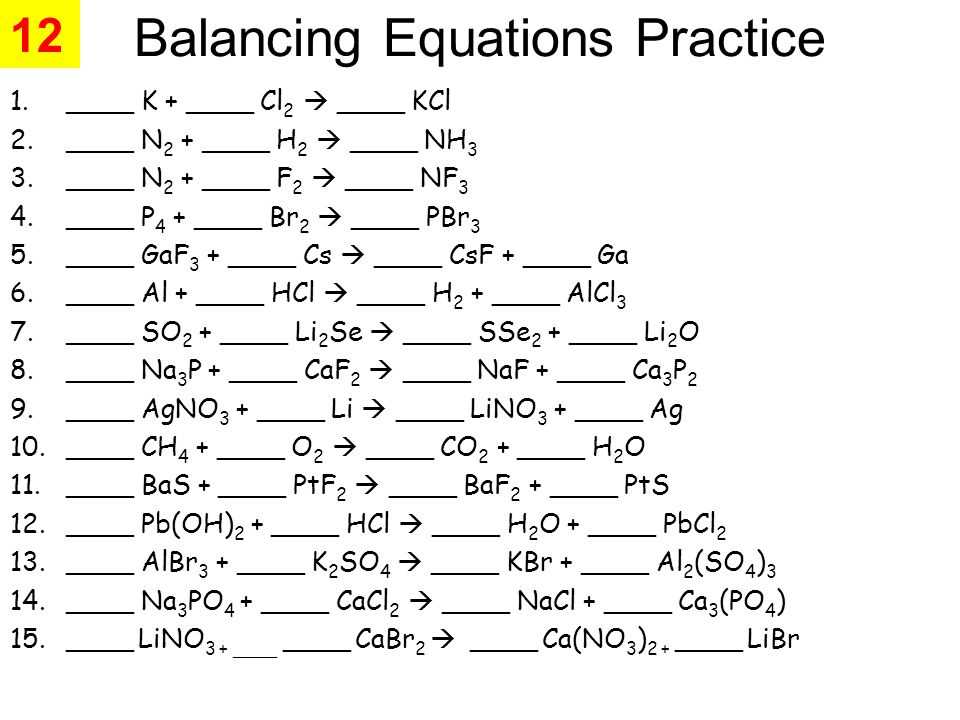
When it comes to balancing equations in chemistry, many students often struggle with understanding the concept and finding the correct coefficients to balance the equation. However, with practice and understanding of some key strategies, one can become proficient at balancing equations.
Why is balancing equations important?
Balancing equations is a fundamental skill in chemistry as it allows us to accurately describe chemical reactions. The balanced equation shows the ratio of reactants and products and helps to understand the stoichiometry of the reaction. It is essential for predicting reaction outcomes, understanding the conservation of mass, and determining the amount of reactants needed or products produced.
What are some strategies for balancing equations?
One strategy is to start by balancing the elements that appear in the fewest compounds first. This helps to simplify the process and ensure that the reaction is balanced. Another strategy is to balance polyatomic ions as a whole unit rather than individual atoms, as this can make the process more efficient. It is also important to check the final balanced equation to ensure that the number of atoms and charges are equal on both sides of the equation.
Can you provide step-by-step guidance for balancing equations?
Sure! Here is a step-by-step guide:
- Write down the unbalanced equation.
- Count the number of atoms of each element on both sides of the equation.
- Start balancing the elements that appear in the fewest compounds.
- Balance polyatomic ions as a whole unit, if present.
- Adjust the coefficients as needed to ensure the same number of atoms on both sides of the equation.
- Check the final balanced equation to ensure that the charges are also balanced.
By following these steps and practicing with various equations, one can become proficient at balancing equations and gain a better understanding of chemical reactions.
What are balanced equations and why are they important?
Balanced equations are equations that represent chemical reactions in which the number of atoms of each element on both sides of the equation is equal. In other words, the equation is balanced when the total mass and charge of the reactants is equal to the total mass and charge of the products. A balanced equation is important because it allows us to accurately describe and understand the chemical reactions that occur.
When an equation is balanced, it provides crucial information about the stoichiometry of the reaction, which refers to the quantitative relationship between the reactants and products. This information is essential for various purposes, including predicting the amount of product that can be obtained from a given amount of reactant, calculating the reactant quantities needed to produce a desired amount of product, and determining the percent yield of a reaction.
In addition, balanced equations help us to analyze and interpret chemical reactions. By balancing the equation, we can determine the ratios in which the reactants combine and the products are formed. This allows us to identify the limiting reactant, which is the reactant that is completely consumed and determines the maximum amount of product that can be obtained. Balanced equations also provide a basis for understanding the conservation of mass and charge during a chemical reaction.
In summary, balanced equations are important because they accurately represent chemical reactions and provide crucial information about stoichiometry, reactant quantities, and product yields. They allow us to analyze and interpret reactions, and they demonstrate the fundamental principles of mass and charge conservation.
How do you balance chemical equations?

Balancing chemical equations is an essential skill in chemistry. It involves adjusting the coefficients of the reactants and products in a chemical equation to ensure that the law of conservation of mass is obeyed. This law states that matter cannot be created or destroyed in a chemical reaction, and thus the number of atoms of each element must be the same on both sides of the equation.
To balance a chemical equation, there are several steps to follow. First, identify and write down the unbalanced equation, indicating the reactants on the left side of the arrow and the products on the right side. Next, start by balancing the atoms of the elements that appear in the fewest number of molecules or compounds. You can begin with elements that appear individually or in simple compounds.
Once you have balanced the atoms of these elements, move on to balancing the atoms of elements that appear in more complex compounds. This may involve adjusting the coefficients of multiple molecules or compounds. It is important to remember that you can only adjust the coefficients, not the subscripts, as this would indicate a different compound altogether.
Continue this process until all the atoms in the equation are balanced. Check your final balanced equation to ensure that the number of atoms of each element is the same on both sides of the equation. If the equation is not balanced, go back and make further adjustments until it is. Balancing a chemical equation requires practice and attention to detail, but with time and experience, it becomes easier.
Tips and tricks for balancing equations
When it comes to balancing equations, it can often be a challenging task. However, with a few tips and tricks, you can make the process easier and more straightforward. Here are some helpful strategies to keep in mind.
- Identify the reactants and products: Before you even begin balancing the equation, it’s essential to identify the reactants and products. This will help you understand which elements are involved in the reaction and ensure you balance the equation correctly.
- Start with the most complex molecules: Begin balancing the equation by looking at the most complex molecules first. By doing this, you can ensure that you distribute the atoms correctly and minimize any errors in the final equation.
- Balance atoms individually: Instead of trying to balance the entire equation at once, focus on balancing atoms individually. Start with elements that appear in only one molecule on each side of the equation and work your way through the different elements.
- Use coefficients: Coefficients are the numbers written in front of the compounds in the equation. They can be used to balance the equation by adjusting the number of molecules or atoms on each side. Remember that coefficients should be multiplied by the entire molecule, not just the individual atoms.
- Check for symmetry: Once you have balanced the equation, double-check for symmetry. Make sure the number of atoms and molecules is the same on both sides of the equation. This step is crucial to ensure the equation is balanced correctly.
By using these tips and tricks, you can make the process of balancing equations more manageable and achieve accurate results. Practice is key, so don’t hesitate to try out different equations and keep honing your balancing skills.
Common challenges in balancing equations
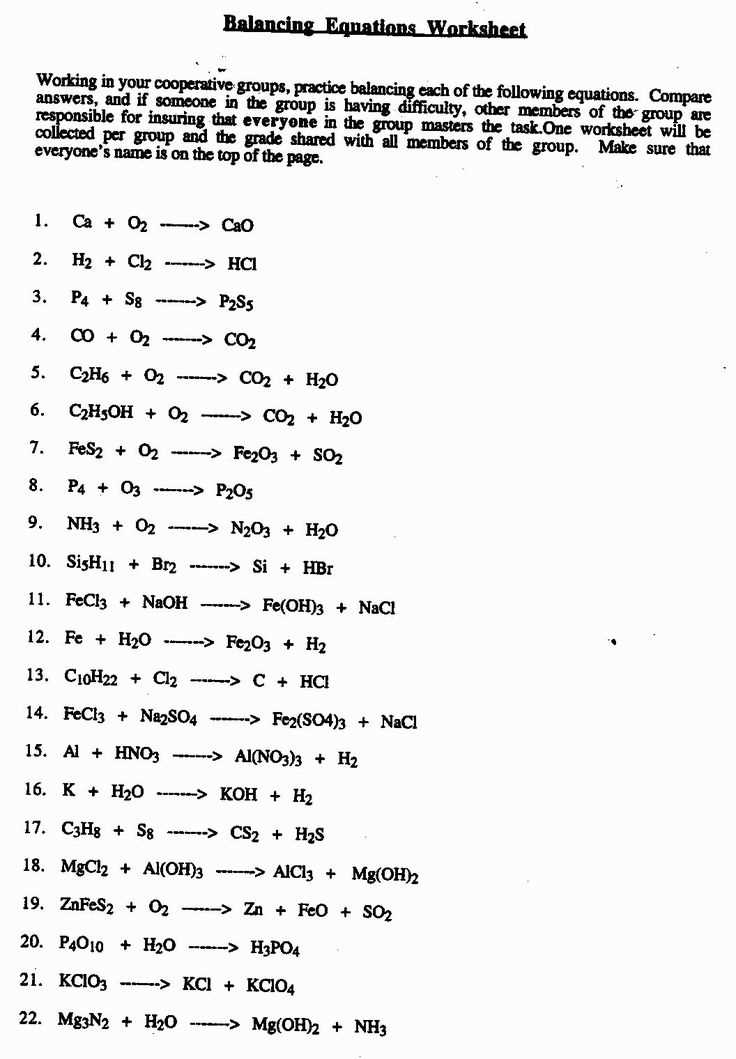
When it comes to balancing equations, many students face common challenges that can make the process more difficult. One of the main challenges is understanding the concept of balancing equations and why it is important. Students may struggle to grasp the idea that chemical equations must be balanced in order to accurately represent the law of conservation of mass. Without this understanding, it can be difficult to know where to start when trying to balance an equation.
Another challenge is identifying the correct coefficients to balance the equation. It requires a strong understanding of chemical formulas and the ability to manipulate numbers. Students may find it challenging to determine how many of each element are present on both sides of the equation and how to adjust the coefficients accordingly. This can lead to frustration and confusion as they try to balance the equation.
Additionally, some equations may contain complex compounds or polyatomic ions, making the balancing process more intricate. It is important to have a solid understanding of the chemical formulas and charges of these compounds and ions in order to balance the equation correctly.
Furthermore, some equations may involve redox reactions, which require a deeper understanding of oxidation numbers and electron transfer. Balancing redox reactions can be particularly challenging as it involves balancing both the mass and charge of the elements and ions involved.
In conclusion, balancing equations can present several challenges for students. Understanding the concept of balancing equations, identifying the correct coefficients, dealing with complex compounds or ions, and handling redox reactions are all common obstacles that can make the process more difficult. It is important for students to practice and develop a strong understanding of these concepts in order to successfully balance equations.
Examples of Balanced Chemical Equations
Chemical equations are used to represent the reactions that occur between different substances. These equations must be balanced to accurately represent the conservation of mass. Here are a few examples of balanced chemical equations:
Example 1: Combustion of Methane

Methane, CH4, is a common gas that is often used for heating and cooking. When methane reacts with oxygen (O2) in the air, it undergoes combustion, producing carbon dioxide (CO2) and water (H2O).
The balanced equation for this reaction is:
- CH4 + 2O2 → CO2 + 2H2O
Example 2: Formation of Table Salt

Sodium chloride, NaCl, is commonly known as table salt. It is formed through a reaction between sodium (Na) and chlorine (Cl). The balanced equation for this reaction is:
- 2Na + Cl2 → 2NaCl
Example 3: Neutralization of an Acid

Neutralization is a reaction that occurs between an acid and a base, resulting in the formation of water and a salt. In the example below, sulfuric acid (H2SO4) reacts with sodium hydroxide (NaOH) to produce water and sodium sulfate (Na2SO4).
- H2SO4 + 2NaOH → 2H2O + Na2SO4
In each of these examples, the number of atoms of each element is the same on both sides of the equation, demonstrating the conservation of mass. Balancing chemical equations is an important skill in chemistry for accurately representing chemical reactions.
Frequently Asked Questions about Balancing Equations
Here are some commonly asked questions about balancing equations:
-
What is balancing equations?
Balancing equations is the process of ensuring that there are an equal number of atoms of each element on both sides of a chemical equation. This is done by adjusting the coefficients in front of the chemical formulas.
-
Why is balancing equations important?
Balancing equations is important because it allows us to accurately represent the chemical reactions that occur. It ensures that the law of conservation of mass is followed, which states that matter cannot be created or destroyed in a chemical reaction.
-
How do you balance equations?
To balance equations, you need to adjust the coefficients in front of the chemical formulas. Start by counting the number of atoms of each element on both sides of the equation. Then, use coefficients to balance the equation by adding or changing the numbers in front of the formulas.
-
What are some tips for balancing equations?
Some tips for balancing equations include starting with the most complex molecule or the one with the most atoms, balancing polyatomic ions as a group, and checking your work by counting the atoms on each side of the equation.
-
Can chemical equations be balanced without changing the formulas?
Chemical equations can be balanced without changing the formulas. The only changes that should be made are the coefficients in front of the formulas to ensure that the number of atoms of each element is the same on both sides of the equation.
Remember, balancing equations is an important skill in chemistry and with practice, it can become easier. It’s essential to understand the concept and follow the step-by-step process to achieve accurate and balanced chemical equations.