Mastering Chemistry: A Comprehensive Guide to Ace Your Final Exam
In the world of science, chemistry holds a special place. It is a branch of science that deals with the composition, structure, properties, and reactions of matter. Whether you are a student studying chemistry or someone who simply wants to expand their knowledge, preparing for a final exam can be a challenging task. This article aims to provide you with valuable resources and tips on how to effectively prepare for a chemistry final exam.
One of the first steps in preparing for a chemistry final exam is to review the material covered throughout the course. This can include going over lecture notes, textbook readings, and laboratory experiments. It is important to identify any areas where you may need additional review or clarification and focus on those topics. Additionally, creating a study schedule can help you stay organized and allocate time to review each section of the course.
Another helpful strategy is to practice solving chemistry problems. This can include working through assigned homework problems, practicing sample exam questions, or using online resources with practice quizzes and tests. By actually applying the principles and concepts learned in the course, you can enhance your understanding and problem-solving skills.
Lastly, it is important to stay relaxed and confident during the final exam. This can be achieved by getting enough rest the night before, eating a nutritious breakfast, and practicing deep breathing or meditation techniques to calm your mind. Remember that your hard work and preparation will pay off, and approach the exam with a positive mindset.
Chemistry Final Exam Practice
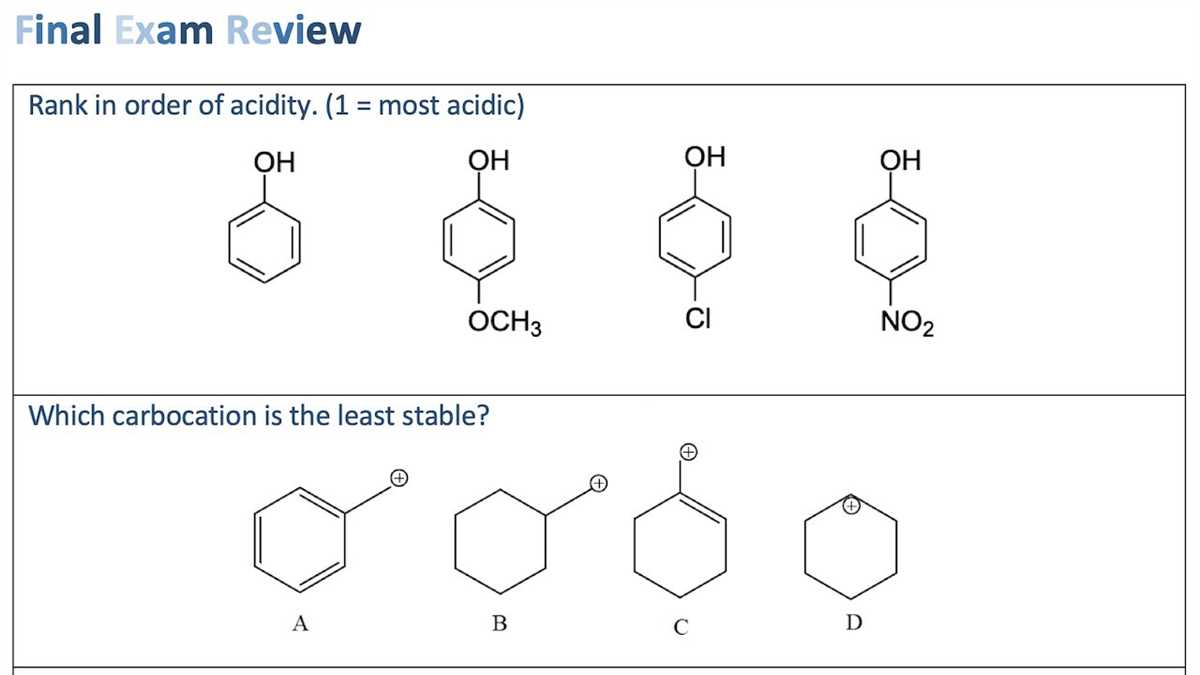
Preparing for the chemistry final exam can be a challenging task, but with enough practice and understanding of the key concepts, it is definitely achievable. One important aspect of preparation is solving practice problems that cover various topics from the course. This helps in reinforcing the knowledge gained throughout the semester and also improves problem-solving skills.
1. Stoichiometry: Stoichiometry is an essential topic in chemistry that deals with the quantitative relationships between reactants and products in a chemical reaction. To practice stoichiometry problems, make sure to understand how to balance chemical equations and calculate the amount of reactants and products using mole ratios.
2. Chemical Equilibrium: Chemical equilibrium is a state in which the reactants and products in a chemical reaction are present in constant concentrations. To practice this topic, familiarize yourself with the concept of equilibrium constants and how to calculate them using concentration or partial pressure values. Additionally, understand the factors that can shift the equilibrium and how to predict the direction of the shift.
3. Acid-Base Reactions: Acid-base reactions involve the transfer of protons from an acid to a base. Practice problems related to acid-base reactions by understanding the concept of pH, pOH, and the pH scale. Additionally, be familiar with different acid-base theories, such as the Arrhenius, Bronsted-Lowry, and Lewis theories.
4. Electrochemistry: Electrochemistry involves the study of the interconversion of chemical energy and electrical energy. Practice problems related to electrochemistry by understanding concepts such as oxidation-reduction reactions, galvanic cells, electrolytic cells, and calculating cell potentials.
5. Organic Chemistry: Organic chemistry deals with the study of carbon compounds. Practice problems related to organic chemistry by understanding the concepts of functional groups, nomenclature, isomerism, and reactions involving organic compounds.
- Overall, practicing a wide range of problems from different topics in chemistry will help in familiarizing yourself with the types of questions that might appear on the final exam.
- Make use of textbooks, online resources, and previous exam papers to find practice problems.
- Work on problems step by step and consult your course materials or instructors for any doubts or clarifications.
- Regular practice and revision during the exam preparation period will help in boosting your confidence and ensuring better performance on the final exam.
Chemistry is the scientific study of matter and the changes it undergoes. It is a central science that connects different fields of study such as physics, biology, and environmental science. The study of chemistry is essential for understanding the world around us and has practical applications in various industries, including medicine, agriculture, and materials science.
One of the fundamental concepts in chemistry is the atom, which is the smallest unit of an element that retains the chemical properties of that element. Atoms consist of a nucleus, which contains protons and neutrons, and electrons that orbit the nucleus. The number of protons in an atom’s nucleus determines its atomic number and defines its identity as a particular element.
Periodic Table
The organization of elements and their properties is represented in the periodic table. The periodic table is a tabular arrangement of elements based on their atomic number, electron configuration, and recurring chemical properties. It allows scientists to classify elements into groups and periods and provides valuable information about their characteristics and reactivity.
Bonding and Chemical Reactions:
Chemical bonding involves the formation of chemical bonds between atoms, leading to the creation of molecules or compounds. There are different types of chemical bonds, including covalent bonds, where atoms share electrons, and ionic bonds, where one atom transfers electrons to another. Chemical reactions occur when these bonds are broken and new bonds are formed, resulting in the rearrangement of atoms to create new substances.
Stoichiometry and Chemical Equations
Stoichiometry is the calculation of the quantities of reactants and products in chemical reactions. It helps determine the ratio of substances involved in a reaction and allows us to predict the amount of product formed. Chemical equations are symbolic representations of chemical reactions, showing the reactants on the left side and the products on the right side. Balancing chemical equations is a crucial skill in chemistry to ensure that the Law of Conservation of Mass is obeyed.
Acids, Bases, and pH

Acids and bases are important concepts in chemistry and have various applications in everyday life. Acids are substances that release hydrogen ions (H+) in water, while bases are substances that release hydroxide ions (OH-). The pH scale is used to measure the acidity or alkalinity of a solution, with pH 7 considered neutral, pH less than 7 acidic, and pH greater than 7 basic. Understanding acids, bases, and pH is crucial in fields such as medicine, environmental science, and industrial processes.
Essential Equations and Formulas
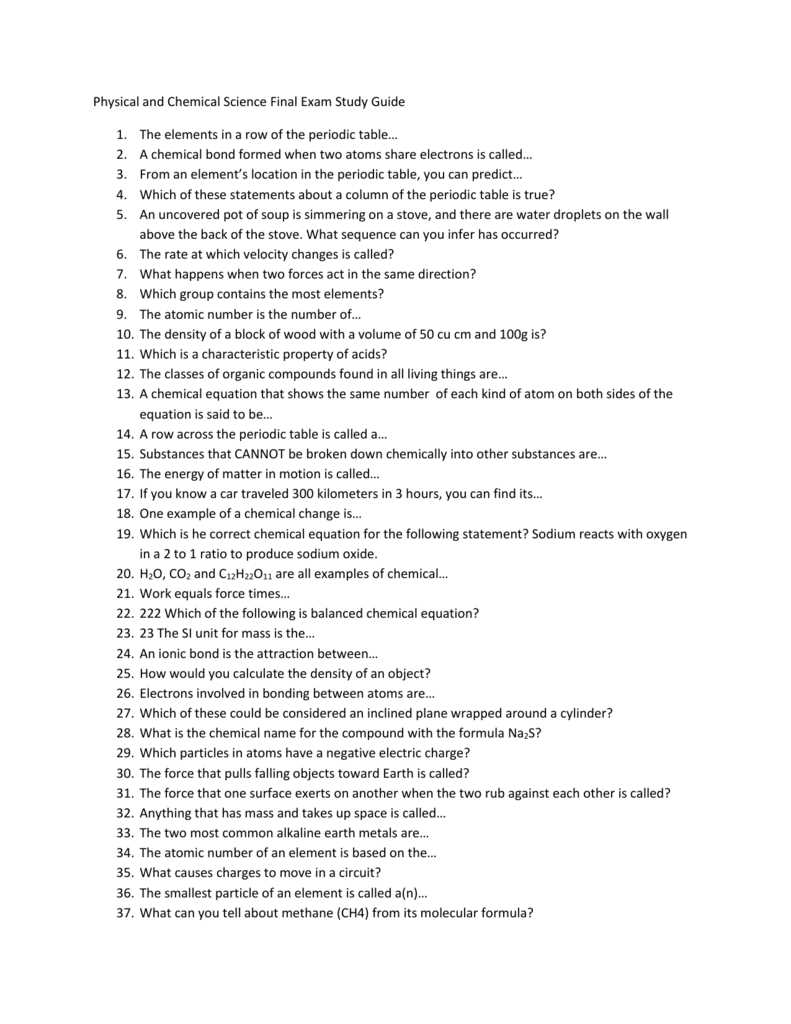
In chemistry, there are several essential equations and formulas that are commonly used to solve problems and understand various concepts. These equations and formulas serve as fundamental tools for chemists to analyze and quantify chemical reactions and properties.
One of the most well-known equations in chemistry is the famous mass-energy equivalence equation, E=mc2, derived by Albert Einstein. This equation states that energy (E) is equal to the mass (m) multiplied by the speed of light squared (c2). It relates mass and energy, providing a deep insight into the interconversion between the two forms.
- Ideal Gas Law: The ideal gas law equation, PV = nRT, relates the pressure (P), volume (V), amount of substance (n), gas constant (R), and temperature (T) of an ideal gas. This equation is often used to calculate one of these variables when the others are known.
- Stoichiometry: Stoichiometry involves the quantitative relationship between reactants and products in a chemical reaction. The balanced chemical equation serves as a foundational tool for stoichiometric calculations.
- Hess’s Law: Hess’s Law allows the calculation of the enthalpy change for a chemical reaction by using known enthalpy changes of other reactions. It states that the overall enthalpy change of a reaction is independent of the pathway taken.
- Equilibrium Constant: The equilibrium constant (K) expression relates the concentrations of reactants and products at equilibrium for a chemical reaction. It provides valuable information about the extent of a reaction and can be used to calculate equilibrium concentrations.
These are just a few examples of the essential equations and formulas in chemistry. Understanding and utilizing these equations can greatly enhance one’s understanding of chemical phenomena and their quantitative aspects.
Chemical Reactions and Balancing

The study of chemical reactions is an essential part of chemistry, as it allows us to understand how substances interact and transform into new substances. A chemical reaction occurs when two or more substances, called reactants, combine to form different substances, known as products. This transformation often involves the breaking and formation of chemical bonds.
One important concept in chemical reactions is the law of conservation of mass, which states that matter cannot be created or destroyed during a chemical reaction. This means that the total mass of the reactants must be equal to the total mass of the products. In order to represent this conservation of mass, chemical equations are used. These equations consist of reactants on the left side, separated by a plus sign, an arrow to indicate the direction of the reaction, and products on the right side, also separated by a plus sign.
In order to balance chemical equations, coefficients are used to adjust the number of atoms of each element on both sides of the equation. The coefficients must be chosen in such a way that the number of atoms of each element is the same on both sides. This balancing process is crucial to ensure that the law of conservation of mass is upheld. It requires knowledge of the stoichiometry of the reaction, which involves the ratios of the numbers of molecules or moles of reactants and products.
Chemical reactions and balancing are fundamental concepts in chemistry, as they allow us to predict and understand the behavior of substances and how they can be transformed into new substances. By mastering the skill of balancing chemical equations, chemists can accurately represent and manipulate reactions, paving the way for advancements in various scientific and industrial applications.
Periodic Table and Elements
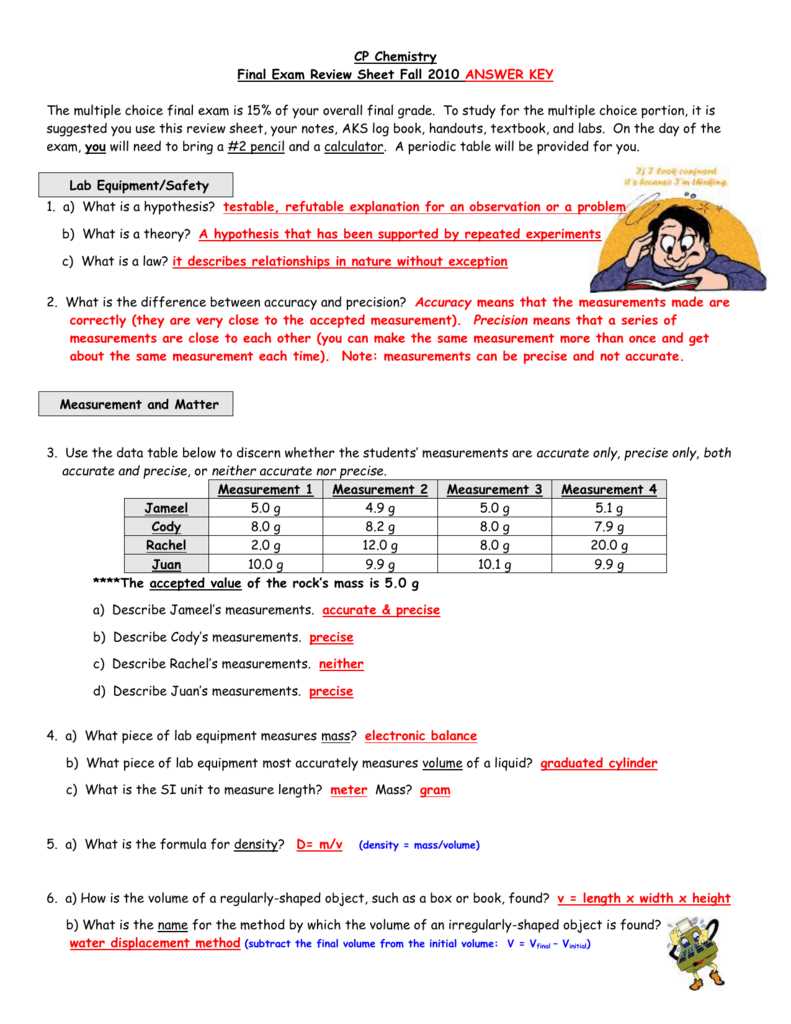
The periodic table is a tabular arrangement of chemical elements, organized based on their atomic number, electron configuration, and recurring chemical properties. It provides a systematic way of classifying and understanding the building blocks of matter. The table is divided into periods (horizontal rows) and groups (vertical columns), with each element represented by its atomic symbol and atomic number.
Elements are the fundamental substances that cannot be broken down into simpler substances by chemical means. They are characterized by their unique properties and behavior in chemical reactions. There are currently 118 known elements, with hydrogen being the lightest and uranium being the heaviest. These elements are grouped into different categories, including metals, nonmetals, and metalloids, based on their physical and chemical properties.
The periodic table is an essential tool for chemists as it helps them predict the properties and behavior of elements and compounds. Each element in the table has its own set of characteristics, such as atomic radius, electronegativity, and ionization energy, which determine how it interacts with other elements. By understanding the periodic trends and patterns, chemists can make informed decisions about reactions, bonds, and the behavior of matter.
Moreover, the periodic table also provides information about the isotopes of each element, which are variants of the atom with different numbers of neutrons. Isotopes have slightly different physical properties, but their chemical behavior remains the same. This knowledge is vital for various applications, including radiocarbon dating, nuclear medicine, and the study of nuclear reactions.
In conclusion, the periodic table is a powerful tool that enables scientists to understand and explore the world of chemistry. It organizes elements based on their unique properties and helps predict their behavior in chemical reactions. By studying the periodic table, chemists can unlock the secrets of matter and make significant contributions to various scientific fields.
Bonding and Molecular Structure
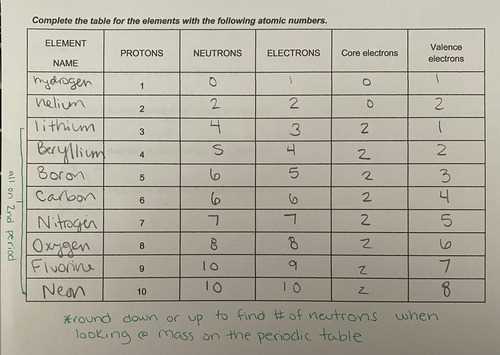
In chemistry, bonding refers to the attractive forces that hold atoms together in compounds. Understanding bonding is crucial for understanding the properties and behavior of substances. There are several types of chemical bonds, including ionic bonds, covalent bonds, and metallic bonds, each with different characteristics and properties.
An ionic bond is formed when one or more electrons are transferred from one atom to another, resulting in the formation of positively charged ions (cations) and negatively charged ions (anions). These oppositely charged ions are then attracted to each other, forming a strong bond. Ionic compounds typically have high melting and boiling points and are often soluble in water.
Covalent bonding occurs when electrons are shared between atoms. In this type of bond, atoms are held together by the mutual attraction of their shared electrons. Covalent compounds can be further classified as polar or nonpolar depending on the electronegativity difference between the bonded atoms. Polar covalent bonds have unequal sharing of electrons, resulting in a partial positive charge on one atom and a partial negative charge on the other. Nonpolar covalent bonds have equal sharing of electrons.
Metallic bonding is found in metals and alloys. In this type of bond, valence electrons are delocalized and move freely within a lattice of positive metal ions. The delocalized electrons create a “sea” of electrons, which allows metals to conduct electricity and heat. Metallic bonding also gives metals their characteristic properties such as malleability and ductility.
The structure of molecules is determined by the arrangement of atoms and the type of bonding between them. Molecular geometry refers to the three-dimensional arrangement of atoms in a molecule and is influenced by factors such as bond angles and electron pair repulsion. Understanding molecular structure is crucial for predicting the chemical and physical properties of substances.
Conclusion: Stoichiometry and Molarity

In conclusion, stoichiometry and molarity are fundamental concepts in chemistry that are crucial for understanding and predicting chemical reactions. Stoichiometry helps determine the quantitative relationship between reactants and products in a chemical reaction, allowing chemists to calculate the amount of substance involved and make informed decisions in laboratory experiments and industrial processes.
Molarity, on the other hand, is a measure of the concentration of a solution, expressed in moles of solute per liter of solution. It is a key parameter in many chemical reactions and plays a significant role in determining reaction rates, equilibrium, and stoichiometric calculations.
Understanding and applying stoichiometry and molarity principles are essential skills for any chemistry student or professional chemist. This knowledge allows for accurate and efficient chemical analysis, synthesis, and experimentation. By mastering these concepts, chemists can manipulate the quantities of substances involved in a reaction, control reaction conditions, and produce desired results.
Furthermore, stoichiometry and molarity are interconnected, as stoichiometric equations provide information about the ratio of substances involved in a reaction, which is necessary for calculating molarity. These concepts work hand in hand to provide a comprehensive understanding of chemical reactions and enable chemists to design and optimize processes in various fields, including pharmaceuticals, materials science, environmental science, and more.
Overall, stoichiometry and molarity are fundamental tools in the chemist’s arsenal for understanding, predicting, and controlling chemical reactions. Mastering these concepts allows for accurate and efficient analysis, manipulation, and synthesis of substances, making them indispensable in the field of chemistry.