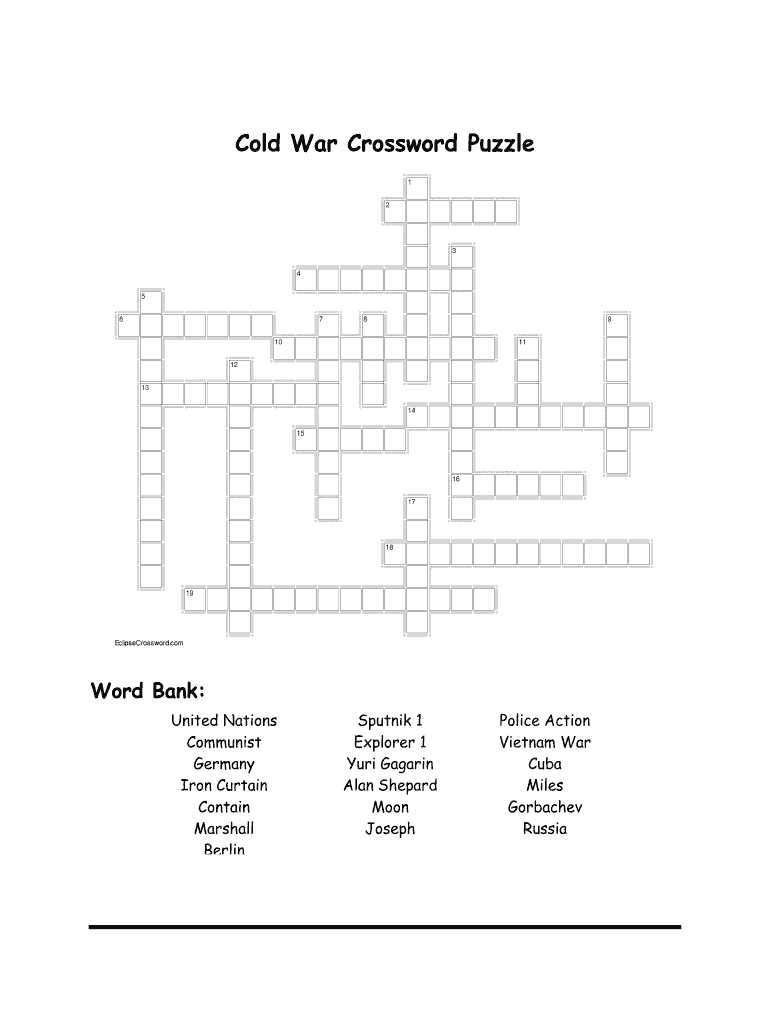
The Ultimate Guide to Cold War Vocabulary: Unlock the Answer Key Here

The Cold War was a period of intense political, military, and ideological rivalry between the United States and the Soviet Union. Lasting from the end of World War II until the early 1990s, the Cold War was characterized by a constant state of tension and the threat of nuclear war. During this time, a number of key terms and concepts emerged that were essential to understanding the events and dynamics of the era. In this answer key, we will explore some of these terms and their meanings, providing a comprehensive guide to the language of the Cold War.
One of the key terms in the vocabulary of the Cold War is “containment.” This concept, which was first articulated by American diplomat George Kennan, referred to the policy of preventing the spread of communism and Soviet influence. The United States believed that it was essential to contain the Soviet Union and its Communist allies, as they posed a direct threat to the democratic world. This led to a series of military alliances, such as NATO, and conflicts, such as the Korean War, as the United States sought to contain the Soviet Union and its allies.
Another important term during the Cold War was “arms race.” The United States and the Soviet Union engaged in a competition to build up their military capabilities, particularly in terms of nuclear weapons. This resulted in the development of increasingly powerful and destructive weapons, such as intercontinental ballistic missiles and hydrogen bombs. The arms race created a sense of fear and instability, as both sides constantly sought to outdo each other in terms of military might. The Cuban Missile Crisis of 1962, when the United States and the Soviet Union came to the brink of nuclear war, was a stark reminder of the dangers of the arms race.
A third key term in the vocabulary of the Cold War is “proxy war.” As direct confrontation between the United States and the Soviet Union was considered too dangerous, both sides often supported conflicts in other countries, known as proxy wars. These conflicts, such as the Vietnam War and the Soviet invasion of Afghanistan, allowed the United States and the Soviet Union to assert their influence and compete for dominance in strategic regions. Proxy wars were characterized by significant human suffering and geopolitical implications.
Cold War Vocabulary Answer Key

In order to understand the complex dynamics of the Cold War, it is crucial to familiarize oneself with key terms and concepts that shaped this period of intense geopolitical rivalry between the United States and the Soviet Union. In this answer key, we will provide definitions for some of the most important terms related to the Cold War.
Containment:
Containment refers to the U.S. foreign policy strategy aimed at preventing the spread of communism. It was based on the belief that the Soviet Union had expansionist ambitions and that the United States needed to contain Soviet influence to protect its own interests and the interests of its allies.
Mutually Assured Destruction (MAD):
MAD is a military doctrine that held that a full-scale nuclear war between the United States and the Soviet Union would lead to the complete annihilation of both countries. This understanding led to a policy of deterrence, as both sides knew that initiating a nuclear conflict would result in their own destruction.
NATO:
The North Atlantic Treaty Organization (NATO) is a military alliance formed in 1949 comprised of Western democracies, primarily led by the United States. It was established as a response to the perceived threat of Soviet aggression and aimed to provide collective defense among member states.
Warsaw Pact:
The Warsaw Pact was a collective defense alliance established in 1955 by the Soviet Union and its Eastern European satellite states. It served as the Soviet counterpart to NATO and was created as a response to the integration of West Germany into NATO.
Iron Curtain:
The Iron Curtain was a metaphorical term coined by Winston Churchill to describe the division between Western Europe, under democratic influence, and Eastern Europe, under Soviet influence. It represented the ideological and physical separation between the two superpowers and the restrictions placed on the flow of information and people.
Space Race:
The Space Race was a competition between the United States and the Soviet Union to achieve technological and scientific superiority in space exploration. It began with the launch of the Soviet satellite Sputnik in 1957 and culminated in the U.S. landing astronauts on the moon in 1969.
Proxy Wars:
Proxy wars were conflicts where the United States and the Soviet Union supported opposing sides without directly confronting each other. Examples include the Korean War and the Vietnam War, where the two superpowers provided military and financial assistance to their respective allies.
This Cold War vocabulary answer key provides a foundation for understanding the terminology and concepts that defined this era of global tension. By familiarizing oneself with these terms, one can better comprehend the complexities of the Cold War and its lasting impact on the world.
Understanding the Cold War
The Cold War was a period of geopolitical tension between the United States and the Soviet Union that lasted from the end of World War II until the early 1990s. It was characterized by a rivalry between the two superpowers, as they vied for political, economic, and military influence around the world. The Cold War was primarily fought through proxy wars, propaganda, espionage, and an arms race, with each side trying to outdo the other in terms of technological advancements and military capabilities.
One of the key factors that contributed to the Cold War was the ideological divide between capitalism and communism. The United States, as a capitalist nation, championed free markets, individualism, and democracy, while the Soviet Union, as a communist state, advocated for collective ownership, planned economies, and dictatorship of the proletariat. This fundamental difference in ideology fueled the conflict between the two powers, as they sought to spread their respective systems of government and rule.
The Cold War was also characterized by a series of major events, such as the Berlin Blockade, the Korean War, the Cuban Missile Crisis, and the Vietnam War. These events were not direct confrontations between the United States and the Soviet Union, but rather proxy conflicts fought on behalf of the two superpowers by their respective allies. These conflicts often resulted in significant loss of life and heightened global tensions.
- Proxy wars: The Cold War was marked by numerous proxy wars, where the United States and the Soviet Union supported opposing sides in conflicts around the world. For example, the United States supported South Vietnam in the Vietnam War, while the Soviet Union supported North Vietnam.
- Arms race: The United States and the Soviet Union engaged in a nuclear arms race, each trying to outdo the other in terms of the number and destructive power of their nuclear weapons. This arms race led to an unprecedented stockpiling of nuclear weapons and an atmosphere of fear and distrust.
- Propaganda: Both the United States and the Soviet Union used propaganda to shape public opinion and gain support for their respective ideologies. This included the dissemination of biased information, censorship, and the manipulation of media to promote their own agendas.
- Espionage: Both sides engaged in extensive espionage operations to gather intelligence and secret information. This included spying on each other’s military activities, political strategies, and technological advancements. The most famous spy of the Cold War era was perhaps Soviet double agent, Kim Philby, who infiltrated British intelligence.
In conclusion, the Cold War was a period of intense geopolitical tension between the United States and the Soviet Union, characterized by proxy wars, an arms race, propaganda, and espionage. It was driven by the ideological divide between capitalism and communism, as well as the pursuit of global influence and power. The Cold War left a lasting impact on world politics and shaped the modern geopolitical landscape.
Key Events of the Cold War
The Cold War between the United States and the Soviet Union was characterized by a series of key events that shaped the geopolitical landscape of the world. These events, often marked by tensions and competition between the two superpowers, had far-reaching consequences and defined the era of the Cold War.
1. The Berlin Blockade and Airlift (1948-1949)
One of the first major events of the Cold War was the Berlin Blockade and Airlift. In an attempt to consolidate their control over the divided city of Berlin, the Soviet Union blocked all land and water routes to West Berlin in 1948. In response, the United States and its allies organized a massive airlift operation to provide essential supplies to the besieged city. This event marked a turning point in the Cold War, as it showcased the determination of the West to protect its interests and demonstrated the vulnerability of the Soviet Union.
2. The Korean War (1950-1953)
The Korean War was another significant event of the Cold War. It began when North Korea, supported by the Soviet Union and China, invaded South Korea. The United States, along with its allies, intervened to defend South Korea. The war ended in a stalemate, with the establishment of the demilitarized zone (DMZ) along the 38th parallel. The Korean War highlighted the global nature of the Cold War and the intense competition between the United States and the Soviet Union for influence in the world.
3. The Cuban Missile Crisis (1962)
Perhaps one of the most tense moments of the Cold War was the Cuban Missile Crisis. In 1962, the United States discovered that the Soviet Union was secretly installing nuclear missiles in Cuba. This event brought the world to the brink of nuclear war, as the United States demanded the removal of the missiles. After intense negotiations, the crisis was resolved peacefully, with the Soviet Union agreeing to remove the missiles and the United States promising not to invade Cuba. The Cuban Missile Crisis highlighted the dangers of nuclear weapons and the fragile balance of power between the superpowers.
4. The Vietnam War (1955-1975)
The Vietnam War was another major event of the Cold War. It began as a civil war between North and South Vietnam, but quickly escalated into a conflict involving the United States and its allies supporting South Vietnam, while the Soviet Union and China backed the North Vietnamese. The war had profound consequences for both sides, with millions of casualties and extensive destruction. The Vietnam War highlighted the ideological and strategic rivalries of the Cold War, as well as the limits of military power in achieving political objectives.
5. The Fall of the Berlin Wall (1989)
The fall of the Berlin Wall in 1989 marked the symbolic end of the Cold War. The wall, which had divided East and West Berlin since 1961, was torn down by the people of Berlin, signaling the reunification of Germany and the collapse of the Soviet Union’s influence in Eastern Europe. This event symbolized the victory of the democratic and capitalist values of the West over the communist ideologies of the Soviet Union. The fall of the Berlin Wall represented the beginning of a new era of geopolitical realignment and the end of the Cold War.
These key events of the Cold War played a crucial role in shaping the political, social, and ideological landscapes of the world. They demonstrated the intense rivalry and competition between the United States and the Soviet Union, as well as the global reach of the Cold War. The repercussions of these events are still felt today, as they continue to influence international relations and shape the balance of power in the world.
Ideologies and Political Terms
Ideologies and political terms played a significant role during the Cold War. The conflict between the United States and the Soviet Union was not just a military standoff, but also an ideological battle between two opposing systems: capitalism and communism.
Capitalism, an economic system based on private ownership and free market competition, was championed by the United States and its allies. It emphasized individual freedoms, private property, and the pursuit of profit. The United States saw capitalism as the best way to promote economic growth and individual prosperity. It believed that free markets and competition would lead to innovation, efficiency, and overall economic progress.
Communism, on the other hand, was the economic and political system advocated by the Soviet Union and its satellite states. It called for the abolition of private property and the establishment of a classless society. The means of production were to be owned and controlled by the state, and the goal was to achieve economic equality and social justice. The Soviet Union saw communism as a way to empower the working class and create a fairer society without exploitation.
During the Cold War, these competing ideologies led to intense rivalry and competition between the two superpowers. They each sought to spread their own political and economic systems, often through military interventions and proxy wars. The conflict was not just about military might and geopolitical influence, but also about the clash of ideas and values. The language and terminology associated with these ideologies, such as “freedom,” “democracy,” “equality,” and “socialism,” were used as rallying cries and propaganda tools to mobilize support and delegitimize the opposing side.
Arms Race and Nuclear Terminology
The Cold War between the United States and the Soviet Union was marked by a fierce competition in the development and accumulation of weapons. This period became known as the Arms Race, where both superpowers heavily invested in their military capabilities to gain a strategic advantage over one another. As a result, an extensive vocabulary of terms related to arms and nuclear weapons emerged.
One of the key terms during the Cold War was “nuclear deterrence.” This concept refers to the belief that possessing a significant arsenal of nuclear weapons would prevent an enemy from launching a nuclear attack due to the fear of massive retaliation. The doctrine of Mutually Assured Destruction (MAD) was the cornerstone of nuclear deterrence, suggesting that any nuclear attack would result in the complete annihilation of both the attacker and the defender.
The arms race also led to the development of “intercontinental ballistic missiles” (ICBMs) and “ballistic missile submarines” (SSBNs). ICBMs are missiles capable of traveling long distances and carrying nuclear warheads, while SSBNs are submarines equipped with ballistic missiles. These weapons provided the ability to strike the enemy’s homeland from afar, enhancing the superpowers’ nuclear capabilities and ensuring a second-strike capability.
Furthermore, the Cold War vocabulary included terms like “nuclear proliferation” and “non-proliferation.” Nuclear proliferation referred to the spread of nuclear weapons to additional countries, while non-proliferation aimed to prevent the proliferation of these weapons. The Treaty on the Non-Proliferation of Nuclear Weapons (NPT) was a significant international agreement signed by many nations to prevent the spread of nuclear weapons and promote disarmament.
In conclusion, the Arms Race and the nuclear terminology that emerged during the Cold War showcased the high-stakes competition between the United States and the Soviet Union. The focus on nuclear weapons and deterrence strategies shaped the geopolitical landscape of the time and left a lasting impact on global security policies.
Key Figures of the Cold War
The Cold War was a political and ideological conflict between the United States and the Soviet Union that lasted from the late 1940s to the early 1990s. During this time, several key figures emerged who played significant roles in shaping the course of the Cold War. Their actions and decisions had far-reaching consequences and influenced the geopolitical landscape for decades to come.
One of the most prominent figures of the Cold War was Joseph Stalin, the leader of the Soviet Union. Stalin’s policies and actions during his time in power shaped the Soviet Union’s aggressive expansionist agenda and heightened tensions with the United States. His harsh rule and disregard for human rights led to significant mistrust between the two superpowers.
Another key figure of the Cold War was Harry S. Truman, the 33rd President of the United States. Truman assumed office shortly after the end of World War II and was faced with the challenge of containing Soviet influence and communism. He implemented the Truman Doctrine, which provided economic and military aid to countries threatened by communism, and also approved the use of atomic bombs against Japan, a move that demonstrated the United States’ military superiority but also raised concerns about the use of nuclear weapons.
- Winston Churchill: The Prime Minister of the United Kingdom during World War II and an influential figure during the early years of the Cold War. Churchill famously coined the phrase “Iron Curtain” to describe the division between Western democracies and Soviet-dominated Eastern Europe.
- Nikita Khrushchev: The leader of the Soviet Union during the late 1950s and early 1960s. Khrushchev’s decisions, such as the construction of the Berlin Wall and the Cuban Missile Crisis, intensified the Cold War and brought the world to the brink of nuclear war.
- John F. Kennedy: The 35th President of the United States who had to navigate the tense relations with the Soviet Union during the early 1960s. His handling of the Cuban Missile Crisis is considered a key moment in Cold War history, as it showcased the dangers of a nuclear conflict.
These are just a few examples of the key figures who played critical roles in the Cold War. Their actions, decisions, and ideologies shaped the course of the conflict and had a lasting impact on the world order. Understanding their contributions is essential for comprehending the complexities of the Cold War and its implications.
Impact and Legacy of the Cold War
The Cold War had a profound impact on global politics, economics, and culture, and its legacy continues to be felt to this day. Here are some of the key impacts and legacies of the Cold War:
Nuclear Arms Race:
One of the most significant impacts of the Cold War was the development of nuclear weapons and the ensuing arms race between the United States and the Soviet Union. Both countries sought to build up their nuclear arsenals, leading to a dangerous escalation of tensions and fears of a nuclear war. The legacy of this arms race can still be seen today, as nuclear weapons remain a major concern in international relations.
Proxy Wars:
During the Cold War, the United States and the Soviet Union fought many proxy wars, in which they supported opposing sides in conflicts around the world. These conflicts, such as the Korean War and the Vietnam War, had devastating consequences for the countries involved and led to the loss of millions of lives. The legacy of these proxy wars can still be seen in regions like the Middle East, where the United States and Russia continue to support opposing factions.
Divided World:
The Cold War created a divided world, with the United States and its allies forming the Western bloc, and the Soviet Union and its allies forming the Eastern bloc. This division created a lasting sense of us-versus-them mentality and led to an intense rivalry between the two sides. Even after the end of the Cold War, this division continues to shape global politics and relationships.
Technological Advancements:
To gain an edge over each other, both the United States and the Soviet Union invested heavily in research and development, leading to major technological advancements. Space exploration, computer technology, and military technology all saw major breakthroughs during the Cold War. The legacy of these advancements can still be seen today, as technological innovation continues to shape our world.
Cultural Influence:
The Cold War had a significant impact on popular culture, with themes of espionage, paranoia, and the threat of nuclear war often featuring in movies, books, and television shows. The legacy of this cultural influence can still be seen today, as many Cold War tropes and themes continue to dominate the entertainment industry.
In conclusion, the Cold War had far-reaching impacts on global politics, economics, and culture. Its legacy can still be felt in the ongoing nuclear arms race, the presence of proxy wars, the division of the world, technological advancements, and cultural influences. The Cold War shaped the world we live in today and continues to shape international relations and global dynamics.