Demystifying the Doppler Effect: All Your Questions Answered in a PDF
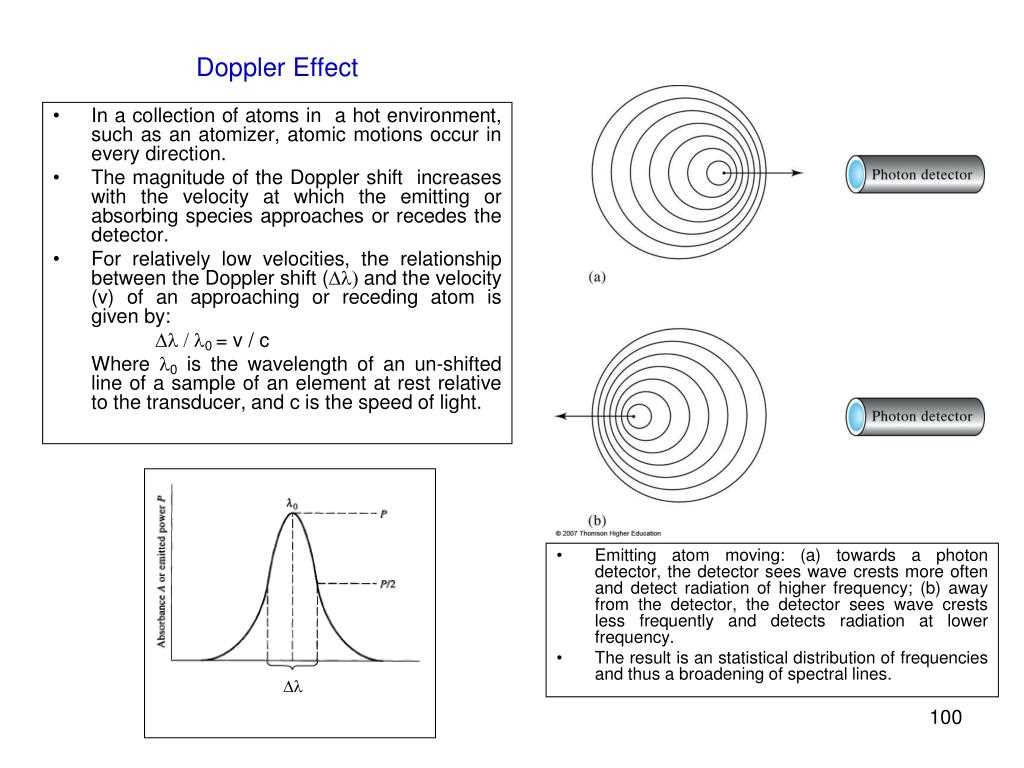
The Doppler effect is a phenomenon that occurs when there is a perceived change in the frequency and wavelength of a wave as the source of the wave moves relative to an observer. This effect is observed in various situations, such as the sound of an ambulance siren changing as it approaches and then passes by. The study of the Doppler effect is important in fields such as physics, astronomy, and meteorology.
If you are studying the Doppler effect or are simply curious about it, you may have some questions. In this article, we have compiled a list of commonly asked questions about the Doppler effect. We have also provided answers to help you better understand this interesting phenomenon. Whether you are a student, a teacher, or someone who is just curious, we hope that this article will answer your questions and provide you with a better understanding of the Doppler effect.
In this PDF, you will find questions ranging from basic to advanced, exploring various aspects of the Doppler effect. Some of the questions cover the concept of frequency shift, while others delve into the mathematical equations used to calculate the Doppler effect. Whether you are looking for a quick answer or a detailed explanation, this PDF can serve as a valuable resource.
Doppler Effect Questions and Answers PDF
In this PDF, you will find a collection of frequently asked questions and their answers about the Doppler effect, which is a phenomenon that describes the change in frequency or wavelength of a wave as observed by an observer moving relative to the source of the wave.
1. What is the Doppler effect?
The Doppler effect is the change in frequency or wavelength of a wave as observed by an observer moving relative to the source of the wave. It is responsible for the perceived change in pitch of a sound as a moving ambulance approaches and then passes by.
2. How does the Doppler effect work?
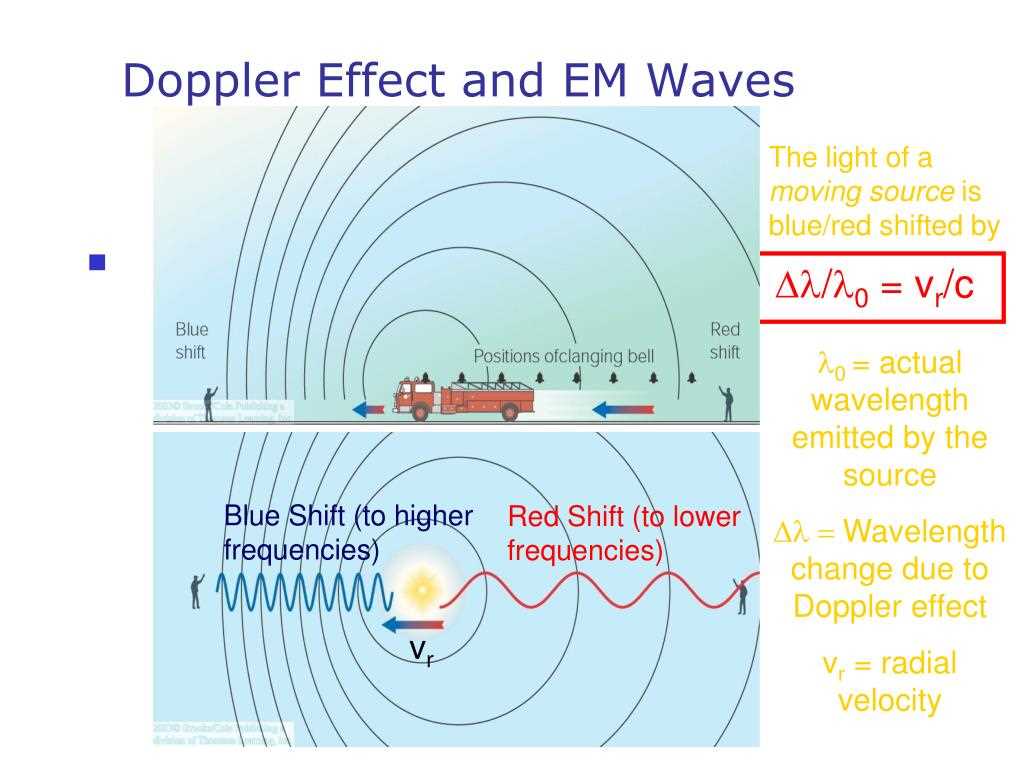
The Doppler effect occurs because when the source of a wave (such as a sound or light wave) moves relative to an observer, the waves in front of the source get compressed, resulting in a higher frequency and shorter wavelength. Conversely, the waves behind the source get stretched, resulting in a lower frequency and longer wavelength.
3. What are some applications of the Doppler effect?
The Doppler effect has many practical applications. It is used in weather radar to determine the velocity of precipitation and in medical ultrasound to measure blood flow. It is also used in Doppler radar systems to measure the velocity of moving objects, such as vehicles on a highway.
4. How is the Doppler effect related to light?
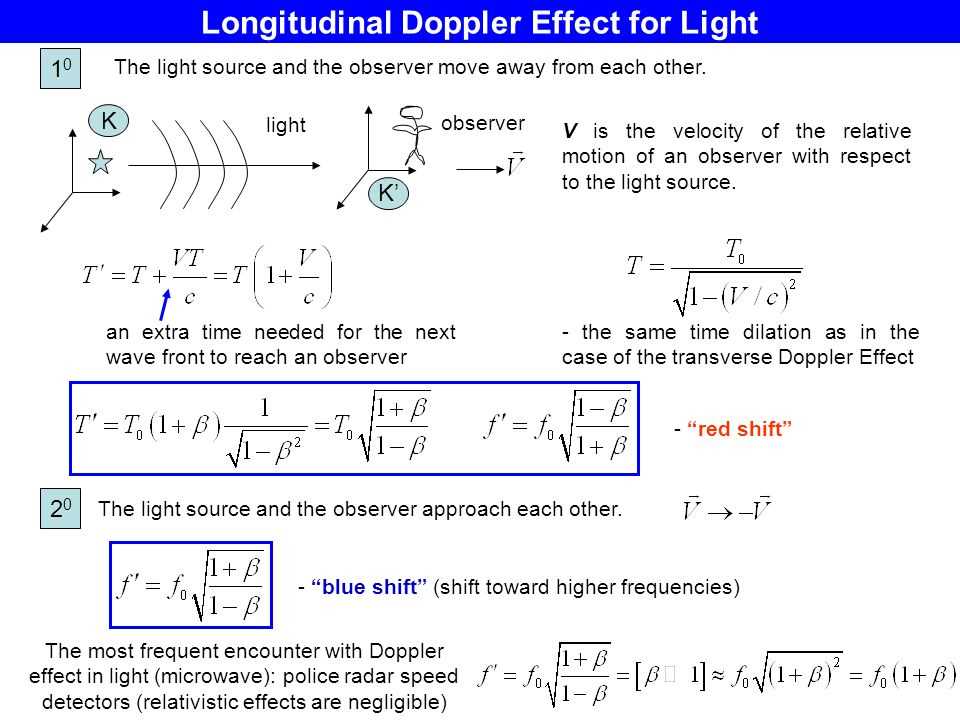
The Doppler effect also applies to light waves. When an object emitting light moves towards an observer, the observed wavelength of the light decreases, resulting in a shift towards the blue end of the spectrum, known as a “blue shift.” Conversely, when the object moves away from the observer, the observed wavelength increases, resulting in a shift towards the red end of the spectrum, known as a “red shift.”
5. What is the formula for the Doppler effect?
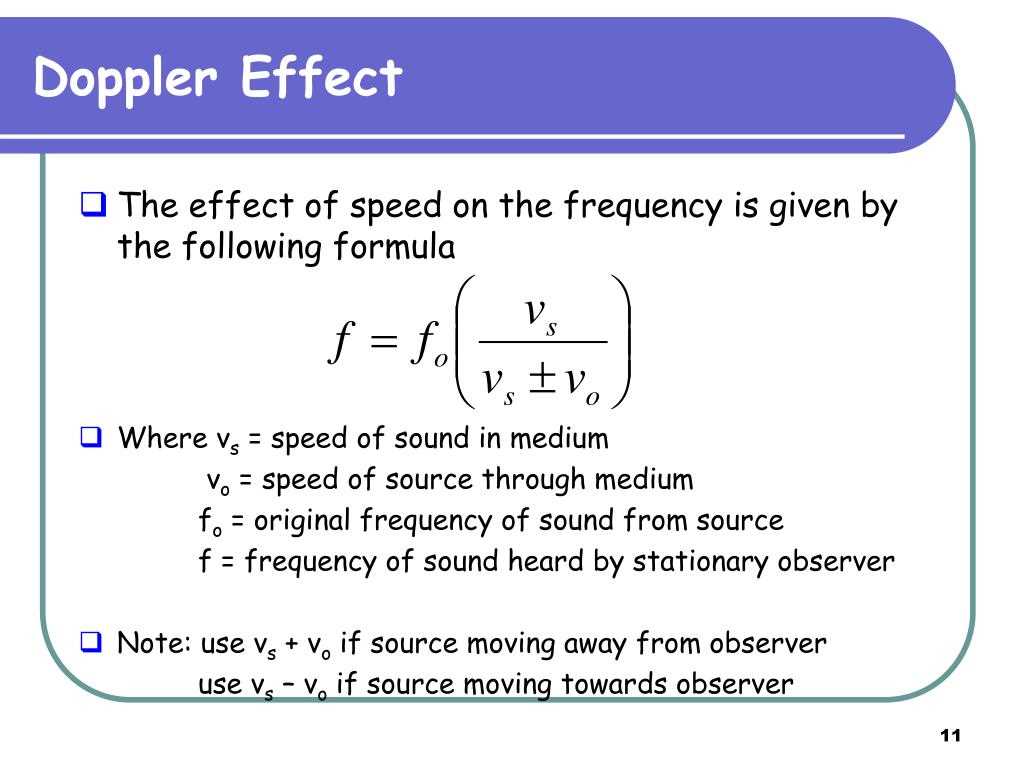
The formula for the Doppler effect depends on whether the source of the wave is moving towards or away from the observer. For a source moving towards the observer, the formula is f’ = f * (v + vo) / (v – vs), where f’ is the observed frequency, f is the actual frequency, v is the speed of sound, vo is the observer’s velocity, and vs is the source’s velocity. For a source moving away from the observer, the formula is f’ = f * (v – vo) / (v + vs).
Overall, understanding the Doppler effect is crucial in various fields, from physics to astronomy, as it helps explain and predict the behavior of waves in different scenarios.
What is the Doppler effect?
The Doppler effect is a phenomenon in physics that describes the apparent change in frequency or wavelength of a wave due to the relative motion between the source of the wave and the observer. This effect is commonly observed in everyday life, for example, when a car with a siren passes by and the pitch of the siren seems to change. The Doppler effect is also applicable to electromagnetic waves such as light or radio waves.
The key factor in the Doppler effect is the relative motion between the source and the observer. When the source and the observer are moving towards each other, the observed frequency or wavelength is higher than the emitted frequency or wavelength, and this is called the “blueshift”. On the other hand, when the source and the observer are moving away from each other, the observed frequency or wavelength is lower than the emitted frequency or wavelength, and this is called the “redshift”. The Doppler effect can be mathematically expressed using the formula:
Δf = (v/c) * f
where Δf is the difference in frequency, v is the velocity of the source or the observer, c is the speed of the wave in the medium, and f is the emitted frequency.
How does the Doppler effect work?
The Doppler effect is a phenomenon that occurs when there is relative motion between the source of a wave and an observer. It causes a change in the observed frequency of the wave. The effect is commonly observed in everyday life, such as when a siren on a moving vehicle passes by and the pitch of the sound changes.
The Doppler effect can be explained using the concept of wavefronts. When the source of a wave, such as a sound wave or a light wave, is moving towards an observer, the wavefronts get compressed, resulting in an increase in the observed frequency. This increase in frequency leads to a higher pitch in sound or a shift towards the blue end of the spectrum in light waves. On the other hand, when the source of the wave is moving away from the observer, the wavefronts get stretched, causing a decrease in the observed frequency. This decrease in frequency leads to a lower pitch in sound or a shift towards the red end of the spectrum in light waves.
Mathematically, the Doppler effect can be described using the equation:
f’ = f * (v + vo) / (v – vs)
where f’ is the observed frequency, f is the actual frequency of the source, v is the speed of the wave, vo is the speed of the observer relative to the medium, and vs is the speed of the source relative to the medium.
In summary, the Doppler effect results in a change in the observed frequency of a wave due to relative motion between the source and the observer. This effect can be observed in various situations, from the sound of a passing vehicle to the colors of distant stars. Understanding the Doppler effect helps scientists and engineers to analyze and interpret the behavior of waves in different scenarios.
Applications of the Doppler Effect
The Doppler effect, also known as the Doppler shift, is a phenomenon observed in waves, including sound and light waves. It occurs when there is relative motion between the source of the wave and the observer. The Doppler effect has a wide range of applications in various fields.
1. Doppler radar: One of the most significant applications of the Doppler effect is in weather forecasting. Doppler radar systems can detect and track precipitation, such as rain or snow. By measuring the frequency shift of the reflected radar signal, meteorologists can determine the speed and direction of the moving precipitation, providing valuable information for predicting weather patterns and severe storms.
2. Medical imaging: The Doppler effect is extensively used in medical imaging techniques, particularly in ultrasound imaging. In ultrasound, the Doppler effect is utilized to measure the movement and speed of blood flow in arteries and veins. By analyzing the frequency shift of the reflected ultrasound waves from moving blood cells, doctors can diagnose and monitor conditions such as arterial blockages or fetal well-being during pregnancy.
3. Astronomy: The Doppler effect plays a crucial role in the field of astronomy. Astronomers use this effect to study the motion of celestial bodies, such as stars and galaxies. By analyzing the shifts in the wavelengths of light emitted by these objects, astronomers can determine their radial velocities and infer important physical properties, including their distance from Earth, composition, and speed of rotation.
4. Traffic monitoring: The Doppler effect is employed in traffic monitoring systems, such as speed cameras or radar guns used by law enforcement. By measuring the frequency shift of electromagnetic waves reflected from moving vehicles, these systems can accurately determine the speed of a vehicle. This information helps enforce speed limits and ensures road safety.
- 5. Astronomy: The Doppler effect is used in the study of celestial objects, such as stars and galaxies.
- 6. Industrial applications: The Doppler effect is utilized in various industrial applications, such as flow rate measurements in pipes or monitoring the speed of rotating machinery.
Difference between the Doppler effect for sound and light
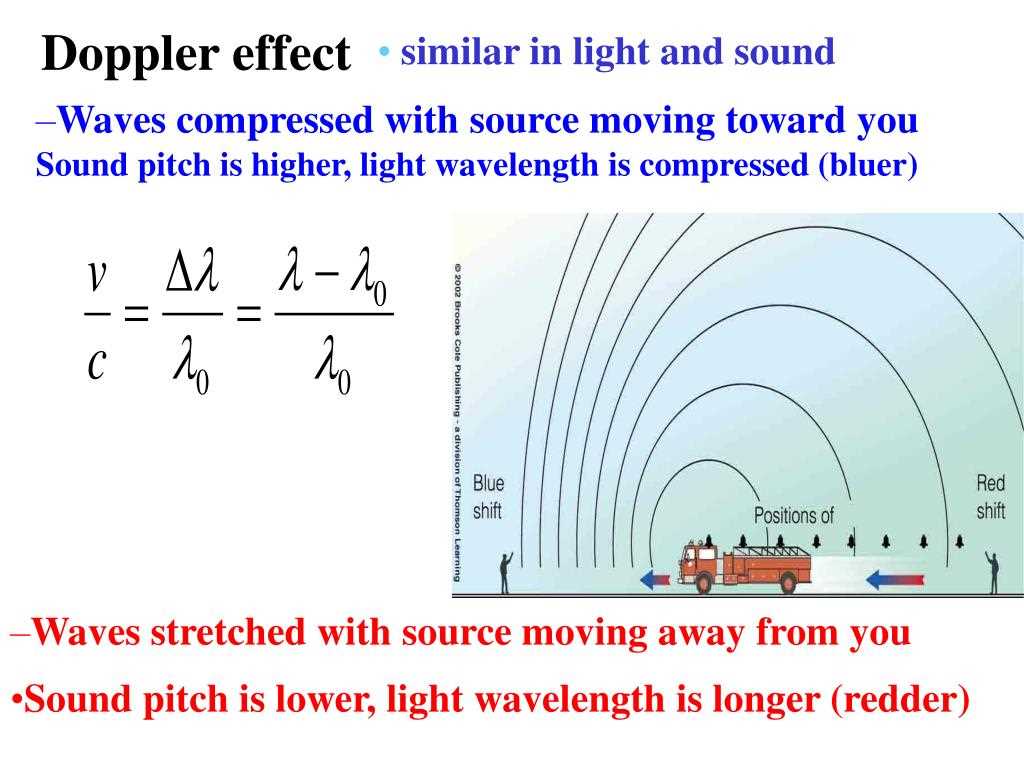
The Doppler effect is a phenomenon that describes the change in frequency and wavelength of waves as an observer or source of the waves is moving relative to each other. While the Doppler effect applies to both sound and light waves, there are some key differences between the two.
Sound waves: When it comes to sound waves, the Doppler effect is more noticeable in everyday life. It describes the change in pitch or frequency of sound waves as the source or observer is moving. For example, if an ambulance is moving towards you, you will perceive the sound of the siren as higher in pitch as the sound waves are compressed due to the relative motion between the source and observer. Conversely, if the ambulance is moving away, the sound waves are stretched, and the pitch will appear lower.
Light waves: The Doppler effect for light waves is not as easily observed in everyday situations as it is for sound waves. However, it still plays a crucial role in astronomical observations. In the case of light waves, the Doppler effect refers to the shift in wavelength, which affects the color or frequency of the light. This shift is caused by the relative motion between the source of light and the observer. An example of the Doppler effect for light is the redshift observed in the light from distant galaxies, indicating that they are moving away from us.
- Key differences:
- The Doppler effect for sound is more noticeable in everyday life, whereas the Doppler effect for light is more commonly observed in astronomical observations.
- The Doppler effect for sound refers to the change in pitch, while for light, it refers to the shift in wavelength.
- Sound waves are mechanical waves that require a medium to propagate, while light waves are electromagnetic waves that can travel through a vacuum.
- The speed of sound waves is much slower than the speed of light waves.
What are some examples of the Doppler effect in everyday life?
The Doppler effect is a phenomenon observed in everyday life where there is a change in the frequency of waves or sound due to relative motion between the source and observer. This effect can be experienced in various situations, such as when we hear a passing ambulance or when a car horn sounds different as it approaches and then moves away from us.
1. Emergency Sirens
One common example of the Doppler effect in everyday life is the sound of emergency vehicle sirens. As an ambulance, police car, or fire truck approaches us, the pitch of the siren seems to increase, becoming higher and more intense. Conversely, as the vehicle moves away from us, the pitch seems to decrease, becoming lower and softer. This change in pitch is due to the Doppler effect, as the motion of the vehicle causes a change in the frequency of the sound waves reaching our ears.
2. Train Horns
Another example can be observed when a train approaches a level crossing and blows its horn. As the train approaches, the sound of the horn appears to be higher in pitch and louder. However, as the train passes by and moves away, the pitch of the horn decreases and the sound becomes softer. This change in pitch and volume is again a result of the Doppler effect, as the motion of the train affects the frequency and intensity of the sound waves.
3. Passing Vehicles
The Doppler effect can also be noticed when a vehicle passes by us on the road. As a car or motorcycle approaches, the sound of its engine becomes louder and higher-pitched. However, as the vehicle moves past us and drives away, the sound of the engine becomes quieter and lower in pitch. This change in sound is caused by the Doppler effect, as the motion of the vehicle affects the frequency and volume of the sound waves reaching our ears.
In conclusion, the Doppler effect can be observed in various everyday situations, from the sound of emergency sirens and train horns to passing vehicles. These examples demonstrate how the relative motion between a source and observer can cause a change in the frequency and intensity of waves or sound. Understanding the Doppler effect can help us better comprehend and appreciate the role it plays in our daily lives.
Where can I find a PDF with Doppler effect questions and answers?
If you’re looking for a PDF with Doppler effect questions and answers, there are several resources available online that can help you practice and test your knowledge of this topic. These PDFs often provide a variety of questions that cover different aspects of the Doppler effect, along with detailed explanations of the correct answers.
Here are a few places where you can find PDFs with Doppler effect questions and answers:
- Physics textbook websites: Many physics textbooks offer companion websites that include additional resources for students, such as practice questions and answers. Check the website associated with your textbook to see if they have any PDFs available.
- Online educational platforms: There are various online platforms that provide educational resources, including PDFs with practice questions on specific topics. Websites like Khan Academy, Study.com, and Physics Classroom often have downloadable PDFs.
- Teacher resources: Some teachers or educational institutions may have PDFs with Doppler effect questions and answers available on their websites. If you’re currently studying the Doppler effect in a class, it’s worth checking your professor’s website or reaching out to them directly for additional resources.
- Physics forums and communities: Online forums and communities dedicated to physics can be a great place to find study materials and resources. These platforms often have sections or threads dedicated to sharing practice questions with their answers, and some of them may offer PDF downloads.
Remember, practicing with Doppler effect questions and answers can help deepen your understanding of the topic and improve your problem-solving skills. It’s always a good idea to supplement your studies with additional practice to ensure you’re fully prepared.
So, whether you’re a student looking to practice for an upcoming exam or someone who wants to enhance their knowledge of the Doppler effect, take advantage of these resources and start exploring the available PDFs with Doppler effect questions and answers.