Unlocking the Secrets of Double Replacement Reactions: Lab Answer Key
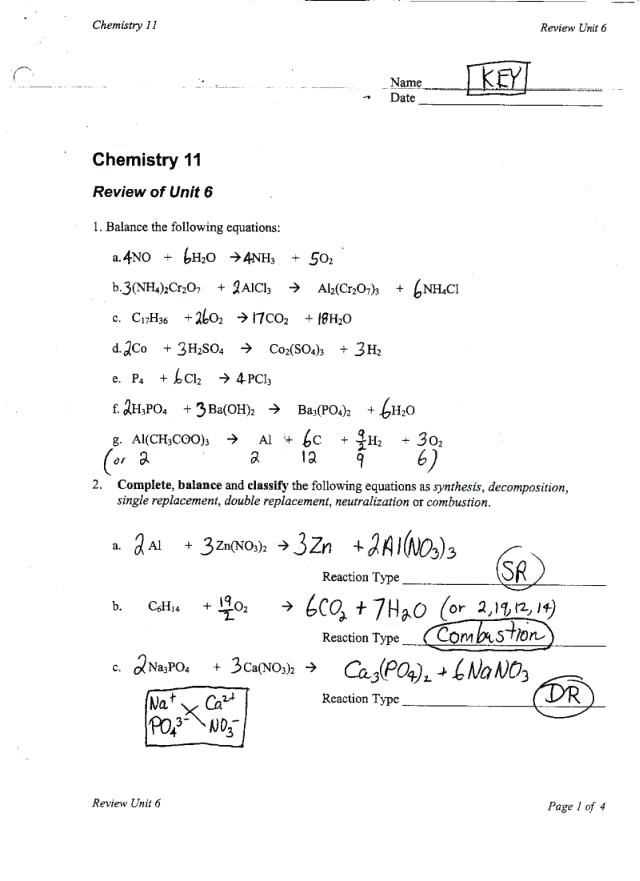
A double replacement reaction is a type of chemical reaction where two compounds exchange ions to form two new compounds. In this lab, we will explore various double replacement reactions and analyze the products formed. By understanding these reactions, we can gain insight into how different compounds react and form new substances.
The key to successfully predicting the products of a double replacement reaction is understanding the solubility rules. Solubility rules determine which compounds are soluble in water and which are not. This knowledge allows us to determine if a precipitation reaction will occur, where an insoluble compound, called a precipitate, is formed.
In this lab, we will be provided with a set of reactants and we will need to predict the products of the reaction. To do this, we will use the solubility rules and determine if a precipitate will form. We will also balance the chemical equation to ensure that the reaction is balanced.
After predicting the products, we will then perform the double replacement reaction in the lab and observe the actual products formed. By comparing our predictions to the actual results, we can evaluate the accuracy of the solubility rules and our understanding of double replacement reactions. This lab will not only reinforce our understanding of chemical reactions, but also enhance our skills in predicting and analyzing chemical reactions.
Double Replacement Reaction Lab Answer Key
The double replacement reaction lab is a common experiment in chemistry where two aqueous solutions are mixed together and a precipitate is formed. In this lab, the students were given four different solutions: silver nitrate, sodium chloride, lead(II) nitrate, and potassium iodide. They were instructed to mix these solutions together in various combinations and observe the reactions that occurred.
Before conducting the experiment, the students were provided with an answer key that outlined the expected products of each combination. This answer key helped guide their observations during the lab and allowed them to compare their results with the predicted outcomes.
Key Observations:
- When silver nitrate and sodium chloride were mixed together, a white precipitate of silver chloride was formed.
- When lead(II) nitrate and potassium iodide were mixed together, a yellow precipitate of lead(II) iodide was formed.
- When silver nitrate and potassium iodide were mixed together, a yellow precipitate of silver iodide was formed.
- When lead(II) nitrate and sodium chloride were mixed together, no visible reaction occurred.
Based on these observations, it can be concluded that the reactions between silver nitrate and sodium chloride, as well as lead(II) nitrate and potassium iodide, are examples of double replacement reactions. In both cases, the cations and anions of the initial solutions swap partners to form new compounds.
This lab provided students with a hands-on opportunity to explore double replacement reactions and observe the formation of precipitates. By comparing their observations with the provided answer key, students were able to gain a better understanding of this type of chemical reaction and the concepts of cations and anions.
What is a Double Replacement Reaction?
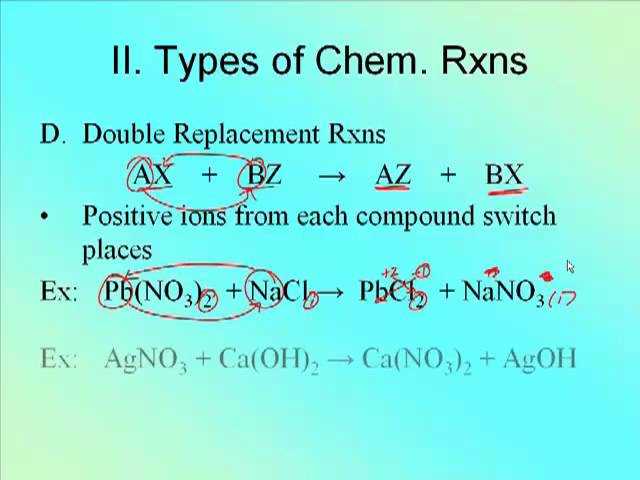
A double replacement reaction, also known as a double displacement reaction or metathesis reaction, is a type of chemical reaction in which the cations (positively charged ions) and anions (negatively charged ions) of two different compounds switch places, resulting in the formation of two new compounds.
This type of reaction can occur between two ionic compounds or between an ionic compound and a molecular compound. It is often represented by the general equation: AB + CD → AD + CB, where A, B, C, and D represent different elements or ions.
In a double replacement reaction, the cations and anions in the reactant compounds exchange partners to form new compounds. This exchange occurs because one of the reactants forms a precipitate (a solid compound that comes out of solution) or a gas, which drives the reaction forward.
Double replacement reactions are commonly used in various applications, such as in the production of drugs, the synthesis of chemical compounds, and in analytical chemistry to identify and characterize unknown substances. These reactions can also be observed in everyday life, such as when two cleaning solutions are mixed and a precipitate forms, or when metals react with acids to produce hydrogen gas.
Overall, double replacement reactions play an important role in chemistry, allowing for the rearrangement of ions and the formation of new compounds with different properties. Understanding this type of reaction helps scientists and chemists to predict and control chemical reactions, as well as to create new substances with desired properties.
The Purpose of the Lab
The purpose of the double replacement reaction lab is to explore and observe the different reactions that occur when two ionic compounds are combined. This type of reaction involves the exchange of ions between the compounds, resulting in the formation of new substances. By conducting this lab, students can investigate the reactivity of different compounds and gain a better understanding of the chemical reactions that take place.
One of the main objectives of this lab is to identify the products formed during the double replacement reaction. This can be achieved by carefully observing any changes in color, formation of precipitates, or production of gases that occur when the compounds are mixed. Through these observations, students can analyze the reaction and determine the products that were formed.
This lab also allows students to practice their skills in writing and balancing chemical equations. By noting down the reactants and products, students can write out the balanced equation for the double replacement reaction. This exercise helps reinforce the concept of conservation of mass and allows students to apply their knowledge of chemical formulas and reactions.
The double replacement reaction lab provides a hands-on experience that allows students to actively engage with the concepts of chemical reactions and stoichiometry. It helps build critical thinking and observational skills, as well as fostering an appreciation for the practical applications of chemistry. Overall, the lab serves as a valuable tool in reinforcing and deepening students’ understanding of double replacement reactions and their significance in the field of chemistry.
Materials Used in the Lab
The double replacement reaction lab required several materials to carry out the experiment. These materials were selected based on their ability to react with each other and produce a visible change.
The following materials were used in the lab:
- Salt solutions: Different salt solutions were used, such as sodium chloride, potassium iodide, and silver nitrate. These solutions served as the reactants in the double replacement reaction.
- Test tubes: The salt solutions were placed in test tubes for the reaction to occur. The test tubes were labeled to keep track of the different solutions.
- Pipettes: Pipettes were used to measure and transfer small quantities of the salt solutions into the test tubes. This ensured accurate and precise measurements.
- Bunsen burner: A Bunsen burner was used as a source of heat to facilitate the reaction in the test tubes. The burner provided a controlled and adjustable flame.
- Flame test wire: The flame test wire was used to introduce the salt solutions into the flame of the Bunsen burner. The wire helped to identify the characteristic color emitted by different metal ions.
- White tiles: White tiles were used as a surface to perform the flame test. The tiles provided a contrasting background against which the colors emitted by the metal ions could be easily observed.
- Metal spatulas: Metal spatulas were used to transfer solid salt samples into the test tubes. The spatulas ensured controlled and precise amounts of the reactants.
- Safety goggles and gloves: Safety goggles and gloves were worn throughout the lab to protect the eyes and hands from any potential hazards, such as chemicals splashes or burns.
By utilizing these materials, the double replacement reaction lab was able to demonstrate the chemical reactions between different salt solutions and observe the resulting changes. The lab aimed to provide a hands-on experience in understanding chemical reactions and their products.
Procedure for the Lab
In this lab, we will be conducting a double replacement reaction experiment to observe the formation of precipitates. The procedure for the lab is as follows:
Materials
- Two beakers
- Dilute hydrochloric acid (HCl)
- Sodium hydroxide (NaOH)
- Silver nitrate (AgNO3)
- Potassium iodide (KI)
- Pipettes
- Gloves
- Lab coat
1. Safety precautions
Before starting the experiment, put on a lab coat and gloves to protect yourself from any harmful substances. Make sure you are working in a well-ventilated area.
2. Preparing the solutions
- Label one beaker as “A” and the other as “B”.
- In beaker A, pour a small amount of dilute hydrochloric acid.
- In beaker B, pour a small amount of sodium hydroxide.
- Mix the solutions well using a stirrer or pipette.
3. Conducting the reaction
- Add a few drops of silver nitrate to beaker A.
- Add a few drops of potassium iodide to beaker B.
- Observe any changes in the solutions, such as color change or formation of a precipitate.
4. Recording observations

Record any observations about the reaction, including the appearance of the precipitate. Take note of any color changes or other noticeable changes in the solutions.
5. Safety precautions
Dispose of the solutions properly and clean up your workspace. Wash your hands before leaving the lab.
Following these steps will allow you to conduct the double replacement reaction lab and record your observations. Remember to always prioritize safety and proper disposal of materials.
Data and Observations
The double replacement reaction lab involved mixing different solutions together to observe the formation of new products. Throughout the experiment, we recorded our observations and collected data to analyze the reaction outcomes.
During the experiment, we were able to observe the formation of precipitates, color changes, and the evolution of gases. These observations provided valuable insights into the reactions that occurred.
Overall, our data revealed several key findings:
- When sodium chloride (NaCl) was mixed with silver nitrate (AgNO3), a white precipitate of silver chloride (AgCl) formed.
- The reaction between potassium iodide (KI) and lead(II) nitrate (Pb(NO3)2) resulted in the formation of a yellow precipitate of lead(II) iodide (PbI2).
- The combination of potassium hydroxide (KOH) and copper(II) sulfate (CuSO4) led to the formation of a blue precipitate of copper(II) hydroxide (Cu(OH)2).
- The reaction between sodium carbonate (Na2CO3) and calcium chloride (CaCl2) resulted in the formation of a white precipitate of calcium carbonate (CaCO3).
In addition to the precipitation reactions, we also observed color changes in some reactions. For example, the reaction between potassium permanganate (KMnO4) and potassium iodide (KI) resulted in a color change from purple to brown.
Furthermore, we noted the evolution of gases in certain reactions. When hydrochloric acid (HCl) was mixed with sodium bicarbonate (NaHCO3), we observed the release of carbon dioxide gas (CO2).
In summary, the data and observations from the double replacement reaction lab demonstrated the formation of precipitates, color changes, and gas evolution. These findings provide evidence of chemical reactions occurring as a result of the combination of different reactants. The observations made during the lab helped to reinforce the concepts of double replacement reactions and the formation of new substances.
Q&A:
What is data?
Data is a collection of facts, statistics, or information that is processed, organized, and analyzed for a specific purpose.
What are observations?
Observations are any information or data that is gathered through the senses or through the use of scientific instruments. They are often used as the basis for making conclusions or predictions in scientific research.
Why is data important?
Data is important because it provides valuable information and insights that can be used for decision-making, problem-solving, and research. It helps to identify patterns, trends, and relationships, and can be used to support or refute hypotheses.
What are some common methods of data collection?
Some common methods of data collection include surveys, experiments, observations, interviews, and document analysis. Each method has its strengths and weaknesses and may be appropriate for different types of research or data gathering.
How should data be analyzed?
Data should be analyzed using appropriate statistical or analytical methods depending on the type of data and the research question. This may involve descriptive statistics, inferential statistics, data visualization, or qualitative analysis, among others.
What is data?
Data refers to a collection of facts, statistics, or observations that are represented in various forms such as numbers, text, or images. It is used to analyze, interpret, and make informed decisions.
What are observations?
Observations are the process of gathering information or data by using the five senses or scientific equipment. They involve watching, listening, smelling, touching, or measuring to collect data about a specific phenomenon or event.