Mastering Number Sequencing: Ordering Digits from Smallest to Largest
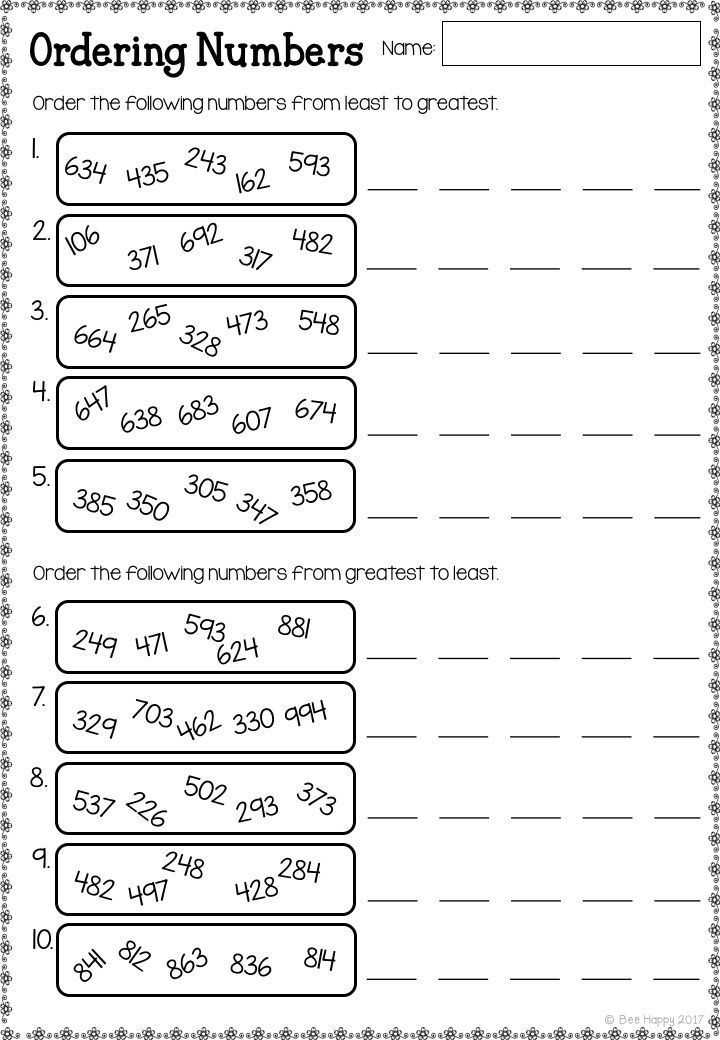
Ordering numbers from least to greatest is an essential skill in mathematics. It allows us to compare and analyze numerical data more efficiently. By arranging numbers in ascending order, we can easily identify the smallest and largest values in a set, as well as the numbers in between.
When it comes to ordering numbers, it’s important to understand the concept of magnitude. The magnitude of a number refers to its value or size compared to other numbers. By arranging numbers from least to greatest, we can observe the gradual increase in magnitude and better understand the numerical relationships within a set of numbers.
One way to order numbers is by using a number line. A number line is a horizontal line that represents the set of real numbers. By plotting numbers on a number line and arranging them in order, we can visualize their relative positions and easily determine which number is the smallest and which is the largest.
Understanding the Concept of Ordering Numbers
Ordering numbers is an essential skill in mathematics that helps us compare and organize numerical values. When we order numbers, we arrange them in a specific sequence based on their magnitude or value. This skill is vital in various real-life situations, such as organizing data, ranking items, or solving mathematical problems.
To order numbers correctly, we need to understand the concept of magnitude. Magnitude refers to the size or quantity of a number. When comparing two numbers, the one with a greater magnitude is considered larger, while the one with a smaller magnitude is considered smaller. By understanding this concept, we can determine the order of numbers, whether they are integers, decimals, or fractions.
Integers: When ordering integers, we arrange them in ascending or descending order based on their value. For example, the integers -5, 0, 3, and 8 can be ordered from least to greatest as follows: -5, 0, 3, 8. We can also represent this order on a number line, where the lowest number (-5) is on the left, and the highest number (8) is on the right.
Decimals: Ordering decimals follows a similar approach. We compare the digits to determine their relationship. For example, the decimals 0.2, 1.5, 0.6, and 0.8 can be ordered from least to greatest as follows: 0.2, 0.6, 0.8, 1.5. It is essential to consider all the digits, including the numbers after the decimal point, when comparing and ordering decimals.
Fractions: Ordering fractions requires comparing the numerators and denominators. We can convert the fractions into a common denominator to simplify the comparison. For example, when ordering the fractions 1/4, 3/8, and 1/2, we can convert them to have a common denominator of 8. The order from least to greatest would then be 1/4, 3/8, 1/2.
In conclusion, ordering numbers is a fundamental skill in mathematics that enables us to compare and organize numerical values. By understanding the concept of magnitude, we can order numbers correctly in various forms, including integers, decimals, and fractions. Practicing this skill helps develop mathematical reasoning and problem-solving abilities, which are beneficial in both academic and real-life situations.
Exploring the Importance of Number Order
Understanding and being able to arrange numbers in order is a fundamental skill in mathematics. It allows us to make comparisons between different numbers and determine their relative values. Whether it is ordering numbers from least to greatest or vice versa, this skill is essential for solving various math problems and practical applications.
When we order numbers, we are essentially organizing them in a sequence based on their magnitudes. This sequence provides us with valuable information about the numbers’ relationships and allows us to analyze patterns and trends. For example, when ordering a set of numbers in ascending order, we can easily identify the smallest number in the set and determine how it compares to the rest.
Ordering numbers from least to greatest is particularly important when dealing with data and measurements. By arranging numerical data in ascending order, we can easily identify the smallest value and the largest value, enabling us to calculate measures such as the range, mean, and median. It also helps us visually present the data in a clear and organized manner, making it easier to interpret and draw conclusions.
Ordering numbers is not limited to integers or whole numbers; it extends to fractions, decimals, and even negative numbers. When working with fractions or decimals, ordering them correctly allows us to simplify or compare them easily. Negative numbers, on the other hand, require careful consideration when arranging them since their order is based on their proximity to zero.
In conclusion, the ability to order numbers is a foundational mathematical skill that facilitates understanding, analysis, and problem-solving. By mastering this skill, students not only enhance their mathematical capabilities but also develop critical thinking and logical reasoning skills that are applicable in various real-life situations.
Tips and Tricks for Ordering Numbers
Ordering numbers from least to greatest is an important skill in mathematics. Whether you are working on a homework assignment or solving a real-world problem, understanding how to properly order numbers can make your task much easier. Here are some tips and tricks to help you order numbers efficiently and accurately.
1. Compare the Whole Numbers
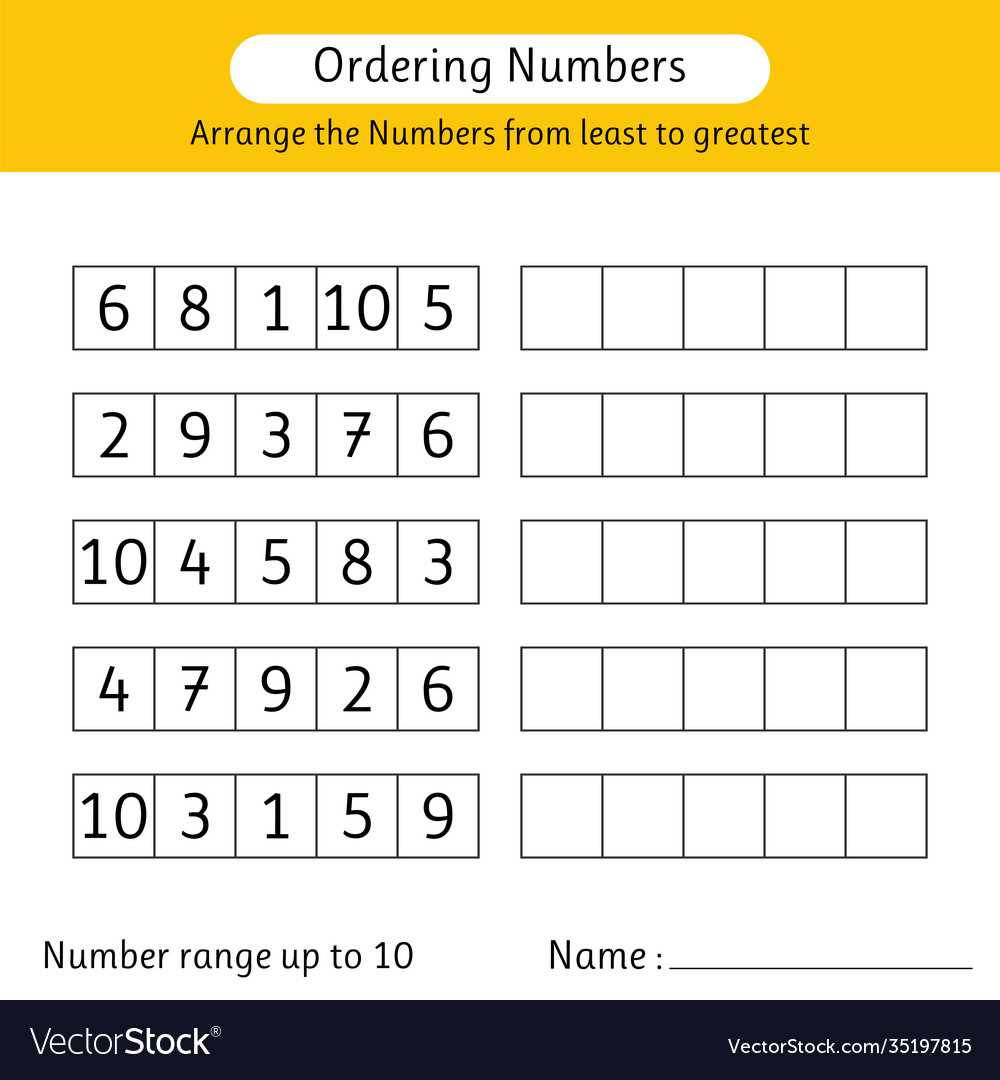
When ordering whole numbers, start by comparing the value of the digit in the highest place value position. For example, when ordering the numbers 532, 137, and 998, compare the hundreds place first. The number 998 has the highest hundreds place value, so it should be placed first. Next, compare the tens place, and then the ones place. This process ensures that the numbers are ordered correctly.
2. Consider the Sign of the Numbers
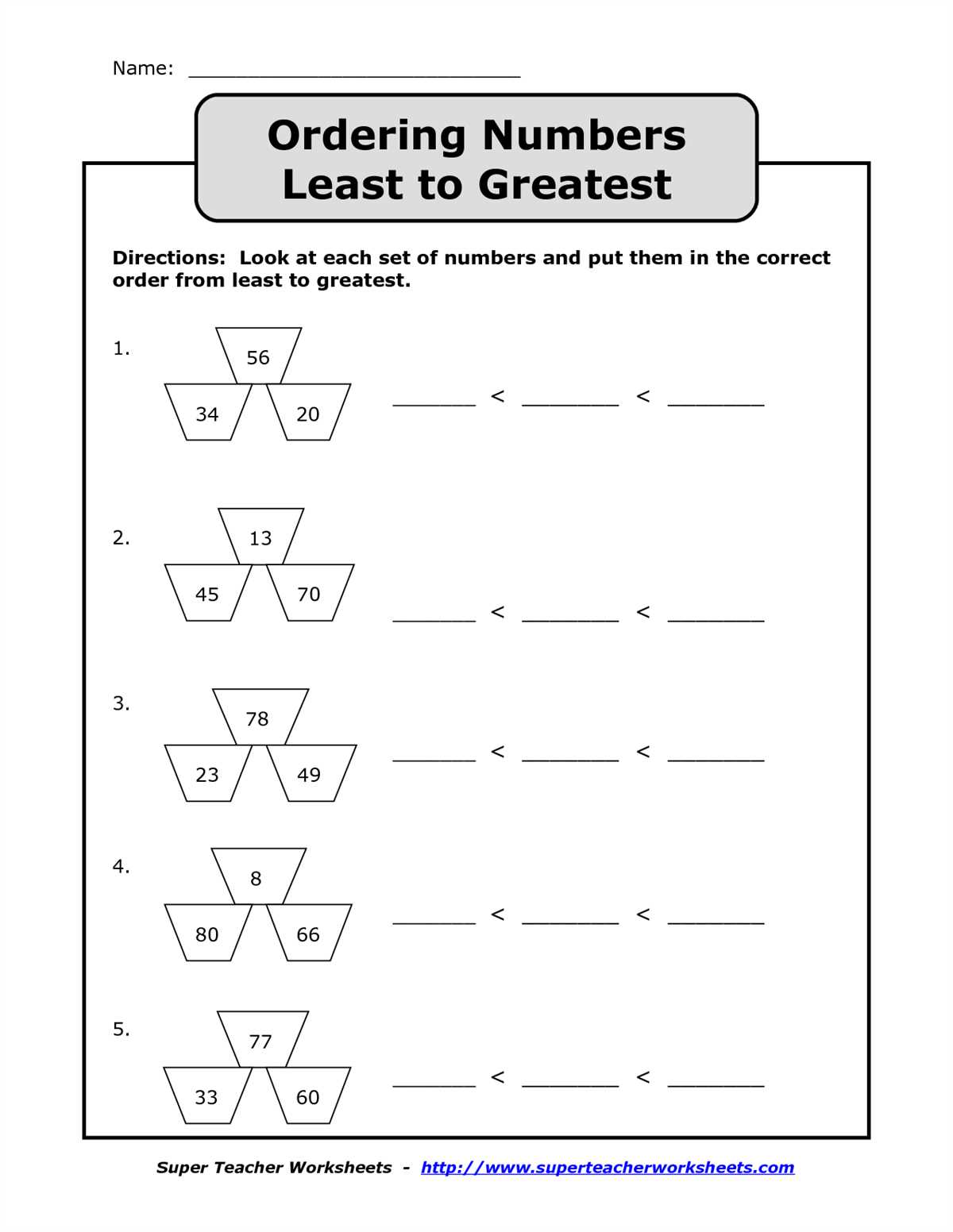
When ordering numbers that include both positive and negative values, remember that negative values are smaller than positive values. For example, if you are ordering the numbers -5, 3, and -2, start by placing the numbers in order based on their sign. The two negative numbers should come first, followed by the positive number. Then, compare the absolute values to determine the final order.
3. Use Number Lines
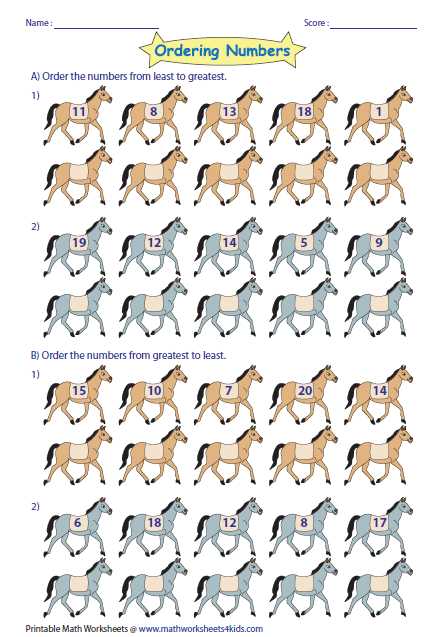
A number line can be a helpful tool when ordering numbers. Draw a horizontal line and mark the starting point, as well as any given numbers. Then, place the remaining numbers on the line according to their value. This visual representation can make it easier to compare and order the numbers accurately.
4. Break Down Decimal Numbers
When ordering decimal numbers, it can be useful to break them down into whole number parts and fractional parts. For example, when ordering the numbers 2.5, 8.75, and 1.9, compare the whole number parts first. Then, compare the decimal parts. This approach can simplify the ordering process.
By following these tips and tricks, you can improve your ability to order numbers accurately and efficiently. Remember to take your time, double-check your work, and use these strategies whenever you encounter a task that involves ordering numbers.
Practicing Number Ordering with Examples
Ordering numbers from least to greatest is an important skill in math. By arranging numbers in the correct order, we can compare and analyze data more easily. Let’s practice number ordering with a few examples.
Example 1:
- Number 1: 15
- Number 2: 8
- Number 3: 21
To order these numbers from least to greatest, we start by looking for the smallest number. In this case, it is 8. The next smallest number is 15, and finally, the largest number is 21. So, the correct order is 8, 15, 21.
Example 2:
- Number 1: -2
- Number 2: 0
- Number 3: 5
- Number 4: -7
When dealing with negative numbers, we follow the same process. The smallest number in this example is -7, followed by -2, then 0, and finally 5. So, the correct order is -7, -2, 0, 5.
Example 3:
- Number 1: 1/2
- Number 2: 1
- Number 3: 0.7
Ordering numbers that include fractions and decimals requires a slightly different approach. We can convert the fractions into decimals and then compare. In this case, we have 0.5, 1, and 0.7. Ordering them from least to greatest gives us 0.5, 0.7, 1.
Practicing number ordering helps us develop critical thinking skills and improves our mathematical abilities. Remember to start with the smallest number and work your way up to the largest. With practice, you’ll become more confident in ordering numbers correctly.
Challenging Number Ordering Exercises
Number ordering exercises are a great way to sharpen your mathematical skills and improve your ability to compare and arrange numbers. In this article, we have explored a variety of challenging number ordering exercises to test your skills and provide a fun and engaging learning experience.
Throughout the exercises, we encountered different types of numbers, including whole numbers, decimals, and fractions. By working through these exercises, you have had the opportunity to practice arranging numbers in ascending or descending order and develop your ability to compare and order numbers accurately.
Summary of Number Ordering Exercises:
- Comparing Whole Numbers: In this exercise, you practiced ordering whole numbers from least to greatest or vice versa.
- Ordering Decimals: This exercise involved arranging decimal numbers, allowing you to apply your knowledge of place value and decimals.
- Arranging Fractions: Here, you encountered fractions and practiced ordering them based on their numerator, denominator, or equivalency.
- Mixed Numbers and Improper Fractions: In this exercise, you worked with mixed numbers and improper fractions, honing your ability to compare and arrange them accurately.
By engaging in these challenging number ordering exercises, you have taken important steps towards improving your mathematical abilities. Continue practicing, and you will become more confident in comparing and arranging numbers effectively.
Remember, the key to mastering number ordering is to carefully analyze the numbers, consider their value or magnitude, and follow the rules of comparing numbers. With practice, you will develop a sharp sense of number ordering and an improved mathematical intuition.