Funniest answers to exam questions
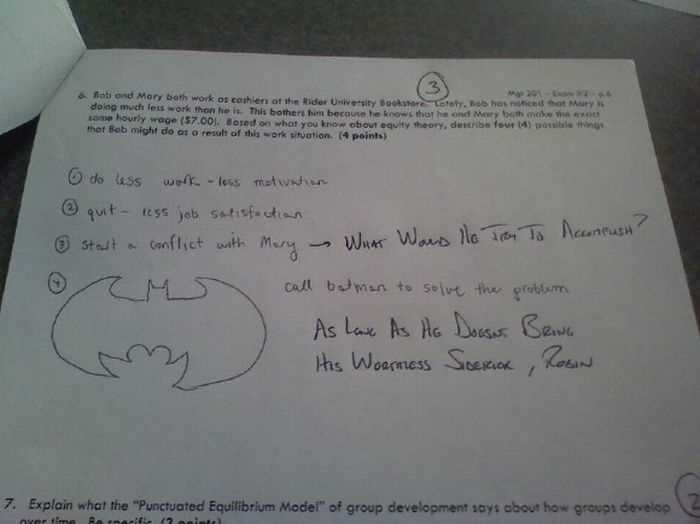
Consider approaching assignments with boldness and humor, as evidenced by students who cleverly sidestep expectations with their unique replies. Whether a mistake or intentional, these creative approaches have a way of surprising both teachers and classmates alike.
Example 1: In a history test, a student answered, “The Battle of Hastings took place in 1066. That’s about all I remember, but it sounds good, right?” The response captured the essence of attempting to stay confident, even when facts aren’t fully grasped.
Example 2: During a math assessment, one student confidently wrote, “Pi equals 3.14. But if you’re looking for something more precise, ask a pie maker.” This playful take lightened the mood, blending accuracy with a touch of humor.
Such responses are a reminder that sometimes humor can provide a unique perspective, even when tackling serious subjects. While not the expected form of completion, these moments of light-heartedness can offer both entertainment and reflection for everyone involved.
Funniest Answers to Exam Questions
“What is the capital of France?” “F.” This response didn’t quite hit the mark, but it sure grabbed attention with its brevity.
“Explain the process of photosynthesis.” “Plants eat sunlight, just like humans eat food.” A concise, yet quite unscientific answer.
“What do you think is the most important event in history?” “When I was born.” Well, someone’s proud of their arrival!
“What is the main cause of the American Revolution?” “Americans were tired of tea.” A simple but somewhat incomplete perspective on a complex historical event.
“Describe the function of the heart in the human body.” “It’s the body’s engine.” Not entirely wrong, but lacks some depth.
“Why did the Roman Empire fall?” “They were just too old.” A short and straight-to-the-point take on a massive historical event.
“What is the speed of light?” “About 60 miles per hour, depending on traffic.” Well, that’s certainly an original take on physics!
“What is the chemical formula for water?” “H2O, but I think it’s more like H2-WHOA!” A bit of humor to lighten up chemistry.
“Who wrote the play Hamlet?” “Shakespeare… but it’s a really old play, so maybe he had a ghostwriter.”
Unexpected Logic: When Creativity Beats Knowledge
Consider the student who, asked to identify the main cause of World War I, confidently responds, “The assassination of Archduke Ferdinand by a time traveler.” This may seem outlandish, but it showcases how a creative mind can find solutions that defy conventional expectations.
- In a biology test, a pupil was asked to name the process by which plants make food. The answer? “Photosynthesis, but also a bit of magic.”
- On a geography paper, the question was about the capital of Australia. The response? “Sydney, or maybe just the entire country is the capital. Who’s to say?”
- A student once filled in an equation with, “The answer is 42, because it’s the meaning of life.” While it doesn’t align with the correct method, the humor is undeniable.
Sometimes, such inventive responses surprise with their ingenuity, highlighting how the mind can make unexpected connections. These approaches may not lead to correct solutions, but they reveal the student’s ability to think outside the box.
While knowledge is a key component of academic success, creativity often brings out the most memorable moments, even if they aren’t the most accurate. Creativity can offer alternative perspectives, but whether they should be taken seriously is another matter altogether.
Literal Interpretations That Went Hilariously Wrong
One student was asked to explain the concept of “growth” in a biology exam. The response was: “Growth is when you get bigger.” While technically true, the simplicity of the answer left the teacher scratching their head.
Another instance occurred when a math question requested students to “round the number to the nearest ten.” One student, quite literally, rounded the number by drawing a circle around it. Needless to say, the teacher wasn’t impressed by this visual solution.
In a history exam, students were asked to explain the role of the “French Revolution” in shaping modern Europe. One response read: “The French Revolution was a time when the French were very angry and had to be stopped.” The historical context was a bit off, but the sentiment was clear.
A geography test included a question about the “tropical zone.” One student, taking the term “zone” too literally, wrote about the “tropical zone being a place where people go on vacation.” Geography might not be their strong suit, but vacationing certainly was.
One physics question asked for an explanation of “Newton’s first law.” The response, “An object at rest stays at rest unless a really strong force pushes it,” was a classic case of taking the term “strong force” a bit too casually, missing the scientific context.
When Students Outsmart the Question Itself
Some students take creativity to the next level, directly confronting the question with unexpected solutions. Instead of simply answering, they tackle the issue from an angle that is both clever and humorous.
One approach is to break the task into a seemingly absurd yet technically sound interpretation. For instance, a student may be asked to “explain the cause of the American Revolution.” Rather than providing a standard historical analysis, the student writes, “The American Revolution was triggered by the frustration of not having free refills on coffee.” Though this response doesn’t adhere to the expected format, it conveys an original approach to problem-solving, challenging the assumption that answers must follow rigid paths.
Another example comes when students take a factual question and inject their personal experience into it, providing answers that blend humor with a hint of truth. When asked, “Describe the process of photosynthesis,” one student answered, “Plants make food by converting sunlight into energy, kind of like how I turn pizza into energy during exam week.” This quirky response not only lightens the mood but showcases the student’s knowledge of the topic in an unexpected way.
Students often turn to unconventional methods when they feel boxed in by the formal expectations of assessments. By doing so, they cleverly sidestep the system, offering responses that are humorous, unexpected, and yet surprisingly insightful.
| Traditional Approach | Unexpected Approach |
|---|---|
| Explain the causes of World War I. | World War I happened because people forgot how to share like adults. |
| Describe the water cycle. | Water evaporates, then floats in the sky, and eventually decides to come back down when it’s tired of being up there. |
| Who invented the telephone? | Alexander Graham Bell was probably just tired of yelling across the room. |
In this way, students can sometimes outwit the question by turning it into an opportunity for humor while still demonstrating their understanding in a unique form. They take ownership of the task by interpreting it in unexpected ways, showing a deep level of engagement with the material, even if it doesn’t align with conventional answers.
Witty Responses That Teachers Couldn’t Ignore
Here are some sharp replies students gave that stuck with their teachers:
- Question: “Name the four seasons.”
Response: “Salt, pepper, mustard, and vinegar.” - Question: “What is the boiling point of water?”
Response: “100 degrees Celsius, unless you add pasta, then it’s 10 minutes longer.” - Question: “Who was the first president of the United States?”
Response: “George Washington, but my history teacher is still stuck on Benjamin Franklin.” - Question: “What is the capital of France?”
Response: “F. Paris.” - Question: “What causes the seasons to change?”
Response: “The Earth spinning and deciding to switch it up for variety.”
Sometimes, a little wit is hard to resist, and teachers can’t help but laugh at the unexpected creativity.
Drawing Instead of Answering: A Risky but Funny Strategy
When faced with a tricky or unanswerable prompt, some may resort to illustrating their response rather than attempting a conventional reply. This approach may seem audacious, but it can also lighten the mood and offer a humorous break from the tension. For instance, instead of detailing a historical event, one student drew a series of stick figures engaging in an epic battle. While this may not have been the expected reply, it showcased creativity and humor.
It’s a high-risk tactic, as it can lead to confusion or frustration for the examiner. However, in rare cases, it may spark a chuckle or even admiration for the boldness. A student faced with a complex math problem might sketch a superhero fighting a giant calculator, humorously implying that numbers are their worst enemy. It won’t earn full marks, but it certainly adds some levity to an otherwise tense situation.
This strategy requires confidence in your artistic skills and the ability to make your drawings somewhat relevant to the topic. A cartoon of a medieval knight could be a clever nod to a question about the Middle Ages, while a drawn-out scene from a famous play might stand in for a detailed analysis of its themes.
Real-Life Exam Answers That Became Internet Legends
One student, asked to describe a specific chemical process, replied, “When you mix baking soda and vinegar, it makes a volcano.” This concise, if unorthodox, response quickly went viral as a prime example of creative thinking under pressure.
Another individual, confronted with a math problem about calculating the area of a triangle, wrote, “The answer is 0 because triangles don’t have feelings.” The boldness of this declaration, while far from mathematically correct, captured the imagination of online communities.
A history question about the significance of the Great Wall of China was met with, “It keeps the pandas from escaping.” This cheeky yet memorable reply became a fan favorite, circulating widely across social platforms.
One student, asked to name the primary source of energy for plants, confidently wrote, “Netflix.” This surprising response gained notoriety for its humor and relatability, showing how everyday life influences exam performances.
For more examples of creative responses, visit sources like Bored Panda.