Mastering Geometry Unit 1: Put Your Skills to the Test with this Practice Exam

Welcome to the Geometry Unit 1 Practice Test! This test is designed to help you review and reinforce the key concepts and skills covered in Unit 1 of your geometry course. Whether you’re a student preparing for a test or a teacher looking for a resource to assess your students’ understanding, this practice test is a valuable tool.
In Unit 1, you will have learned about the basic building blocks of geometry, including points, lines, and planes. You will have also explored the different types of angles, such as acute, obtuse, and right angles. Additionally, you will have studied the properties and relationships of triangles, including the different types of triangles and their angles.
In this practice test, you will be presented with a variety of multiple-choice and free-response questions that cover these topics. You will have the opportunity to apply your knowledge and skills to solve problems and demonstrate your understanding. Whether you’re working through the test on your own or with a study group, make sure to review your answers and explanations to reinforce your learning.
Geometry Unit 1 Practice Test
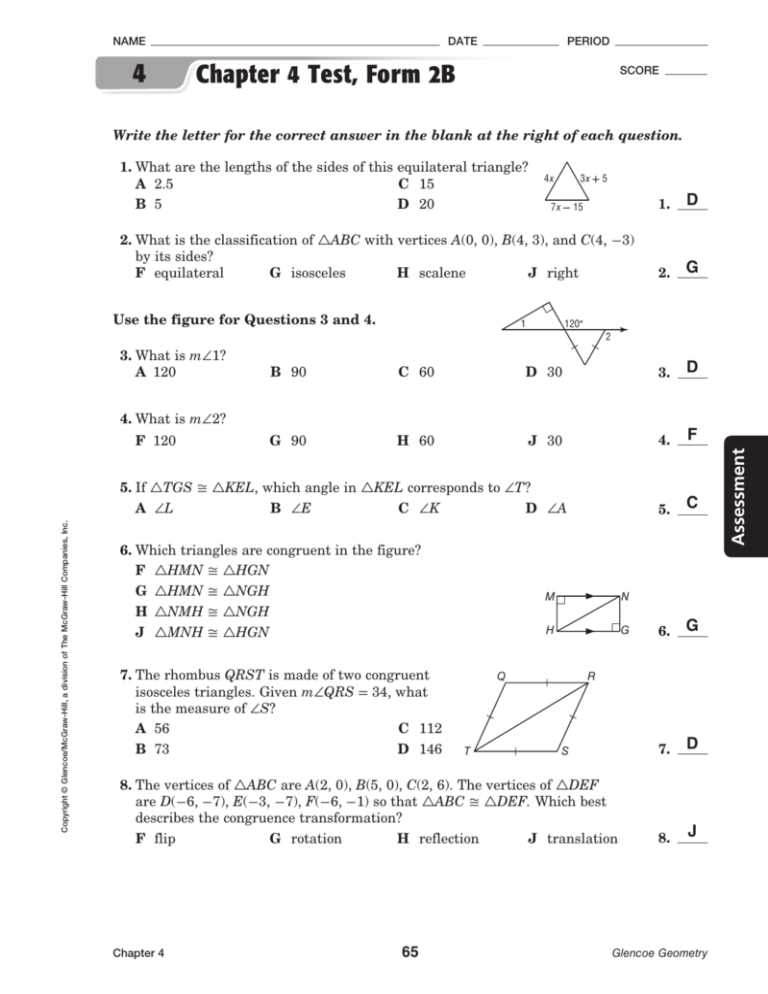
Geometry Unit 1 is an important part of the curriculum for students studying geometry. To assess their understanding of the topics covered in this unit, teachers often administer a practice test. This test serves as a helpful tool for students to review their knowledge and identify areas where they may need additional study and practice.
The Geometry Unit 1 Practice Test typically consists of a variety of questions that cover key concepts such as points, lines, angles, and geometric shapes. Students are expected to demonstrate their ability to identify and classify different types of angles and polygons, solve geometric problems using formulas and theorems, and apply their understanding of geometric properties to real-world scenarios.
The practice test may include multiple-choice questions, short answer questions, and problems that require students to show their work and provide explanations. Students are encouraged to carefully read each question, analyze the given information, and apply their knowledge and problem-solving skills to find the correct answers. It is important for students to show their work neatly and clearly, as this helps teachers understand their thought processes and can provide valuable feedback.
After completing the Geometry Unit 1 Practice Test, students should review their answers and seek clarification on any concepts or problems they struggled with. They can also discuss their answers with their classmates or seek support from their teacher. By reflecting on their performance and seeking additional help if needed, students can improve their understanding of geometry and prepare themselves for future assessments.
Key topics covered in Geometry Unit 1:
- Points, lines, and planes
- Angles and their properties
- Types of triangles
- Quadrilaterals and their properties
- Circles and their properties
- Perimeter and area of polygons
By mastering the concepts covered in Geometry Unit 1 and performing well on the practice test, students can build a solid foundation for their further studies in geometry and other related fields.
Lines and Angles

Lines and angles are fundamental concepts in geometry. They form the building blocks for understanding the relationship between shapes and their properties. A line is a straight path that extends infinitely in both directions. It is defined by two unique points, and any two points on a line can be connected with a straight segment. Lines can intersect, meaning they cross at a point, or be parallel, meaning they never intersect.
An angle is formed by two rays that share a common endpoint, called the vertex. The rays are called the sides of the angle. Angles are measured in degrees, with a full circle measuring 360 degrees. Angles can be classified based on their measure. An acute angle is less than 90 degrees, a right angle is exactly 90 degrees, an obtuse angle is greater than 90 degrees but less than 180 degrees, and a straight angle is exactly 180 degrees.
There are several important relationships between lines and angles. For example, vertical angles are formed when two lines intersect and are opposite to each other. Vertical angles are congruent, meaning they have the same measure. Another important relationship is the sum of angles around a point. When several rays originate from a single point, the sum of the angles they form is always 360 degrees.
Understanding lines and angles is crucial in geometry as they provide the foundation for studying more complex geometric concepts such as polygons, triangles, and circles. By understanding the properties and relationships of lines and angles, mathematicians can analyze the properties of shapes and solve problems involving geometric figures.
Triangles
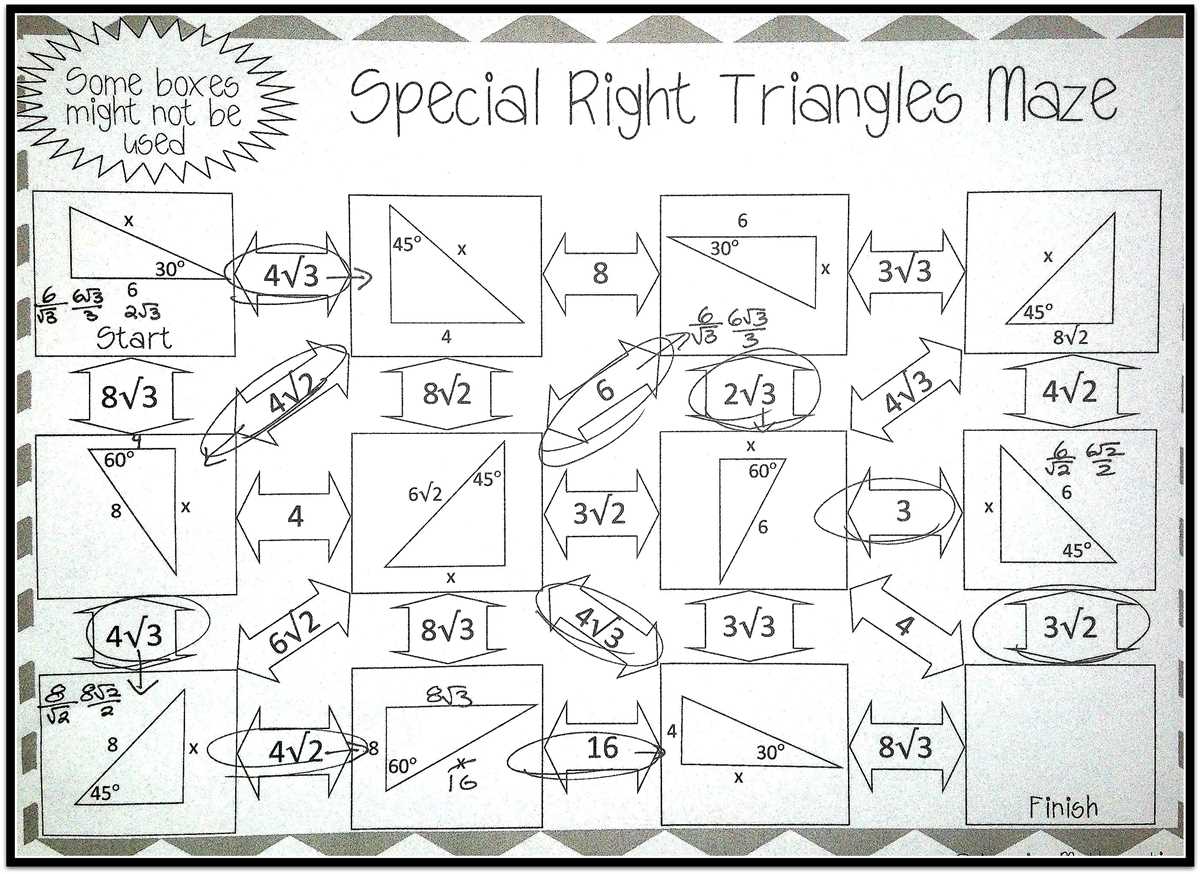
Triangles are one of the fundamental shapes in geometry. They are polygons with three sides and three angles. Triangles play a crucial role in various branches of mathematics and have practical applications in fields such as engineering and architecture.
There are different types of triangles based on their side lengths and angle measurements. One classification is based on side lengths, which includes equilateral triangles, isosceles triangles, and scalene triangles. Equilateral triangles have all three sides of equal length, isosceles triangles have two sides of equal length, and scalene triangles have no sides of equal length.
- Equilateral triangles are characterized by having all three sides of equal length. This means that all three angles of an equilateral triangle are also equal, each measuring 60 degrees.
- Isosceles triangles have two sides of equal length. As a result, the angles opposite the equal sides are congruent, meaning they have the same measure.
- Scalene triangles have no sides of equal length. This means that all three angles of a scalene triangle are different in measure.
Another way to classify triangles is based on their angle measurements. This includes acute triangles, right triangles, and obtuse triangles. Acute triangles have three angles that are all less than 90 degrees. Right triangles have one angle that measures 90 degrees, forming a right angle. Obtuse triangles have one angle that is greater than 90 degrees.
Understanding the properties, classifications, and relationships among triangles is essential in solving geometric problems and proving theorems. Triangles provide a foundation for further exploration of geometric concepts and are integral to the study of geometry.
Quadrilaterals

Quadrilaterals are polygons with four sides. They come in various shapes and sizes, each with its own unique properties and characteristics. Understanding these properties is crucial in geometry, as it helps us classify and analyze different types of quadrilaterals.
One of the most well-known and basic types of quadrilaterals is the rectangle. A rectangle is a quadrilateral with four right angles. This means that all its interior angles measure 90 degrees. Additionally, opposite sides of a rectangle are congruent. This property allows us to easily calculate its area and perimeter.
Types of Quadrilaterals
- Square: A square is a special type of rectangle where all four sides are congruent in length. This means that all the angles of a square are also right angles.
- Parallelogram: A parallelogram is a quadrilateral with opposite sides that are parallel and congruent in length.
- Rhombus: A rhombus is a parallelogram with all four sides congruent in length.
- Trapezoid: A trapezoid is a quadrilateral with at least one pair of parallel sides.
- Kite: A kite is a quadrilateral with two pairs of adjacent sides that are congruent.
These are just a few examples of the many types of quadrilaterals that exist. By understanding their properties and relationships, we can solve problems involving quadrilaterals and gain a deeper understanding of geometry.
Circles
Circles are an important concept in geometry. A circle is a closed curve in which all points are equidistant from a fixed center point. The distance from the center of the circle to any point on the edge is called the radius. The diameter of a circle is a straight line passing through the center and touching two points on the edge. The circumference is the distance around the circle, and it is equal to the diameter times pi (π).
Circles have many properties and formulas associated with them. One important property is that the angles formed by the radii of a circle are always equal. Another property is that the area of a circle is given by the formula A = πr^2, where A is the area and r is the radius. Circles are also used in many real-life applications, such as calculating the area of a circular field or finding the circumference of a tire.
Key concepts about circles include:
- The radius is the distance from the center of the circle to any point on the edge.
- The diameter is a straight line passing through the center and touching two points on the edge.
- The circumference is the distance around the circle and is equal to the diameter times pi (π).
- The area of a circle is given by the formula A = πr^2, where A is the area and r is the radius.
Overall, understanding circles is crucial in geometry as they have various properties and formulas that are used to solve problems involving circles. Whether it’s calculating the circumference or finding the area, circles play a significant role in many mathematical calculations and real-life applications.
Coordinate Geometry

Coordinate geometry is a branch of mathematics that combines algebra and geometry. It involves using coordinates to describe the position of points, lines, and shapes on a plane. This branch of geometry is particularly useful for solving problems involving distances, angles, and slopes.
In coordinate geometry, points are located using their coordinates, which are pairs of numbers (x, y). The x-coordinate represents the horizontal position of the point and the y-coordinate represents the vertical position. By plotting points on a coordinate plane, we can visualize shapes and solve various geometric problems.
Key concepts in coordinate geometry:
- Distance formula: This formula allows us to find the distance between two points on the coordinate plane. It is based on the Pythagorean theorem and is given by:
| Distance formula: | √((x2 – x1)² + (y2 – y1)²) |
|---|
- Midpoint formula: This formula allows us to find the midpoint of a line segment on the coordinate plane. It is given by:
| Midpoint formula: | ((x1 + x2)/2, (y1 + y2)/2) |
|---|
- Slope: In coordinate geometry, slope represents the steepness of a line. It determines whether the line is increasing or decreasing. The slope of a line passing through two points (x1, y1) and (x2, y2) is given by:
| Slope formula: | (y2 – y1)/(x2 – x1) |
|---|
Coordinate geometry is widely used in various fields such as surveying, engineering, architecture, and physics. It provides a powerful analytical tool to solve real-world problems and analyze geometric relationships. By understanding and applying the concepts of coordinate geometry, we can solve complex geometric problems and gain a deeper understanding of the spatial world around us.