Finding the Solutions: Unveiling the Medians and Altitudes Worksheet Answers
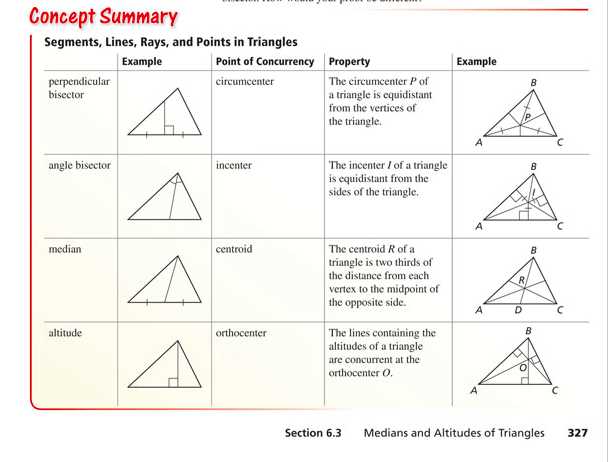
In geometry, medians and altitudes are important concepts that help us understand the properties of triangles. A median is a line segment that connects a vertex of a triangle to the midpoint of the opposite side. An altitude, on the other hand, is a line segment that extends from a vertex of a triangle perpendicular to the opposite side.
When working with medians and altitudes, it is important to be able to find their lengths and solve for unknown variables. This can be done by applying certain properties and theorems. For example, the centroid theorem states that the centroid of a triangle is located two-thirds of the distance from each vertex to the midpoint of the opposite side. This theorem can be used to find the lengths of medians.
Similarly, the altitude theorem states that the length of the altitude drawn from a vertex of a right triangle to the hypotenuse is the geometric mean of the lengths of the two segments into which the altitude divides the hypotenuse. This theorem can be used to find the lengths of altitudes in right triangles. By understanding and applying these theorems, we can easily solve medians and altitudes worksheet problems and find the answers.
Understanding the Basics of Medians and Altitudes
Medians and altitudes are important concepts in geometry that help us understand various properties of triangles. A median is a line segment that connects a vertex of a triangle to the midpoint of the opposite side. On the other hand, an altitude is a perpendicular line segment drawn from a vertex of a triangle to the opposite side (or its extension).
Medians: In a triangle, there are three medians, one originating from each vertex. The three medians intersect at a point called the centroid, which is the center of gravity of the triangle. The centroid divides each median in a 2:1 ratio, meaning that the distance from the vertex to the centroid is twice the distance from the centroid to the midpoint of the opposing side.
Altitudes: Like medians, a triangle has three altitudes, with each originating from a different vertex. The three altitudes meet at a point called the orthocenter. The orthocenter has a unique property – it can lie inside, outside, or on the triangle itself, depending on the type of triangle. In an acute triangle, the orthocenter lies inside the triangle; in a right triangle, the orthocenter lies on the triangle; and in an obtuse triangle, the orthocenter lies outside the triangle.
Understanding the properties and concepts of medians and altitudes is crucial in solving various problems in geometry. Additionally, these concepts provide insight into the relationships between the sides, angles, and vertices of a triangle. They are fundamental tools that help us analyze and reason about triangles and their properties.
What are Medians and Altitudes?
In geometry, medians and altitudes are special lines that can be drawn in a triangle. They provide important information about the triangle and help us solve various problems related to triangles.
Medians: A median is a line segment in a triangle that connects a vertex to the midpoint of the opposite side. Every triangle has three medians, and they are always concurrent, which means they intersect at a single point called the centroid. The centroid divides each median into two segments, with the ratio of 2:1. Medians have several properties, such as they divide the triangle into six smaller triangles with equal area, and the centroid is the center of gravity of the triangle.
Altitudes: An altitude is a line segment in a triangle that is perpendicular to a side and passes through the opposite vertex. Every triangle has three altitudes, and they can be inside, outside, or on the triangle. The point of intersection of the altitudes is called the orthocenter. Altitudes have unique properties; for example, they form right angles with the sides of the triangle, and the length of an altitude can be used to find the area of the triangle.
In summary, medians and altitudes are important lines in a triangle that provide valuable information about the triangle’s properties and can be used to solve various problems. Medians intersect at the centroid, while altitudes intersect at the orthocenter. Understanding these concepts helps us study and analyze triangles in geometry.
How to Find the Length of a Median in a Triangle?

A median is a line segment that connects a vertex of a triangle to the midpoint of the opposite side. The length of a median can be found using various methods, including the use of the triangle’s side lengths and the properties of medians.
To find the length of a median, you can start by using the formula for the length of a median in terms of the side lengths of the triangle. The formula states that the length of a median from a vertex to the midpoint of the opposite side is half the length of that side. This means that if you know the length of the side opposite the desired median, you can simply divide it by 2 to find the length of the median.
Another way to find the length of a median is by using the properties of medians in a triangle. One of these properties is that the medians of a triangle intersect at a point called the centroid. The centroid divides each median into two segments, with the ratio of the lengths of the segments being 2:1. This means that if you know the length of one segment of a median, you can multiply it by 3 to find the length of the entire median.
Overall, finding the length of a median in a triangle can be done using different approaches, such as the formula for the length of a median in terms of side lengths or the properties of medians and the centroid. By understanding these principles, you can easily determine the length of any median in a given triangle.
Solving Medians and Altitudes Problems
When solving medians and altitudes problems in geometry, it is important to understand the definitions and properties of these lines in a triangle. Medians are lines that connect a vertex of a triangle to the midpoint of the opposite side, while altitudes are lines drawn from a vertex perpendicular to the opposite side.
To solve problems involving medians and altitudes, one often needs to use properties such as the midpoint theorem, the Pythagorean theorem, and congruent triangles. These properties can help to determine the lengths of segments and angles in the triangle.
One common type of problem involves finding the length of a median or altitude in a triangle. To solve this type of problem, one can use the midpoint theorem to find the length of the segment from the vertex to the midpoint of the opposite side, and then use the Pythagorean theorem or use congruent triangles to find the length of the entire median or altitude.
Another type of problem involves finding the intersection point of two medians or altitudes in a triangle. To solve this type of problem, one can set up and solve equations based on the properties of the medians or altitudes. These equations can be solved algebraically, graphically, or using other methods to find the coordinates of the intersection point.
Solving medians and altitudes problems involves applying geometric principles and properties of triangles. By understanding these principles and using appropriate methods, one can solve various types of problems related to medians and altitudes in geometry.
Using the Midpoint Formula to Find the Centroid
The centroid is an important point in a triangle that is located at the intersection of its three medians. Medians are line segments drawn from each vertex of the triangle to the midpoint of the opposite side. The centroid is often referred to as the “center of gravity” of the triangle and it has several properties that make it useful in various applications.
To find the centroid of a triangle, we can use the midpoint formula. The midpoint formula allows us to find the coordinates of the midpoint of a line segment when we know the coordinates of its endpoints. By finding the midpoints of each side of the triangle, we can then find the centroid by taking the average of these midpoints.
Step 1: Find the coordinates of the midpoints of each side of the triangle using the midpoint formula. The midpoint formula is given by: M = (x1 + x2)/2, (y1 + y2)/2, where (x1, y1) and (x2, y2) are the coordinates of the endpoints of the line segment.
Step 2: Calculate the average of the x-coordinates and the average of the y-coordinates of the midpoints. This will give us the coordinates of the centroid. The centroid is given by: C = (M1 + M2 + M3)/3, where M1, M2, and M3 are the midpoints of the three sides of the triangle.
By using the midpoint formula to find the centroid, we can determine the exact location of this important point in a triangle. This can be useful in various mathematical and engineering applications, such as determining the balance point of a structure or analyzing the motion of objects. Understanding the centroid can provide valuable insights into the geometry and behavior of triangles.
The Relationship Between Medians and Centroids

Medians and centroids are important concepts in geometry that define the relationships between the sides and vertices of a triangle. A median of a triangle is a line segment that connects a vertex of the triangle to the midpoint of the opposite side. On the other hand, a centroid is the point of concurrency of the three medians of a triangle, which is located two-thirds of the way along each median.
The relationship between medians and centroids is an interesting one. The centroid is often referred to as the “center of gravity” of a triangle because it is the balance point for the triangle when it is suspended at the centroid. This means that if the triangle is made of a material with uniform density, it will balance perfectly on a pivot placed at the centroid.
Furthermore, the centroid is also the point that divides each of the medians into two segments. The longer segment is always twice the length of the shorter segment. This means that if the length of a median is denoted as “m”, then the length of the longer segment is “2m” and the length of the shorter segment is “m”. This property holds true for all three medians of a triangle.
In summary, medians and centroids have a close relationship in geometry. The centroid is the point where all three medians of a triangle intersect, and it is the balance point of the triangle. Additionally, the centroid divides each median into two segments, with the longer segment being twice the length of the shorter segment.
Exploring Altitudes in Triangle Geometry
Altitudes are important tools in triangle geometry that help us understand the relationships between the sides and angles of a triangle. They are perpendicular segments drawn from each vertex of a triangle to the opposite side or its extended line. In this section, we will explore the properties and applications of altitudes in triangle geometry.
One of the key properties of altitudes is that they intersect at a single point called the orthocenter. This is a unique point that can be inside, outside, or on the triangle depending on the relationships between the angles. The orthocenter is an important point of concurrency in a triangle, and it can be used to solve various problems in geometry.
Altitudes also help us understand the lengths and ratios of the sides in a triangle. For example, the length of an altitude can be used to find the area of a triangle using the formula: Area = (base * height) / 2. By knowing the lengths of the sides and the altitude, we can also determine the angles of a triangle using trigonometric functions such as sine, cosine, and tangent.
Furthermore, altitudes can be used to prove various geometric theorems and solve problems related to triangle congruence, similarity, and special triangles. They provide a valuable tool for analyzing and understanding the properties of triangles and their corresponding parts.
In conclusion, altitudes play a crucial role in triangle geometry. They help us visualize the relationships between the sides, angles, and heights of triangles. By understanding the properties and applications of altitudes, we can solve problems, prove theorems, and gain a deeper insight into the world of triangle geometry.