Mastering Momentum: Unlocking the Answers to Practice Problems in PDF Format
If you’re looking for practice problems to help you understand the concept of momentum and how to solve related problems, you’re in the right place. This article provides a collection of momentum practice problems in PDF format, along with their accompanying answers, to help you test your knowledge and improve your problem-solving skills.
Momentum is a fundamental concept in physics that describes the motion of an object. It is defined as the product of an object’s mass and its velocity. Momentum can be understood as the quantity of motion possessed by an object. Understanding and calculating momentum is essential for analyzing the motion and collisions of objects.
The momentum practice problems PDF contains a variety of questions that cover different aspects of momentum, such as calculating momentum, using the law of conservation of momentum, and applying the principles of momentum to solve collision problems. Each problem is accompanied by a detailed solution to help you understand the steps and concepts involved in solving it.
Momentum Practice Problems PDF Answers
Below you will find the answers to the practice problems in the Momentum Practice Problems PDF. These answers will help you understand the concepts and solve similar problems in the future.
Problem 1:
Question: A car with a mass of 1200 kg is traveling at a velocity of 25 m/s. What is its momentum?
Answer: To find the momentum, we use the formula momentum = mass × velocity. Plugging in the values, we get momentum = 1200 kg × 25 m/s = 30,000 kg·m/s. Therefore, the car’s momentum is 30,000 kg·m/s.
Problem 2:
Question: A 0.5 kg ball is thrown with a velocity of 20 m/s. What is the ball’s momentum?
Answer: Using the same formula momentum = mass × velocity, we can calculate the ball’s momentum. Plugging in the values, we get momentum = 0.5 kg × 20 m/s = 10 kg·m/s. Therefore, the ball’s momentum is 10 kg·m/s.
Problem 3:
Question: A hockey puck with a mass of 0.15 kg is sliding on the ice at a velocity of 10 m/s. What is its momentum?
Answer: Once again, applying the formula momentum = mass × velocity, we can determine the hockey puck’s momentum. Plugging in the values, we get momentum = 0.15 kg × 10 m/s = 1.5 kg·m/s. Therefore, the hockey puck’s momentum is 1.5 kg·m/s.
By analyzing and understanding these answers, you can now confidently solve momentum problems and apply the concept to various scenarios. Remember to always consider the mass and velocity of an object to determine its momentum.
What is Momentum?
Momentum refers to the quantity of motion possessed by an object. It is a vector quantity that depends on an object’s mass and velocity. The momentum of an object can be calculated by multiplying its mass by its velocity. The equation for momentum is:
Momentum (p) = mass (m) × velocity (v)
The SI unit for momentum is kilogram-meter per second (kg·m/s), which is the same as a Newton-second (N·s).
The concept of momentum is closely related to the concept of inertia, which is the tendency of an object to resist changes in its motion. The greater an object’s momentum, the harder it is to stop or change its direction. This is why larger objects, such as cars, have a greater impact in collisions than smaller objects, such as bicycles.
In addition to its magnitude, momentum also has direction. When two objects collide, the total momentum of the system is conserved, meaning that the total momentum before the collision is equal to the total momentum after the collision. This principle is known as the law of conservation of momentum.
Momentum is a fundamental concept in physics and is used to analyze various types of motion, such as collisions, explosions, and the motion of projectiles. By understanding and applying the principles of momentum, scientists and engineers can predict and control the behavior of moving objects.
How is Momentum Calculated?
Momentum is a fundamental concept in physics that describes the motion of an object. It is calculated by multiplying an object’s mass by its velocity. The equation for momentum is:
Momentum = mass x velocity
Mass is a measure of the amount of matter in an object, and it is typically measured in kilograms (kg). Velocity, on the other hand, is a measure of how fast an object is moving and in what direction. It is typically measured in meters per second (m/s).
To calculate the momentum of an object, you simply multiply its mass by its velocity. For example, if an object has a mass of 2 kg and a velocity of 10 m/s, its momentum would be:
Momentum = 2 kg x 10 m/s = 20 kg m/s
The unit for momentum is kilogram-meter per second (kg m/s), which represents the amount of motion an object possesses. The greater the mass and velocity of an object, the greater its momentum will be. In other words, an object with a larger mass or higher velocity will have more momentum than an object with a smaller mass or lower velocity.
Momentum is a vector quantity, which means it has both magnitude and direction. The direction of an object’s momentum is the same as the direction of its velocity. This means that if an object is moving to the right, its momentum will also be to the right.
In conclusion, momentum is calculated by multiplying an object’s mass by its velocity. It is a key concept in physics that describes the motion of objects and is represented by a vector quantity with both magnitude and direction.
Momentum Practice Problems with Explanation
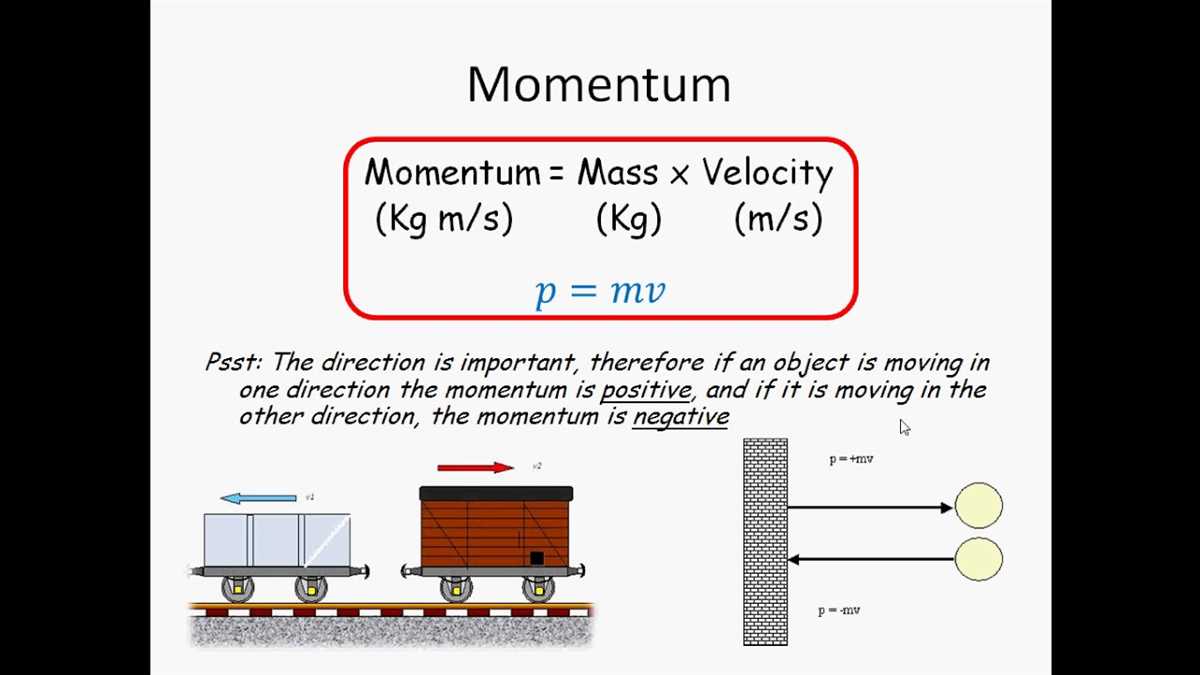
In this set of momentum practice problems, we will explore different scenarios where momentum plays a crucial role. Momentum is the product of an object’s mass and velocity, and it is a vector quantity. This means that momentum has both magnitude and direction. These problems will help us understand how momentum is conserved in different situations and how we can calculate it.
1. Two cars collide
- Car A has a mass of 1000 kg and is moving at 20 m/s to the east.
- Car B has a mass of 1200 kg and is initially at rest.
- After the collision, Car A moves at 10 m/s to the east, while Car B moves at 15 m/s to the west.
To solve this problem, we can calculate the initial momentum of Car A and Car B separately, using the formula p = mv. The initial momentum of Car A is 1000 kg * 20 m/s = 20000 kg·m/s to the east, while the initial momentum of Car B is 0 kg·m/s (since it is at rest).
After the collision, we can calculate the final momentum of Car A and Car B using the same formula. The final momentum of Car A is 1000 kg * 10 m/s = 10000 kg·m/s to the east, while the final momentum of Car B is 1200 kg * (-15 m/s) = -18000 kg·m/s to the west.
2. A ball is thrown
- A ball with a mass of 0.5 kg is thrown with a velocity of 10 m/s to the right.
- The ball hits a wall and bounces back with the same velocity but in the opposite direction.
We can calculate the initial momentum of the ball using the formula p = mv. The initial momentum is 0.5 kg * 10 m/s = 5 kg·m/s to the right.
After the bounce, the ball’s velocity changes direction, so its final momentum is -5 kg·m/s to the left (opposite to the initial direction).
These practice problems demonstrate how momentum is conserved in different scenarios. By understanding the concept of momentum and using the appropriate formulas, we can analyze the motion of objects and calculate their momentum in various situations.
Tips for Solving Momentum Problems
Momentum is an important concept in physics and is often used to analyze collisions and other interactions between objects. To help solve momentum problems, it is important to understand the definition of momentum and the principles that govern its conservation. Here are some tips to keep in mind when dealing with momentum problems:
- Understand the definition of momentum: Momentum is the product of an object’s mass and velocity. It is a vector quantity, which means it has both magnitude and direction. Remember that momentum is conserved in a closed system, meaning the total momentum before an event is equal to the total momentum after the event.
- Break down the problem into smaller components: Sometimes, solving a momentum problem requires breaking it down into smaller parts. For example, in a collision problem, you may need to analyze the change in momentum for each object involved and determine the final velocities.
- Apply the law of conservation of momentum: Use the law of conservation of momentum to find unknown values in a problem. This law states that the total momentum of a system remains constant before and after a collision or interaction. Since momentum is conserved, you can set up equations to solve for unknown variables.
- Use vector notation when necessary: Momentum is a vector quantity, so it is important to pay attention to the direction of momentum in your calculations. Use vector notation and take into account the positive and negative directions to ensure accurate results.
- Consider external forces: In some cases, external forces may be involved in a momentum problem. These forces can affect the overall momentum of a system. Make sure to analyze any external forces and include them in your calculations if necessary.
By following these tips and practicing various momentum problems, you can develop a strong understanding of momentum and improve your problem-solving skills in physics.
Downloadable PDF with Momentum Practice Problems
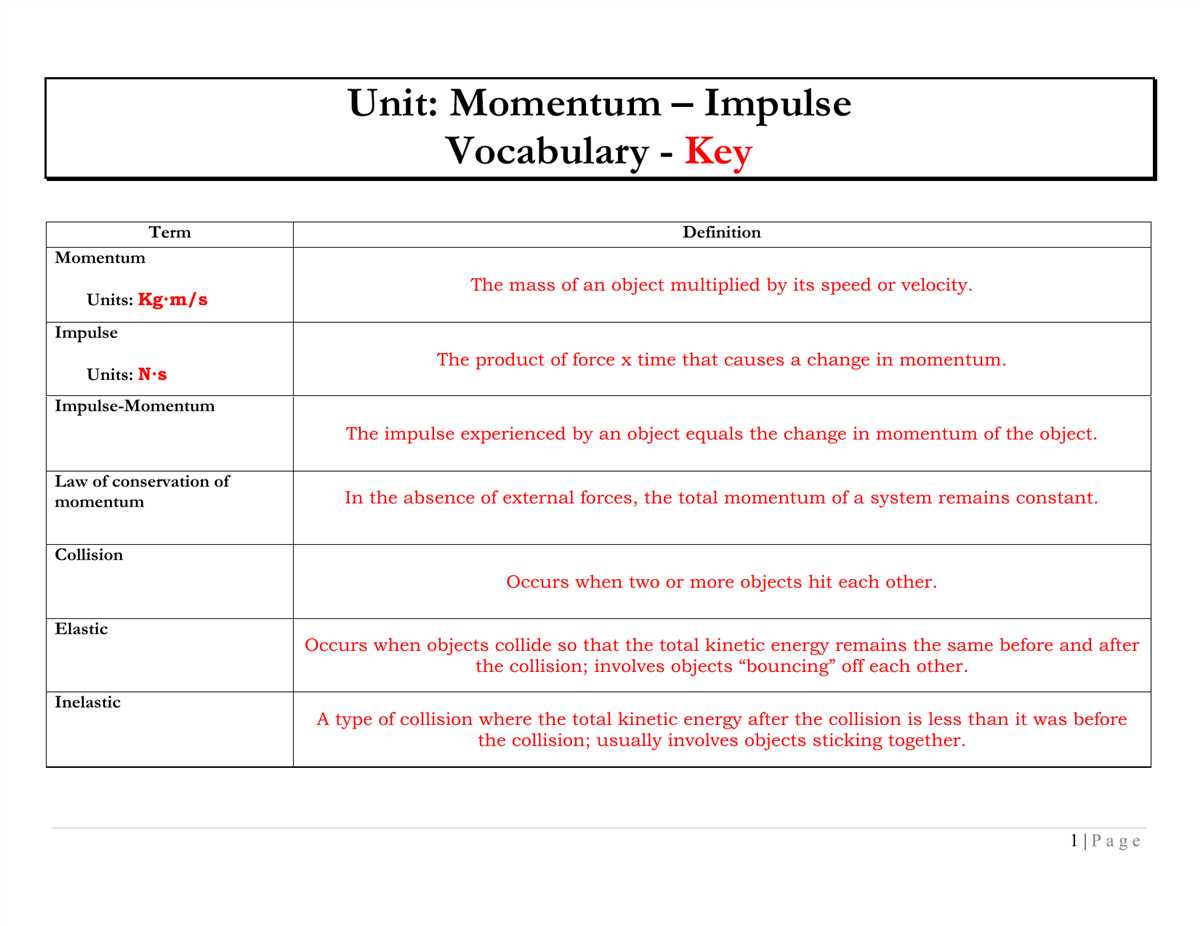
Are you struggling to understand and solve momentum problems in physics? Do you find it difficult to apply the momentum equations to real-life scenarios? If so, you’re not alone. Many students struggle with momentum, but with the right practice problems and resources, you can improve your understanding and master this concept.
One helpful resource is a downloadable PDF with momentum practice problems. This PDF contains a variety of problems that cover different aspects of momentum, including calculations, collisions, and conservation of momentum. Each problem provides a scenario and requires you to apply the momentum equations to solve it.
Example problem:
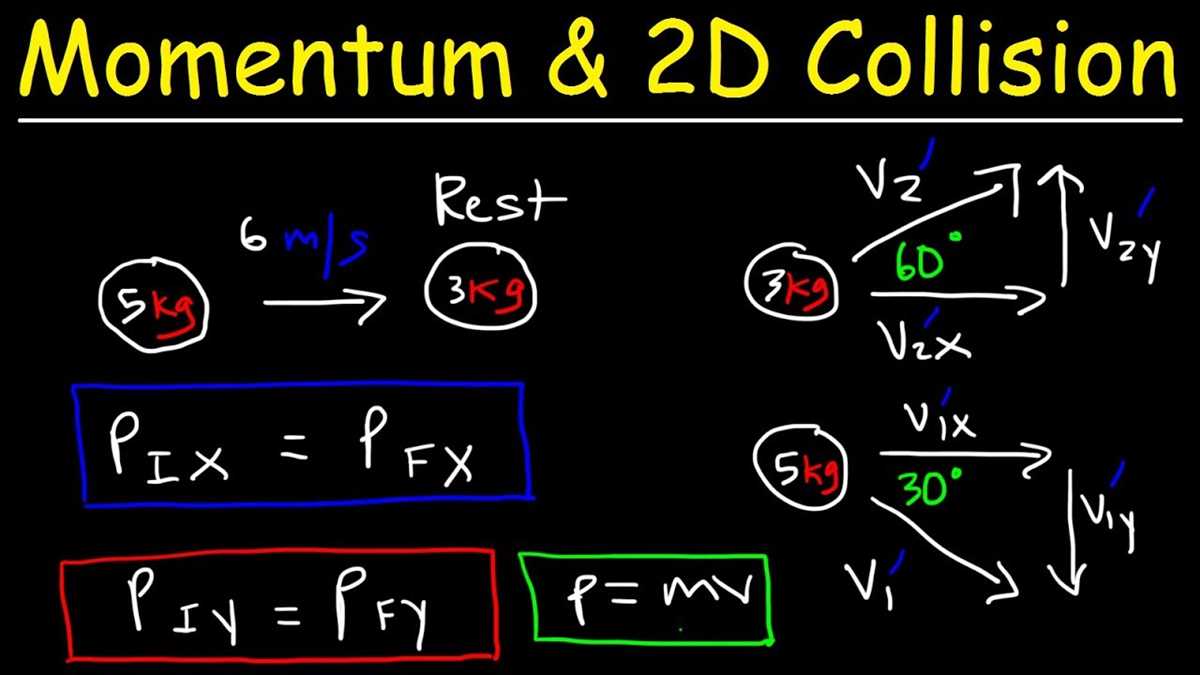
A car with a mass of 1000 kg is traveling at a velocity of 20 m/s. It collides with another car of mass 1200 kg, initially at rest. After the collision, the two cars stick together and move in the same direction. What is the final velocity of the two cars?
To solve this problem, you would need to use the equation for conservation of momentum, which states that the total momentum before a collision is equal to the total momentum after the collision. You would set up the equation:
m1v1 + m2v2 = (m1 + m2)vf
where m1 is the mass of the first car, v1 is its initial velocity, m2 is the mass of the second car, v2 is its initial velocity, and vf is the final velocity of the two cars.
By plugging in the given values and solving for vf, you would find the final velocity of the two cars.
The downloadable PDF with momentum practice problems provides many more examples like this, allowing you to practice and strengthen your skills in solving momentum problems. By working through these problems and understanding the underlying concepts, you’ll be well-prepared to tackle any momentum problem that comes your way.
Answers to Momentum Practice Problems
In this article, we have provided the answers to a set of momentum practice problems. Understanding and solving momentum problems is crucial in physics, as it helps us analyze the motion of objects and predict their future behavior.
Here are the answers to the momentum practice problems:
- Problem 1: The momentum of an object with a mass of 2 kg and a velocity of 3 m/s is 6 kg·m/s.
- Problem 2: The momentum of an object with a mass of 5 kg and a velocity of -2 m/s is -10 kg·m/s.
- Problem 3: The momentum of an object with a mass of 10 kg and a velocity of 0 m/s is 0 kg·m/s.
- Problem 4: The momentum of an object with a mass of 4 kg and a velocity of 8 m/s is 32 kg·m/s.
- Problem 5: The momentum of an object with a mass of 6 kg and a velocity of -5 m/s is -30 kg·m/s.
By solving these problems, we have learned how to calculate momentum using the formula:
Momentum (p) = mass (m) × velocity (v)
It is important to note that momentum is a vector quantity, which means it has both magnitude and direction. The direction of momentum is the same as the direction of the object’s velocity.
Overall, understanding momentum and being able to solve momentum problems is crucial in physics to analyze the motion of objects and predict their behavior in various situations. Practice problems like these help strengthen our understanding and problem-solving skills.