Unlock the Secrets of Percent Composition with this Answer Key
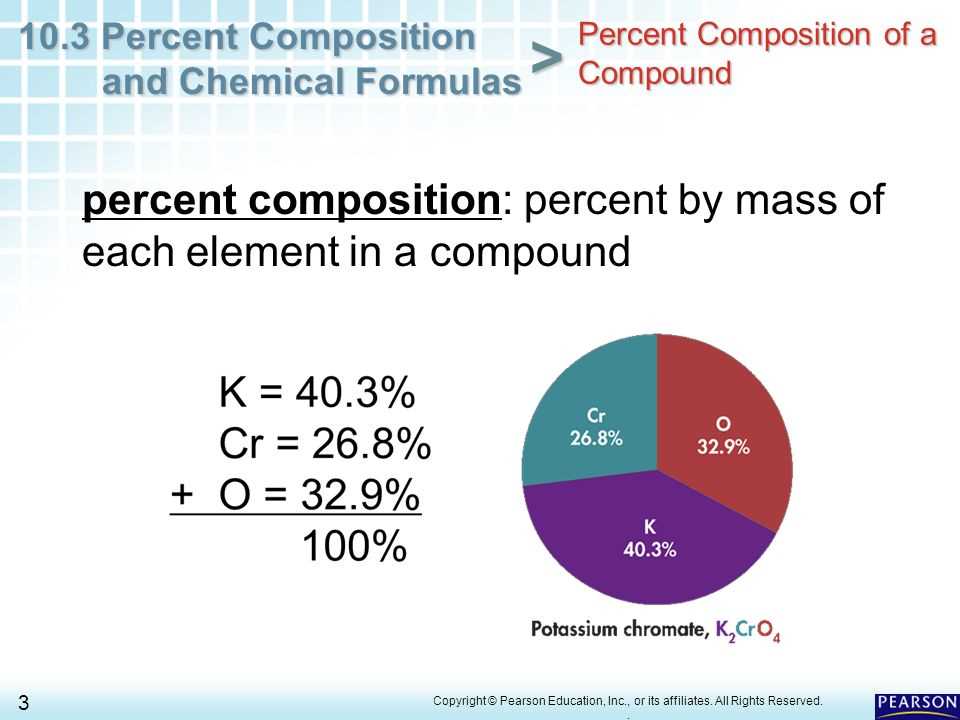
Understanding percent composition is a fundamental concept in chemistry. It allows chemists to determine the proportion of elements in a compound by mass. This information is crucial for a variety of applications, from determining the purity of substances to calculating reaction stoichiometry.
To find the percent composition of a compound, you need to know the formula and the molar masses of each element present. The percent composition of an element is calculated by dividing the mass of that element by the total mass of the compound, and then multiplying by 100. This gives you the percentage of each element in the compound.
Knowing the percent composition can help chemists identify unknown compounds. By comparing the percent composition of an unknown substance to that of known compounds, chemists can narrow down the possibilities and make educated guesses about the identity of the compound. This is especially useful in fields such as forensic science, where identifying unknown substances is crucial to solving crimes.
Overall, understanding percent composition is essential for any chemist. It provides valuable information about the composition of compounds and allows for a deeper understanding of chemical reactions and processes. Whether you’re a student learning the basics or an experienced chemist analyzing complex compounds, knowing how to calculate and interpret percent composition is a valuable skill.
What is Percent Composition?
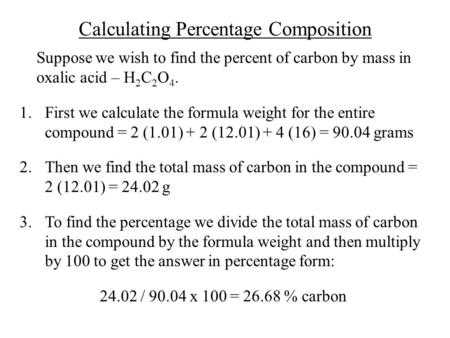
The percent composition refers to the relative amounts of the elements present in a compound. It is determined by calculating the mass of each element and dividing it by the total mass of the compound, then multiplying by 100 to express it as a percentage. The percent composition provides valuable information about the chemical makeup of a compound and allows scientists to understand its properties and behavior.
When determining the percent composition, it is important to know the formula of the compound and the molar masses of its constituent elements. The formula of a compound gives the ratio of the number of atoms of each element present in a molecule, while the molar masses reflect the atomic masses of the elements in the periodic table.
In order to calculate the percent composition, the molar mass of each element is multiplied by its subscript in the formula to obtain the mass contributed by that element. The sum of the masses of all the elements in the compound gives the total molar mass. Then, the percent composition of each element is calculated by dividing its mass by the total molar mass and multiplying by 100.
Knowing the percent composition of a compound is useful for various purposes. It helps chemists determine the empirical formula of a compound, which represents the simplest ratio of the elements present. It also helps in identifying unknown compounds, as the percent composition can be compared to known compounds to narrow down possibilities. Additionally, the percent composition is used in stoichiometry calculations to determine the amount of reactants and products in a chemical reaction.
Definition and Explanation
The concept of percent composition is a fundamental principle in chemistry that relates to the proportions of elements present in a compound. It refers to the percentage by mass of each element in a compound, which can be calculated by dividing the mass of that element by the total mass of the compound and multiplying by 100.
This information is important because it allows scientists to understand the composition of a compound and make predictions about its properties and behavior. By knowing the percent composition, it is possible to determine the empirical formula of a compound, which represents the simplest, whole number ratio of atoms present.
To calculate the percent composition of a compound, one must first determine the molar mass of each element in the compound. The molar mass is the mass of one mole of a substance, expressed in grams. Then, the mass of each element is divided by the molar mass of the compound and multiplied by 100 to obtain the percent composition.
For example, consider the compound water (H2O). The molar mass of hydrogen (H) is 1.01 g/mol, and the molar mass of oxygen (O) is 16.00 g/mol. To calculate the percent composition of water, the mass of hydrogen (2.02 g) is divided by the molar mass of water (18.02 g/mol) and multiplied by 100, resulting in a percent composition of approximately 11.19% hydrogen. The mass of oxygen (16.00 g) is divided by the molar mass of water and multiplied by 100, resulting in a percent composition of approximately 88.81% oxygen.
By understanding the percent composition of a compound, scientists can analyze its properties, such as boiling point, melting point, and reactivity, and make comparisons between different compounds. This knowledge is essential for a range of applications, including pharmaceuticals, materials science, and environmental studies.
How to Calculate Percent Composition
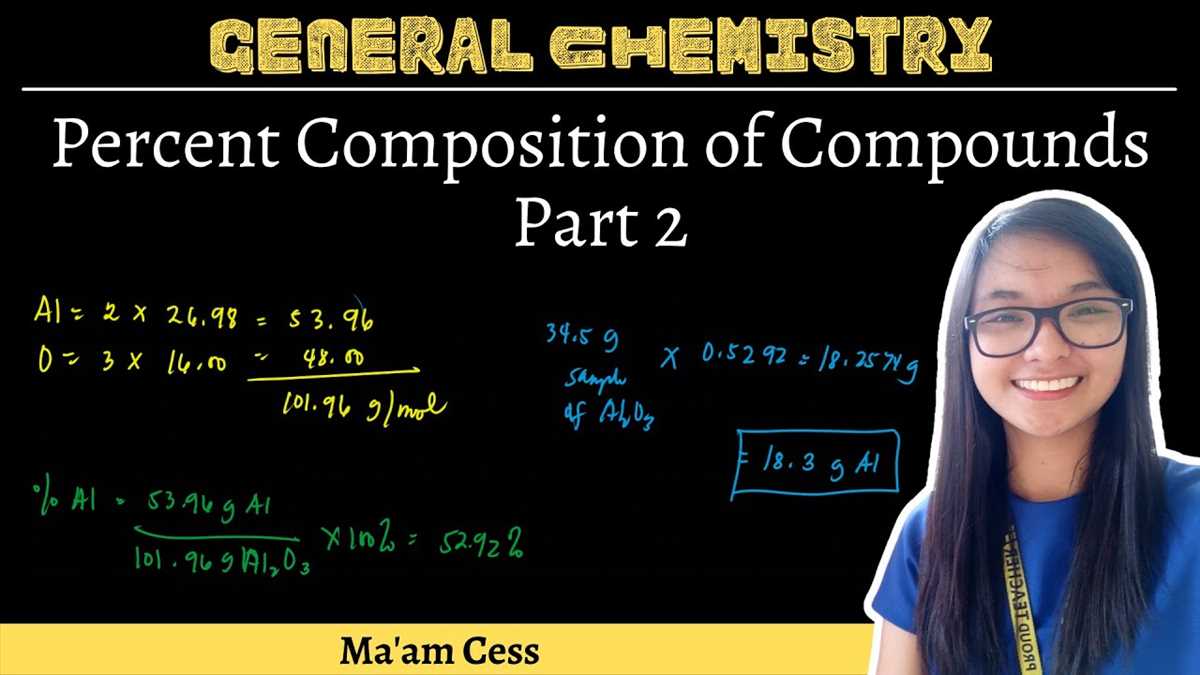
Percent composition is a calculation that allows you to determine the relative amounts of each element in a compound. It is an important concept in chemistry, as it provides valuable information about the composition and properties of substances. To calculate percent composition, you will need to know the molar mass of the compound and the molar mass of each individual element within it.
To start, you will need to determine the molar mass of the compound. This can be done by adding up the atomic masses of all the atoms in the compound. You can find the atomic masses of elements on the periodic table. For example, if you are calculating the percent composition of water (H2O), you would add the atomic masses of hydrogen (1.008 g/mol) and oxygen (16.00 g/mol) to get the molar mass of water (18.02 g/mol).
Next, you will need to determine the molar mass of each individual element in the compound. This can be done by multiplying the atomic mass of each element by the number of atoms of that element in the formula. In the case of water, there are 2 hydrogen atoms, so you would multiply the atomic mass of hydrogen by 2. For oxygen, there is only 1 atom, so you would multiply the atomic mass of oxygen by 1.
Once you have the molar mass of the compound and the molar mass of each element, you can calculate the percent composition. This is done by dividing the molar mass of each element by the molar mass of the compound and multiplying by 100. For example, to calculate the percent composition of hydrogen in water, you would divide the molar mass of hydrogen (2.016 g/mol) by the molar mass of water (18.02 g/mol) and multiply by 100. This gives you the percent composition of hydrogen in water, which is approximately 11.19%.
In summary, calculating percent composition involves determining the molar mass of a compound and the molar mass of each element within it. This information is then used to calculate the percent composition of each element in the compound. It is a useful calculation in chemistry for understanding the composition and properties of substances.
Step-by-Step Guide
Here is a step-by-step guide on how to find the percent composition of a compound:
- Determine the molar masses: To find the percent composition, you first need to know the molar masses of all the elements in the compound. This can be done by finding the atomic masses of each element and multiplying them by the number of atoms present in the compound.
- Calculate the total molar mass: Add up the molar masses of all the elements in the compound to find the total molar mass. This will give you the mass of one mole of the compound.
- Calculate the percent composition: Divide the molar mass of each element by the total molar mass of the compound and multiply by 100 to get the percent composition. This will give you the percentage of each element in the compound.
- Check your work: Make sure that the percentages of all the elements add up to 100%. If they don’t, double-check your calculations to find any mistakes.
By following these steps, you can easily determine the percent composition of a compound. It is an important concept in chemistry and is often used to analyze and understand the properties of different substances.
Why is Percent Composition Important?
Percent composition is an essential concept in chemistry that allows us to determine the proportion of each element in a compound. It provides crucial information about the chemical makeup of a substance, which is valuable for various reasons.
1. Identification and characterization of compounds: Knowing the percent composition of a compound helps in identifying and characterizing it. By comparing the experimental percent composition with the known values, scientists can determine whether the compound is pure or contaminated. Additionally, percent composition data can be used to confirm the identity of a compound or to differentiate between different compounds with similar formulas.
2. Stoichiometry calculations: Percent composition is vital in stoichiometry, which is the study of the quantities of substances involved in chemical reactions. By knowing the percent composition of a compound, we can determine the amounts of its constituents, which are necessary for performing various stoichiometric calculations, such as calculating the mass of a product or the amount of a reactant required.
3. Predicting physical and chemical properties: Percent composition helps in predicting the physical and chemical properties of a compound. The types and arrangement of elements in a compound greatly influence its properties. By knowing the percent composition, scientists can make educated guesses about a compound’s behavior, such as its melting and boiling points, solubility, reactivity, and toxicity.
4. Quality control and analysis: Percent composition analysis is commonly used in quality control to ensure the purity and consistency of products. By determining the percent composition, manufacturers can verify that their products meet the required specifications. It is especially crucial in industries such as pharmaceuticals, food, and cosmetics, where even small variations in composition can affect the product’s effectiveness, safety, or shelf life.
5. Education and research: Percent composition is a fundamental concept taught in chemistry education. It helps students understand the composition of substances, how to analyze and interpret data, and how to perform various calculations. Additionally, percent composition data is invaluable in research, where scientists often need to know the exact composition of a compound to study its properties or develop new materials with specific characteristics.
In conclusion, percent composition plays a vital role in chemistry. It enables the identification and characterization of compounds, facilitates stoichiometric calculations, helps predict properties, ensures quality control, and supports education and research in the field. Overall, percent composition is a foundational concept that allows scientists to understand and manipulate the chemical world.
Significance and Applications
The concept of percent composition is widely used in various fields of science and industry due to its significance in determining the composition of a substance. By calculating the percent composition, scientists and researchers can gain valuable insights into the structure and properties of a material.
In chemistry, percent composition is crucial in identifying unknown substances. By analyzing the percent composition of elements present in a compound, chemists can determine its molecular formula and predict its behavior. This information is essential for drug development, as it allows scientists to understand the composition of pharmaceutical compounds and optimize their effectiveness and safety.
In materials science, percent composition analysis is used to study the composition of alloys, ceramics, and polymers. By understanding the precise composition of a material, engineers can tailor its properties to meet specific requirements. For example, in the automotive industry, percent composition analysis is used to develop lightweight and high-strength alloys for improved fuel efficiency and safety.
Percent composition also plays a vital role in the field of environmental science. By analyzing the percent composition of pollutants in air, water, and soil samples, scientists can assess the level of contamination and develop effective strategies for remediation. This information is crucial for maintaining a clean and sustainable environment.
In summary, percent composition is a powerful tool used in diverse scientific and industrial applications. By providing insights into the composition of substances, it enables scientists and researchers to make informed decisions and develop innovative solutions in fields such as chemistry, materials science, and environmental science.
Examples of Percent Composition Calculations
Percent composition calculations are an important part of chemistry, allowing scientists to determine the relative amounts of different elements in a compound. These calculations can be done using the formula of the compound and the atomic masses of the elements involved.
For example, let’s consider the compound water, which has the chemical formula H2O. The percent composition of water can be calculated by determining the mass of each element (hydrogen and oxygen) and dividing it by the total mass of the compound. The atomic mass of hydrogen is approximately 1 g/mol, and the atomic mass of oxygen is approximately 16 g/mol. Since there are two hydrogen atoms in water, the total mass of hydrogen is 2 g/mol. The mass of oxygen is 16 g/mol. Therefore, the total mass of water is 2 + 16 = 18 g/mol. To calculate the percent composition of hydrogen in water, divide the mass of hydrogen (2 g/mol) by the total mass of water (18 g/mol) and multiply by 100: (2/18) x 100 = 11.11%. Similarly, the percent composition of oxygen in water can be calculated as (16/18) x 100 = 88.89%.
Another example is carbon dioxide, which has the chemical formula CO2. To calculate the percent composition of carbon in carbon dioxide, we need to know the atomic masses of carbon and oxygen. The atomic mass of carbon is approximately 12 g/mol, and the atomic mass of oxygen is approximately 16 g/mol. Since there is one carbon atom in carbon dioxide, the total mass of carbon is 12 g/mol. The total mass of oxygen is 2 x 16 = 32 g/mol. The total mass of carbon dioxide is 12 + 32 = 44 g/mol. To calculate the percent composition of carbon, divide the mass of carbon (12 g/mol) by the total mass of carbon dioxide (44 g/mol) and multiply by 100: (12/44) x 100 = 27.27%. The percent composition of oxygen in carbon dioxide can be calculated as (32/44) x 100 = 72.73%.
- Water (H2O) – Hydrogen: 11.11%, Oxygen: 88.89%
- Carbon dioxide (CO2) – Carbon: 27.27%, Oxygen: 72.73%
These examples illustrate how percent composition calculations can be used to determine the proportions of different elements in compounds. By understanding the percent composition, scientists can gain insights into the properties and behavior of substances and make accurate predictions about their chemical reactions.
Real-Life Situations and Solutions
In real-life situations, the concept of percent composition is used in various fields to solve problems and make informed decisions. Here are a few examples:
- Chemistry: Percent composition is used to determine the composition of a compound, which is essential in chemical analysis and synthesis. It helps scientists understand the properties and behavior of different substances.
- Medicine: In pharmacology, percent composition is used to determine the concentration of active ingredients in medications. This information is crucial for calculating dosages and ensuring patient safety.
- Food industry: Percent composition is used to analyze the nutrient content of food products. It helps manufacturers create nutritious and balanced food options, and it allows individuals to make informed dietary choices.
- Environmental science: Percent composition is used to determine the concentration of pollutants in air, water, and soil. This information is used to assess environmental risks and develop remediation strategies.
- Finance: Percent composition is used in financial analysis to analyze the composition of an investment portfolio or the allocation of funds in a company’s capital structure. It helps investors make informed decisions and manage risk.
In all of these real-life situations, understanding percent composition is crucial for making accurate calculations and informed decisions. Whether it’s determining the composition of a chemical compound or analyzing the nutrient content of a food product, percent composition provides valuable insights that drive innovation and progress.