Understanding Codominance and Incomplete Dominance: Key Answers Revealed

In the study of genetics, scientists have uncovered fascinating patterns of inheritance that go beyond simple dominant and recessive traits. Two of these patterns are codominance and incomplete dominance. These concepts help explain how certain traits are expressed when an organism inherits alleles from its parents. To fully understand these patterns, it is important to examine key examples and practice problems. In this article, we will explore the answer key for practice questions related to codominance and incomplete dominance.
First, let’s define the terms. Codominance occurs when both alleles of a gene pair in a heterozygous individual are fully expressed. This means that neither allele is dominant or recessive, and both traits are visible in the phenotype. An example of codominance is the AB blood type, where alleles for blood type A and B are both expressed in the phenotype, resulting in the AB blood type.
Incomplete dominance, on the other hand, happens when the phenotype of a heterozygous individual is an intermediate blend of the two alleles. In other words, neither allele is fully dominant, and the resulting trait is a mixture or blend of the two. A classic example of incomplete dominance is the flower color in snapdragons, where the red allele and the white allele blend to produce pink flowers in a heterozygous individual.
Understanding Practice Codominance and Incomplete Dominance

Codominance and incomplete dominance are two important concepts in genetics that help explain the inheritance patterns of certain traits. These concepts are key in understanding how genetic variation can lead to diverse phenotypic outcomes.
Codominance: In codominance, both alleles contribute to the phenotype, resulting in a heterozygous individual expressing both traits simultaneously. This means that neither allele is dominant or recessive, and both are equally expressed. For example, in the case of blood types, the A and B alleles are codominant. A person with the genotype AB will express both A and B antigens on their red blood cells, resulting in the AB blood type. Codominance can be visually represented using Punnett squares, where the phenotypic ratios reflect the equal expression of both alleles.
Incomplete dominance: Unlike codominance, incomplete dominance occurs when neither allele is completely dominant over the other, resulting in an intermediate phenotype in heterozygous individuals. In this case, the phenotype is a blend or mix of the two alleles. For example, in snapdragons, the allele for red flowers (RR) is not completely dominant over the allele for white flowers (WW). Instead, the heterozygous genotype (RW) will result in pink flowers, which is an intermediate phenotype. Incomplete dominance can also be illustrated using Punnett squares, where the phenotypic ratios demonstrate the blending of traits.
Understanding practice codominance and incomplete dominance is important for several reasons. Firstly, it helps scientists and researchers better predict the outcomes of genetic crosses and understand the inheritance patterns of certain traits. Additionally, it provides insight into the diversity and variation within a population, as both codominance and incomplete dominance can result in a range of phenotypes. Finally, these concepts have practical applications in fields such as agriculture and medicine, where knowledge of genetic inheritance patterns is crucial for breeding and understanding genetic disorders. Overall, practice codominance and incomplete dominance are fundamental concepts that contribute to our understanding of the complexity of genetics and inheritance.
Overview of Dominance in Genetics

In the field of genetics, dominance is a fundamental concept that helps to understand how traits are expressed within an organism. Dominance refers to the relationship between versions of a gene, known as alleles, where one allele will mask or override the expression of the other allele. This relationship between alleles determines the phenotype, or the observable characteristics, of an organism.
There are different types of dominance, including complete dominance, incomplete dominance, and codominance. In complete dominance, one allele is dominant over the other, and only the dominant allele is expressed in the phenotype. The recessive allele is only expressed in the absence of the dominant allele. This type of dominance is commonly seen in traits such as eye color, where the allele for brown eyes is dominant over the allele for blue eyes.
In incomplete dominance, neither allele is completely dominant over the other. Instead, a blending of both alleles is observed in the phenotype. For example, when a red-flowered plant is crossed with a white-flowered plant, the resulting offspring may have pink flowers, as the red and white alleles blend together.
Codominance, on the other hand, occurs when both alleles are expressed simultaneously in the phenotype. This means that neither allele is dominant or recessive, and they both contribute to the appearance of the trait. For instance, in the case of blood type, alleles for type A and type B blood are codominant. This means that if an individual inherits both types of alleles, they will have the AB blood type, expressing both A and B antigens on their red blood cells.
The understanding of dominance in genetics is crucial for predicting and analyzing the inheritance patterns of traits. By understanding the relationships between alleles and how they interact, scientists can better understand and explain the complex variations observed within populations and individuals.
Key Concepts of Codominance
Codominance is a concept in genetics that describes the phenomenon where two different alleles of a gene are both expressed in the phenotype of an individual. Unlike in incomplete dominance, where the two alleles blend together to create an intermediate phenotype, in codominance, both alleles are fully expressed in separate, distinguishable ways.
In codominance, neither allele is dominant or recessive, and they do not interact to create a new phenotype. Instead, both alleles are expressed independently, resulting in a phenotype that reflects the presence of both alleles. This can be seen in traits such as blood type, where individuals can have both the A and B antigens on their red blood cells.
Key Concepts:
- In codominance, both alleles are fully expressed in the phenotype of an individual.
- Neither allele is dominant or recessive, and they do not interact to create an intermediate phenotype.
- Both alleles are expressed independently, resulting in a phenotype that reflects the presence of both alleles.
- Codominance can be observed in traits such as blood type, where individuals can have both A and B antigens on their red blood cells.
- Pattern of inheritance in codominance can be represented using a Punnett square, similar to other Mendelian genetics principles.
Understanding codominance is important for studying inheritance patterns and predicting the phenotypes of offspring. It highlights the complexity of genetic inheritance and challenges the simplistic notion of dominant and recessive alleles. By recognizing and studying codominance, scientists can gain a deeper understanding of the genetic variations and diversity found within populations.
Examples of Codominance in Practice
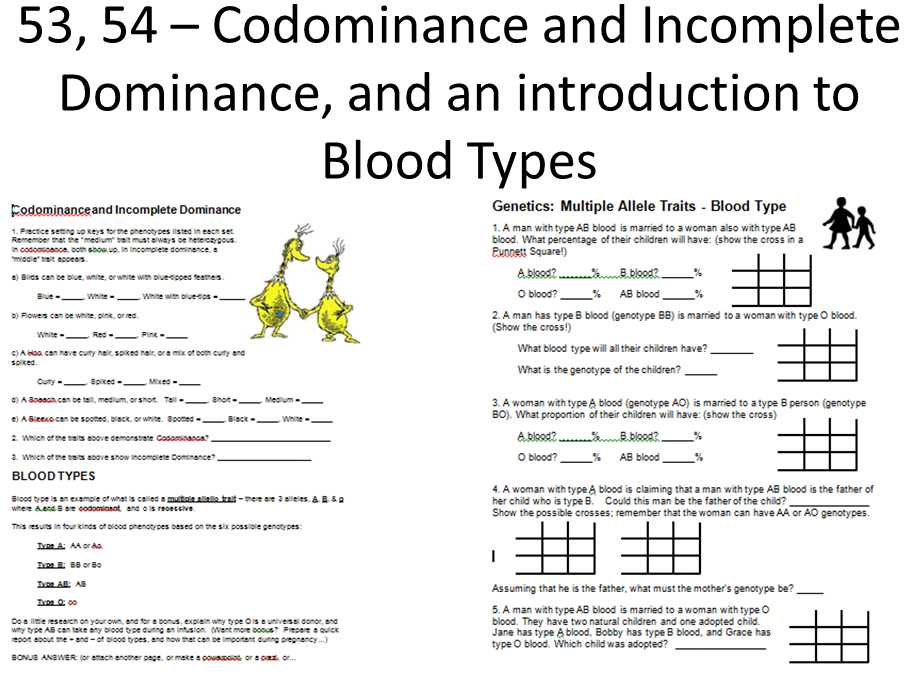
In genetics, codominance refers to a situation where both alleles of a gene are expressed equally in a heterozygous individual. This means that neither allele is dominant or recessive, and both contribute to the phenotype. Codominance can be observed in various species and is responsible for unique and distinct traits. Let’s explore some examples of codominance in practice.
1. ABO Blood Groups
One of the most well-known examples of codominance is the ABO blood group system in humans. The ABO system involves three alleles for the gene that determines blood type: A, B, and O. The A and B alleles are codominant, which means that if an individual inherits both the A and B alleles (genotype AB), they will have type AB blood. This results in a unique phenotype where both A and B antigens are present on the surface of red blood cells. Individuals with type AB blood are considered universal recipients.
2. Roan Cattle
In cattle, the gene responsible for coat color exhibits codominance. A prime example is the color pattern known as “roan.” Roan cattle have a mixture of colored and white hairs evenly distributed throughout their coat. This is due to the codominant expression of two alleles: one for red coat color and one for white coat color. When a cow inherits both alleles (genotype Rr), the result is a roan coat phenotype, showcasing both red and white hairs. This serves as an excellent example of codominance in livestock.
3. Appaloosa Horses
Another example of codominance in practice can be seen in Appaloosa horses. The distinctive coat pattern of Appaloosas, with spots and speckles, is the result of a codominant gene called the Leopard Complex (LP gene). Horses with one copy of the LP gene have a few spots on their coat, while those with two copies of the gene have a more pronounced pattern. This codominant trait contributes to the striking and varied coat colors and patterns observed in Appaloosas.
Codominance is a fascinating aspect of genetics that allows for the expression and combination of multiple alleles. These examples in humans, cattle, and horses highlight the diversity and complexity of biological traits and the intricate interactions between different alleles at specific gene loci.
Understanding Incomplete Dominance
In genetics, incomplete dominance is a concept that describes a situation where neither of the two alleles for a trait is dominant over the other. Instead, the phenotype of the heterozygous individual is an intermediate blend of the phenotypes of the two homozygous individuals. This means that the expression of the trait is not completely dominant nor recessive, but rather a unique combination.
An example of incomplete dominance can be seen in the flower color of certain plants. For instance, in a species of plant with red and white flower alleles, when a plant with red flowers (RR) is crossed with a plant with white flowers (WW), the resulting offspring have pink flowers (RW). This color is a result of the incomplete dominance, as neither the red nor white allele is fully dominant over the other.
It is important to note that incomplete dominance does not result in a blending of the alleles themselves. Each allele still behaves independently and contributes to the phenotype in a distinct way. In the case of the red and white flower example, the pink color is not a true blend of red and white pigments, but rather the expression of a separate pigment that is produced by the heterozygous genotype.
Understanding incomplete dominance is crucial for predicting and understanding the inheritance patterns of certain traits. It can also have practical implications, such as in agriculture and animal breeding, where knowledge of the genetic interactions and expressions of traits can help in selective breeding for desired characteristics.
Examples of Incomplete Dominance in Practice

Incomplete dominance is a genetic phenomenon where neither of the two alleles is completely dominant over the other. Instead, a heterozygous individual displays an intermediate phenotype that is a blend of the two parental phenotypes. This phenomenon is observed in various organisms and has been studied extensively in both plants and animals.
Here are a few examples of incomplete dominance in practice:
- Flower color in snapdragons: In snapdragons, flower color is determined by two alleles, one for red flower color (R) and one for white flower color (W). However, when a plant is heterozygous for these alleles (RW), it displays a pink flower color, which is an intermediate phenotype between red and white.
- Hair texture in humans: The texture of human hair can vary from straight (allele S) to curly (allele C). If an individual is heterozygous for these alleles (SC), their hair will show an intermediate texture, known as wavy hair.
- Feather color in chickens: In chickens, feather color is determined by two alleles, one for black feathers (allele B) and one for white feathers (allele W). When a chicken is heterozygous for these alleles (BW), it displays a speckled pattern with both black and white feathers, known as erminette.
Incomplete dominance is significant because it adds to the genetic diversity within populations. It also demonstrates the complexity of genetic inheritance, highlighting how traits can be influenced by multiple alleles and interactions between them.
Understanding incomplete dominance is crucial in various fields, including agriculture, medicine, and evolutionary biology. It helps in selectively breeding plants and animals to achieve desired traits, predicting the inheritance of certain diseases, and studying the evolution of traits in different populations.