10 Key Topics to Include in Your Pre Calc Final Exam Review
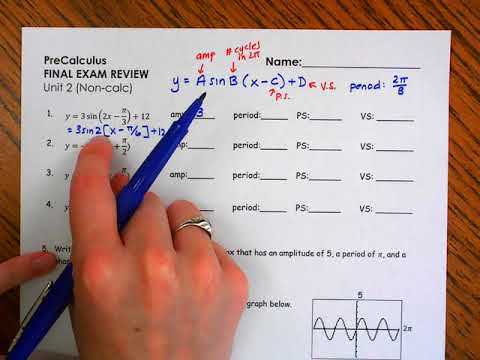
As the end of the semester approaches, precalculus students find themselves immersed in a rush of preparation for the final exam. This comprehensive test serves as a culmination of everything they have learned throughout the course, and it is a critical moment for them to showcase their understanding.
The precalculus final exam covers a wide range of topics, including trigonometry, logarithms, limits, and functions. It requires students to demonstrate their knowledge and problem-solving skills in a variety of contexts and applications. This can be a daunting task, but with proper review and practice, students can enter the exam feeling confident and prepared.
To effectively review for the precalculus final exam, it is important for students to revisit key concepts and practice solving related problems. This may involve working through old quizzes and homework assignments, reviewing class notes, and seeking clarification on any areas of confusion. Additionally, students may benefit from seeking extra help from their teacher or peers, as well as utilizing online resources and textbooks.
By devoting time and effort to a thorough review, precalculus students can increase their understanding and retention of key concepts, making them better equipped to tackle the final exam. Additionally, this type of review can help students identify weak areas and focus their study efforts more efficiently. With dedication and perseverance, success on the precalculus final exam can be within reach.
Pre-Calculus Final Exam Review
As the end of the semester approaches, it’s time to start preparing for the Pre-Calculus final exam. This comprehensive review will help you refresh your knowledge and skills in various topics covered throughout the course. Let’s take a look at some key concepts you should focus on:
1. Functions and their Properties:
- Understand the definition and properties of functions, including domain, range, and vertical line test.
- Review different types of functions, such as linear, quadratic, exponential, and logarithmic, and be able to graph them.
- Practice finding the inverse of a function and solving equations involving functions.
2. Trigonometry:
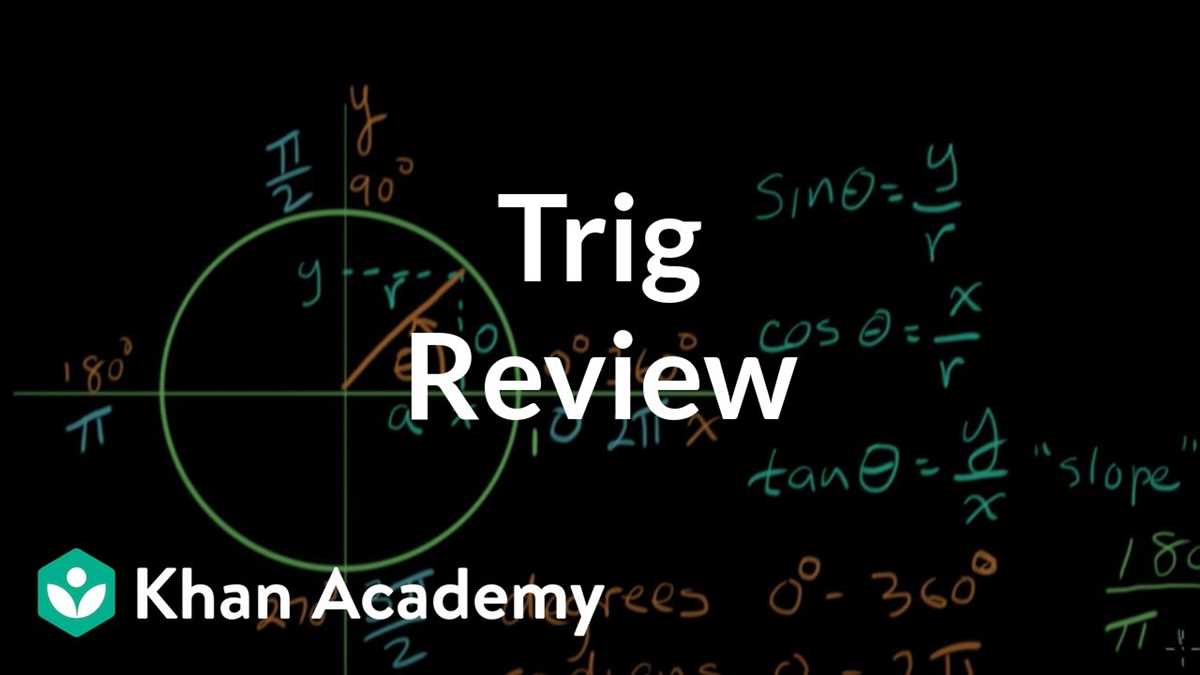
- Refresh your understanding of trigonometric functions, such as sine, cosine, and tangent.
- Review trigonometric identities and be able to solve trigonometric equations.
- Practice working with the unit circle and understanding the relationship between angles and trigonometric values.
3. Analytic Geometry:
- Review the equations of conic sections, such as circles, ellipses, parabolas, and hyperbolas.
- Understand how to graph and write equations for these conic sections.
- Practice finding the distance between points, midpoint, and slope of a line.
4. Sequences and Series:
- Review arithmetic and geometric sequences and be able to find the nth term.
- Understand the concept of series and practice finding the sum of finite arithmetic and geometric series.
Make sure to allocate enough time for studying and practicing problems in each of these areas. Consider using practice exams or working through sample problems to gauge your understanding. Good luck on your Pre-Calculus final exam!
The Importance of Pre-Calculus
Pre-calculus is a fundamental subject that plays a crucial role in preparing students for advanced mathematical concepts. It serves as a bridge between basic algebra and calculus, providing students with the necessary tools and skills to tackle complex problems. By studying pre-calculus, students develop a solid foundation in algebra, trigonometry, and analytical geometry, which are essential for success in higher-level math courses.
One of the main reasons why pre-calculus is important is because it helps students develop critical thinking and problem-solving skills. Through solving various equations, inequalities, and functions, students learn how to approach mathematical problems logically and systematically. This ability to analyze and strategize not only enhances their mathematical abilities but also carries over to other areas of life, such as decision-making and logical reasoning.
Moreover, pre-calculus acts as a prerequisite for calculus, one of the most important branches of mathematics. Calculus is widely used in fields such as physics, engineering, economics, and computer science. It involves concepts like limits, derivatives, and integrals, which build upon the concepts learned in pre-calculus. Without a solid understanding of pre-calculus, students may struggle with the more advanced concepts of calculus, limiting their opportunities in future academic and professional endeavors.
Pre-calculus also provides students with a deeper understanding of the mathematical principles that govern the natural world. Through studying trigonometry, students learn about the relationships between angles and sides of triangles, which is crucial for fields like architecture, navigation, and design. Analytical geometry helps students understand the properties of shapes and curves, enabling them to study motion, distances, and gradients. These real-world applications make pre-calculus a relevant and valuable subject.
In conclusion, pre-calculus is essential for students who wish to pursue advanced mathematics and STEM-related fields. It not only develops critical thinking and problem-solving skills but also acts as a foundation for calculus and provides insights into the natural world. Therefore, investing time and effort in pre-calculus is crucial for students aiming to excel in their future academic and professional endeavors.
Key Concepts and Formulas
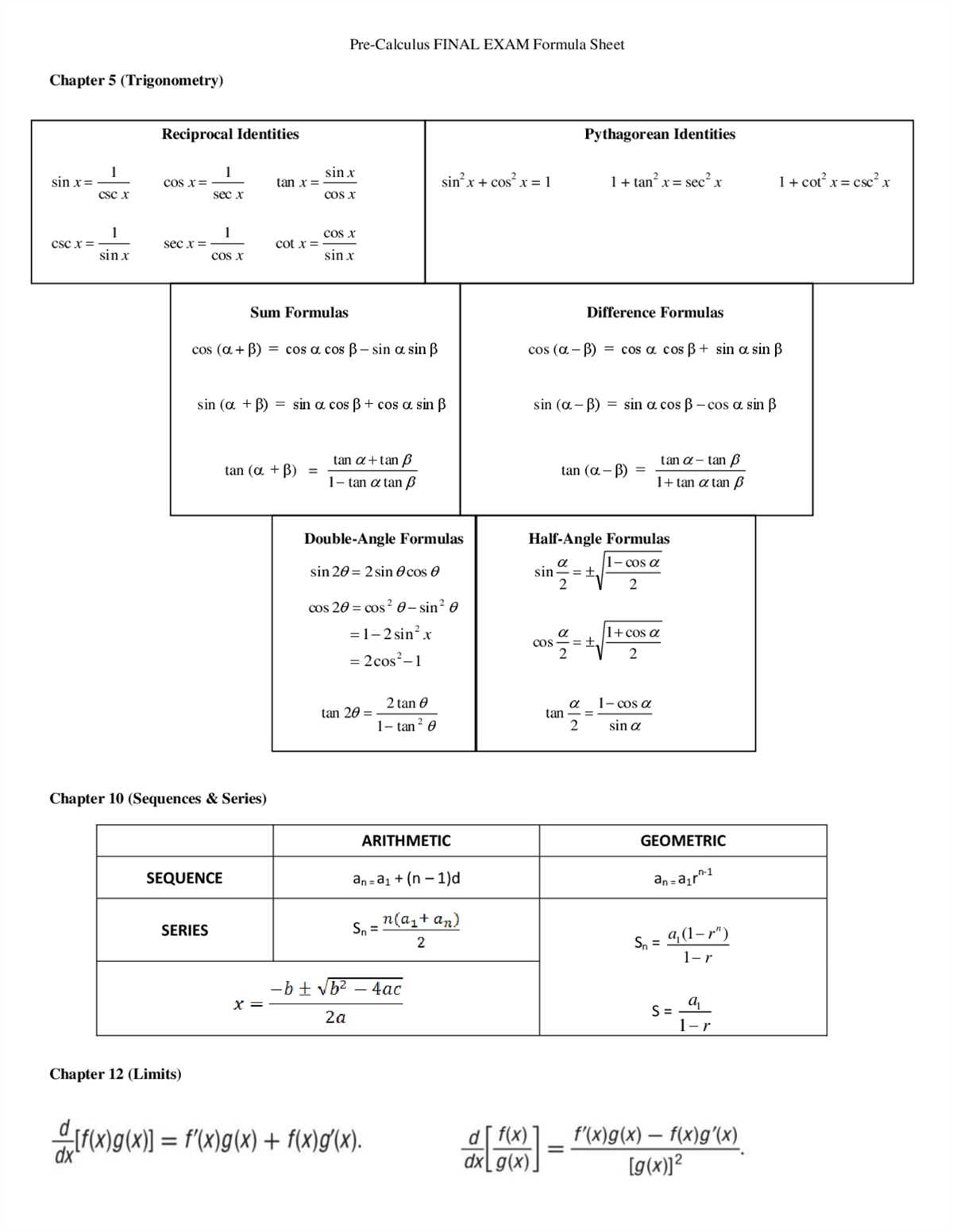
When preparing for a pre-calculus final exam, it’s important to have a solid understanding of key concepts and formulas. These foundational principles will help you solve problems and make connections between different topics in the curriculum.
Functions: Functions are a fundamental concept in pre-calculus. A function is a relation that assigns a unique output value to each input value. Key concepts related to functions include domain and range, inverse functions, and composition of functions.
Trigonometry: Trigonometry involves the study of triangles and the relationships between their sides and angles. Key formulas in trigonometry include the Pythagorean theorem, sine, cosine, and tangent ratios, as well as the double angle and half angle identities.
- The Pythagorean theorem: (a^2 + b^2 = c^2)
- Sine ratio: (sin(theta) = frac{text{opposite}}{text{hypotenuse}})
- Cosine ratio: (cos(theta) = frac{text{adjacent}}{text{hypotenuse}})
- Tangent ratio: (tan(theta) = frac{text{opposite}}{text{adjacent}})
Exponential and Logarithmic Functions: Exponential and logarithmic functions are important in many areas of mathematics and science. Key concepts related to these functions include exponential growth and decay, solving exponential and logarithmic equations, and properties of logarithms.
| Exponential Growth: | (A(t) = P(1 + r)^t) |
|---|---|
| Exponential Decay: | (A(t) = P(1 – r)^t) |
| Logarithmic Property: | (log_b(xy) = log_b(x) + log_b(y)) |
Sequences and Series: Sequences and series involve the study of ordered sets of numbers and the sums of these sets. Key concepts related to sequences and series include arithmetic and geometric sequences, the sum of a finite arithmetic or geometric series, and the infinite geometric series formula.
- Arithmetic Sequence: (a_n = a_1 + (n-1)d)
- Geometric Sequence: (a_n = a_1 cdot r^{n-1})
- Sum of Arithmetic Series: (S_n = frac{n}{2}(a_1+a_n))
- Sum of Geometric Series: (S_n = frac{a_1(1-r^n)}{1-r})
Solving Equations and Inequalities

In pre-calculus, one of the fundamental skills is the ability to solve equations and inequalities. This skill is essential for determining the unknown values of variables and finding solutions to various mathematical problems. Solving equations involves isolating the variable on one side of the equation to determine its value, while solving inequalities involves finding the range of possible values for the variable.
There are different methods to solve equations, such as using inverse operations, factoring, or applying the quadratic formula. The goal is to manipulate the equation to transform it into a form where the variable is isolated. This allows us to find the specific values of the variable that satisfy the equation. It’s important to follow the order of operations and apply the same operation to both sides of the equation to maintain equality.
When solving inequalities, the same principles apply, but with the addition of considering the direction of the inequality symbol. The solution to an inequality is expressed as a range of values that satisfy the given condition. Depending on the type of inequality, such as less than, greater than, less than or equal to, or greater than or equal to, the solution may be an open interval (excluding the endpoints) or a closed interval (including the endpoints).
It’s crucial to check the solution to an equation or inequality by substituting the found value into the original equation or inequality. This verification step ensures that the solution is valid and satisfies the given condition. In case of inequalities, it’s important to pay attention to any restrictions or domain limitations that may affect the range of solutions.
Graphing Functions
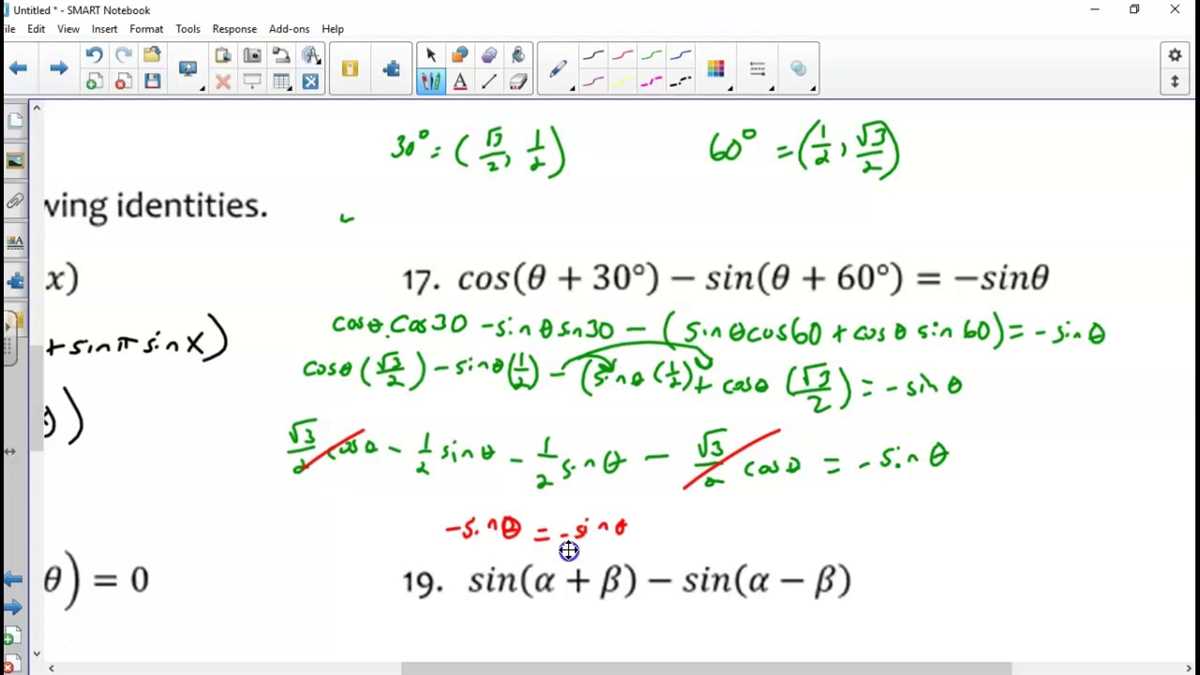
Graphing functions is an important skill in precalculus, as it allows us to visually understand the behavior and properties of different mathematical expressions. By plotting points on a coordinate plane, we can create a visual representation of a function and analyze its characteristics.
One of the first steps in graphing a function is determining its domain and range. The domain represents all the possible input values for the function, while the range represents the corresponding output values. This information helps us determine the limits of the graph and identify any gaps or restrictions.
Another key aspect of graphing functions is understanding the shape and behavior of different types of functions. For example, linear functions have a straight line graph, while quadratic functions have a parabolic shape. Exponential functions exhibit exponential growth or decay, while trigonometric functions oscillate between certain values.
In addition to plotting points, we can also identify important features of a function by examining its equation. For example, the y-intercept represents the value of the function when x is equal to zero, while the x-intercepts are the points where the function crosses the x-axis. We can also determine the maximum or minimum values of a function by finding its vertex or critical points.
To summarize, graphing functions involves identifying the domain and range, understanding the shape and behavior of different functions, and analyzing important features such as intercepts and extrema. It is a valuable tool for visualizing and interpreting mathematical expressions, and can provide valuable insights into the nature of mathematical relationships.
Trigonometry and Trigonometric Functions
Trigonometry is a branch of mathematics that deals with the relationships between the angles and sides of triangles. It is a fundamental component of pre-calculus and is used extensively in various fields such as physics, engineering, and computer science. Understanding trigonometry and its functions is essential for solving problems involving angles and distances.
Trigonometric functions are mathematical functions that relate the angles of a right triangle to the ratios of its sides. The three primary trigonometric functions are sine (sin), cosine (cos), and tangent (tan). These functions are defined using the sides of a right triangle: opposite, adjacent, and hypotenuse. The sine of an angle is the ratio of the length of the opposite side to the length of the hypotenuse, the cosine is the ratio of the adjacent side to the hypotenuse, and the tangent is the ratio of the opposite side to the adjacent side.
Trigonometric identities are mathematical equations that involve trigonometric functions. These identities are used to simplify expressions, solve equations, and prove other mathematical theorems. Some of the well-known trigonometric identities include the Pythagorean identity, which relates the squares of the sine and cosine functions, and the sum and difference identities, which relate the sum or difference of two angles to the trigonometric functions of those angles.
Trigonometry also extends beyond right triangles to include the unit circle and the concept of radian measure. The unit circle is a circle with a radius of 1 centered at the origin of a coordinate plane. Trigonometric functions can be defined using the coordinates of points on the unit circle, allowing for the calculation of angles in radians. Radian measure is an alternative method of measuring angles that uses the radius of a circle as the unit of measure. It is often preferred in trigonometry because it simplifies calculations and provides a more intuitive understanding of angles.
In summary, trigonometry and its functions play a crucial role in pre-calculus and have applications in various fields. Understanding trigonometry allows for the solving of problems involving angles and distances, while trigonometric identities and the unit circle provide additional tools for simplifying expressions and calculating angles.
Conclusion
Pre-Calculus is a fundamental course that serves as a bridge between algebra and calculus, providing students with the necessary skills and knowledge to tackle more advanced mathematical concepts. Throughout this article, we have explored various applications of Pre-Calculus in real-life scenarios, including solving equations and inequalities, analyzing functions, and understanding mathematical modeling.
By studying Pre-Calculus, students can develop critical thinking and problem-solving skills that are invaluable in many fields such as engineering, physics, computer science, and economics. These skills enable individuals to analyze complex situations, make informed decisions, and solve real-world problems.
Furthermore, Pre-Calculus lays the foundation for calculus, which is a cornerstone of advanced mathematics. A solid understanding of Pre-Calculus concepts is essential in mastering calculus topics such as derivatives, integrals, and applications of calculus.
In conclusion, Pre-Calculus has wide-ranging applications in various disciplines and is a crucial stepping stone towards higher-level mathematics. Whether you are pursuing a career in STEM or simply want to enhance your analytical thinking skills, studying Pre-Calculus will undoubtedly benefit you in many ways.