Real Numbers Test: Assessing Your Mathematical Skills
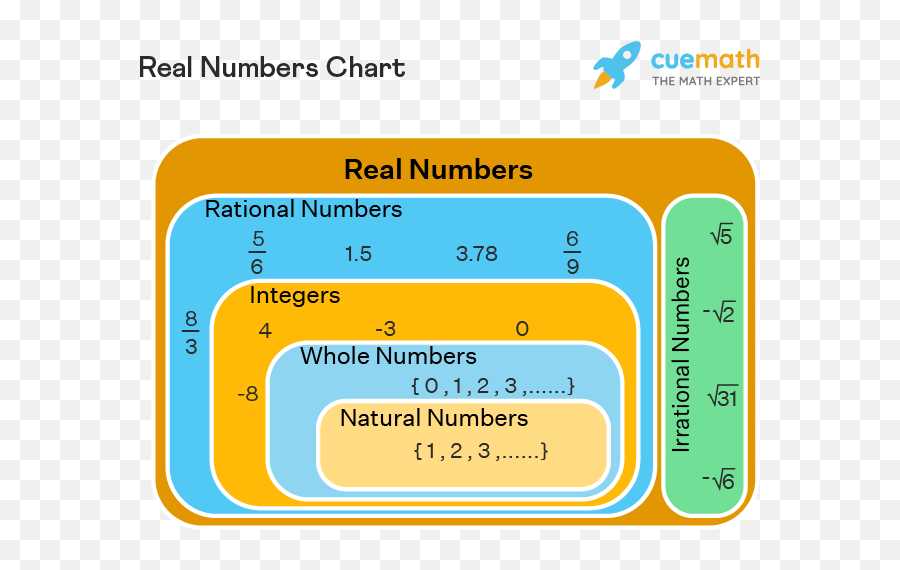
Real numbers are an essential concept in mathematics, and understanding them is crucial for a solid foundation in the subject. A real number is a number that can be represented on the number line, including both rational and irrational numbers. In order to assess and evaluate your understanding of real numbers, taking a real numbers test can be highly beneficial.
Real numbers tests are designed to assess your knowledge and comprehension of various concepts related to real numbers. These tests often include questions that involve identifying real numbers, classifying numbers into different categories, solving problems with real numbers, and analyzing the properties of real numbers.
By taking a real numbers test, you can identify any gaps in your understanding and address them accordingly. It can help you reinforce your knowledge and develop a deeper understanding of the principles and properties of real numbers. Additionally, these tests can also enhance problem-solving skills and logical thinking abilities as they often require critical thinking and application of concepts to solve problems.
What are real numbers?
Real numbers are a fundamental concept in mathematics. They represent the complete set of numbers that can be measured on a real line. Real numbers include both rational and irrational numbers. Rational numbers are numbers that can be expressed as a fraction, while irrational numbers cannot be expressed as a fraction.
The set of real numbers is infinite and contains all possible values between negative infinity and positive infinity. Real numbers can be positive, negative, or zero. They can also be whole numbers, integers, or decimals.
Rational Numbers: Rational numbers include integers and fractions. They can be positive or negative, and their decimal representation either terminates or repeats. For example, the number 2 is a rational number because it can be expressed as the fraction 2/1 or the decimal 2.0. Similarly, the number 1/2 is a rational number because it can be expressed as the decimal 0.5.
Irrational Numbers: Irrational numbers cannot be expressed as a fraction. Their decimal representation does not terminate or repeat. Examples of irrational numbers include the square root of 2 (√2), pi (π), and Euler’s number (e). These numbers have decimal representations that go on forever without repeating, and they cannot be expressed as fractions.
In summary, real numbers encompass all possible values on the real number line, including rational and irrational numbers. They can be positive, negative, or zero, and can be expressed as fractions or decimals.
Properties of Real Numbers
The real numbers are a set of numbers that includes both rational and irrational numbers. They can be represented on a number line and have several properties that make them unique and interesting.
1. Closure Property: One of the fundamental properties of real numbers is closure, which means that the sum, difference, product, or quotient of any two real numbers is also a real number. For example, if you add two real numbers, the result will always be a real number.
2. Associative Property: The associative property states that the grouping of numbers in an operation does not affect the result. For addition, it means that (a + b) + c is equal to a + (b + c). The same applies to multiplication: (ab)c = a(bc). This property allows us to simplify calculations and manipulate expressions without changing the outcome.
3. Commutative Property: The commutative property implies that the order in which numbers are added or multiplied does not affect the result. For addition, it means that a + b = b + a. For multiplication, it means that ab = ba. This property allows us to rearrange terms and perform operations without altering the final result.
4. Distributive Property: The distributive property connects addition and multiplication by stating that a(b + c) = ab + ac. It allows us to simplify expressions and perform calculations involving multiple terms.
5. Identity Properties: The identity properties state that there are two special real numbers, 0 and 1, which have unique properties when used in operations. The additive identity property states that adding 0 to any number does not change its value: a + 0 = a. The multiplicative identity property states that multiplying any number by 1 does not change its value: a * 1 = a.
6. Inverse Properties: The inverse properties state that for every real number, there exists an additive inverse and a multiplicative inverse. The additive inverse of a number a is denoted as -a and satisfies the equation a + (-a) = 0. The multiplicative inverse of a number a (except for zero) is denoted as 1/a and satisfies the equation a * (1/a) = 1.
These properties of real numbers play a crucial role in various areas of mathematics, including algebra, calculus, and number theory. Understanding and applying these properties can help simplify calculations, solve equations, and prove mathematical theorems.
Operations with real numbers

In mathematics, real numbers are a fundamental concept that represents quantities in the real world. Operations with real numbers involve various calculations and manipulations of these numbers to find their sum, difference, product, or quotient.
Addition and subtraction: When adding or subtracting real numbers, you can simply combine the terms with the same sign and add their absolute values. For example, adding -3 and 5 results in 2 since |-3| + 5 = 3 + 5 = 8. When subtracting, you can change the sign of the second number and then perform addition. For instance, subtracting 7 from -2 is equivalent to -2 + (-7) = -9.
Multiplication and division: To multiply or divide real numbers, you can simply multiply or divide their absolute values and assign the product or quotient the appropriate sign. For example, multiplying -4 and 3 gives -12 since |-4| × 3 = 4 × 3 = 12, and the negative sign indicates the result is negative. Similarly, dividing -21 by -7 yields 3 since |-21| ÷ |-7| = 21 ÷ 7 = 3, and the negative signs cancel out.
- Distributive property: The distributive property allows you to distribute a number or variable term to each term within parentheses. For instance, -2(3 + 4) is equal to -2 × 3 + -2 × 4, resulting in -6 + -8 = -14.
- Order of operations: When performing multiple operations with real numbers, it is important to follow the order of operations. This involves solving expressions within parentheses first, then performing any multiplication or division from left to right, and finally executing addition or subtraction from left to right. For example, in the expression 4 – 2 × (5 – 3 ÷ 2) + 1, you would begin by evaluating the subtraction within parentheses, resulting in 4 – 2 × (5 – 1) + 1. Continuing with multiplication, the expression simplifies to 4 – 2 × 4 + 1. Finally, performing the remaining operations yields the answer of 4 – 8 + 1 = -3.
By understanding and applying these rules, you can solve various problems involving operations with real numbers and develop a strong foundation for more advanced mathematical concepts.
Real numbers on the number line
The number line is a visual representation of real numbers. It is a horizontal line that extends infinitely in both directions. Real numbers are represented on the number line by points or dots. Each point on the number line corresponds to a unique real number, and each real number has a unique point on the number line. The number line is a useful tool for understanding the order and magnitude of real numbers.
Real numbers can be classified into different categories on the number line. For example, positive numbers are located to the right of zero, while negative numbers are located to the left of zero. Zero itself is a real number located at the center of the number line. Real numbers can also be categorized as integers, which are whole numbers without fractions or decimals, or as rational numbers, which can be written as a fraction. Irrational numbers, such as pi or the square root of 2, cannot be written as a fraction and are located between rational numbers on the number line.
Real numbers on the number line can be compared using the concepts of greater than, less than, and equal to. When comparing two real numbers, the point on the number line that represents the greater number will be to the right of the point that represents the lesser number. In addition to comparison, real numbers can also be added, subtracted, multiplied, and divided on the number line. These operations can be visualized by moving along the number line in the appropriate direction to represent the operation.
In summary, the number line is a visual representation of real numbers. It allows us to understand the order, magnitude, and relationships between different real numbers. Real numbers on the number line can be classified, compared, and operated on using various mathematical concepts and operations. The number line is an essential tool for understanding and working with real numbers in mathematics.
Applications of Real Numbers
Real numbers have a wide range of applications in various fields, including mathematics, science, finance, and engineering. They are used to represent quantities that can be measured or counted, and their properties make them ideal for solving real-world problems.
Mathematics: Real numbers are fundamental in almost all branches of mathematics. They are used in algebra, calculus, number theory, and geometry, among other fields. Real numbers help in solving equations, calculating limits, finding roots, and representing geometric figures.
Science: Real numbers play a crucial role in scientific research and experimentation. In physics, real numbers are used to describe physical quantities such as mass, distance, time, and temperature. In chemistry, they are used in calculations involving concentrations, reaction rates, and molecular structures.
Finance: Real numbers are extensively used in financial calculations and analysis. They are used to represent monetary amounts, interest rates, stock prices, and other financial indicators. Real numbers help in performing calculations related to investments, loans, and asset valuation.
Engineering: Real numbers are essential in engineering design, analysis, and simulation. They are used to quantify physical properties like force, pressure, energy, and power. Engineers use real numbers in calculations related to structural design, fluid dynamics, electrical circuits, and signal processing.
In conclusion, real numbers are a fundamental concept in mathematics and have widespread applications in various fields. Their properties and versatility make them invaluable for solving real-world problems in disciplines such as mathematics, science, finance, and engineering.