Mastering Scientific Notation Word Problems with Step-by-Step Solutions
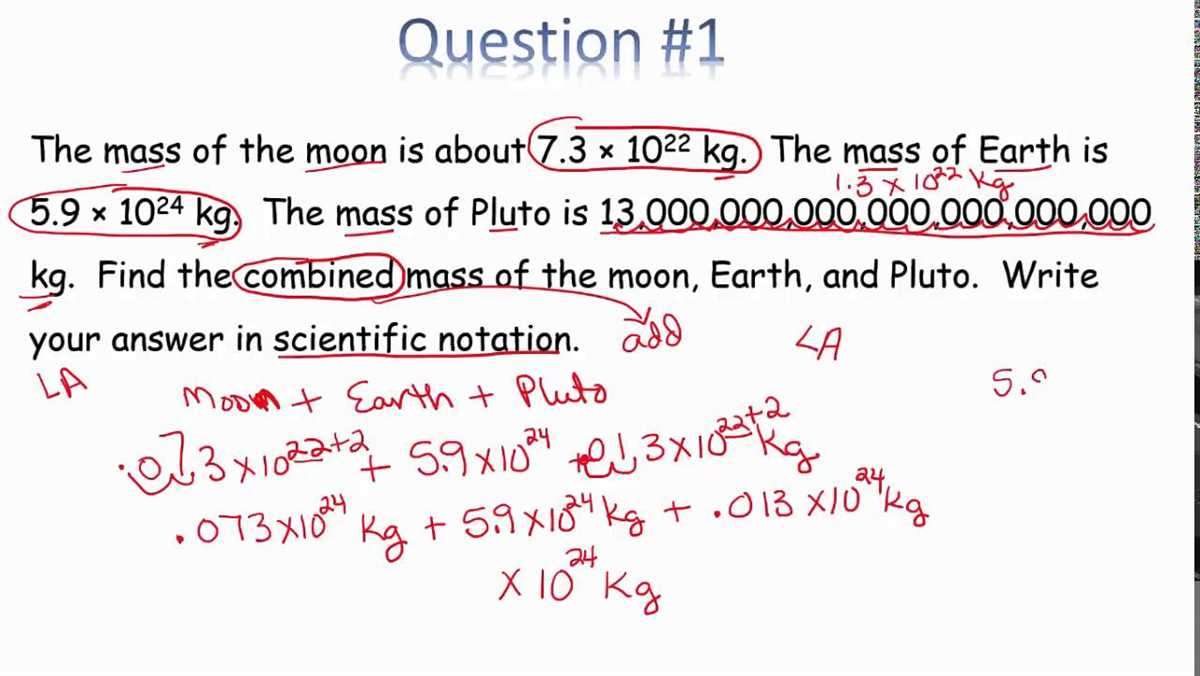
Scientific notation is a shorthand way of expressing large or small numbers in a more compact and manageable form. It is commonly used in scientific and mathematical calculations, as well as in everyday life. Understanding how to work with scientific notation is an essential skill for anyone studying or working in fields such as physics, chemistry, or engineering.
One of the best ways to practice and reinforce your understanding of scientific notation is by working through word problems. These problems provide real-life scenarios where scientific notation can be applied. They require you to think critically, convert numbers between standard and scientific notation, and perform calculations using the rules of scientific notation.
This worksheet provides a collection of word problems that cover various topics, including distance, time, population, and measurements. Each problem is accompanied by detailed explanations and step-by-step solutions, allowing you to check your answers and learn from any mistakes you may make. By completing these problems, you will gain confidence in your ability to use scientific notation effectively and apply it to a wide range of situations.
Scientific Notation Word Problems Worksheet with Answers

The concept of scientific notation is an important skill in mathematics and science. It is a way to express very large or very small numbers in a concise and compact form. Scientific notation is commonly used in scientific research, engineering, and other fields that deal with extremely large or small quantities.
A scientific notation word problems worksheet is a useful tool for practicing and mastering the skill of converting numbers to and from scientific notation. It typically includes a series of word problems that require students to convert numbers to scientific notation, perform operations with numbers in scientific notation, and convert numbers back to standard form.
Here are a few examples of word problems that might be included in a scientific notation worksheet:
- Astronomical distances are often expressed in scientific notation. The distance from the Earth to the Sun is approximately 93 million miles. In scientific notation, this would be written as 9.3 x 10^7 miles. Calculate the distance from the Earth to the Sun in kilometers, given that 1 mile is approximately equal to 1.609 kilometers.
- The mass of an electron is approximately 9.10938356 × 10^-31 kilograms. Find the mass of 10^23 electrons in kilograms.
- The speed of light is approximately 299,792,458 meters per second. Express this speed in scientific notation.
These word problems require students to not only convert numbers to and from scientific notation, but also to perform calculations with numbers in scientific notation. Answer keys are often provided with these worksheets to help students check their work and understand the correct answers.
By practicing word problems with scientific notation, students can strengthen their understanding of this important mathematical concept and build their problem-solving skills. These worksheets provide a valuable resource for teachers and students alike, helping them to explore and master scientific notation in a practical and engaging way.
Understanding Scientific Notation

In the field of science and mathematics, it is common to work with numbers that are extremely large or incredibly small. For instance, the distance between planets in our solar system or the size of an atom. To simplify the representation of these numbers, scientists and mathematicians use a notation called “scientific notation.” This notation allows them to express these numbers in a concise and standardized way.
Scientific notation is a way of writing numbers that are very large or very small in a form that is easier to understand and manipulate. It consists of two parts: a coefficient and an exponent. The coefficient is a number between 1 and 10 and the exponent indicates the power of 10 by which the coefficient is multiplied. For example, the number 2,000,000,000 can be expressed in scientific notation as 2 x 10^9.
In scientific notation, numbers greater than 1 have positive exponents, while numbers smaller than 1 have negative exponents. For example, the number 0.000003 can be written in scientific notation as 3 x 10^-6. Using scientific notation allows scientists and mathematicians to work with these numbers more easily, perform calculations, and compare different values.
Scientific notation is particularly important in physics, chemistry, and astronomy, where measurements often involve very large or very small quantities. It provides a way to communicate these quantities accurately and concisely, without the need for lengthy and cumbersome decimal representations. Understanding and using scientific notation is an essential skill for anyone working in these scientific fields.
Converting Numbers to Scientific Notation
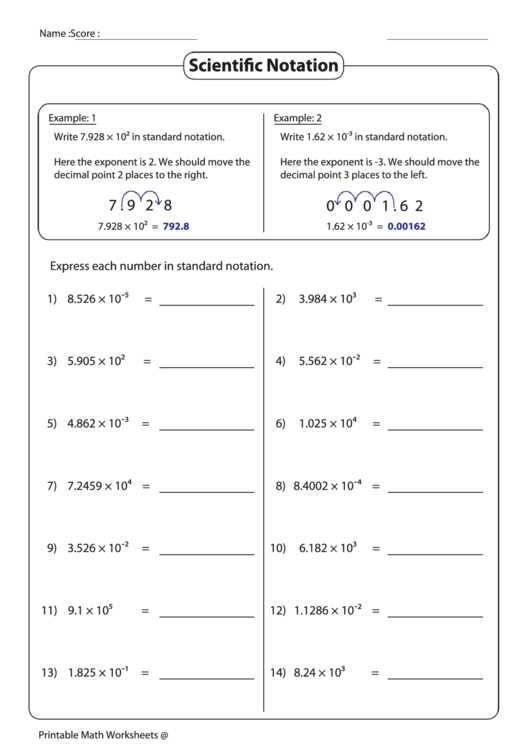
In mathematics and science, it is often necessary to work with very large or very small numbers. Converting these numbers to scientific notation can make them easier to understand and work with. Scientific notation is a way of expressing numbers as a product of a decimal number between 1 and 10 and a power of 10.
To convert a number to scientific notation, follow these steps:
- Identify the decimal place in the original number.
- Move the decimal point to the right or left to create a decimal number between 1 and 10.
- Count the number of places you moved the decimal point.
- Write the decimal number as the coefficient and the number of places you moved the decimal point as the exponent of 10.
For example, let’s convert the number 6,500,000,000 to scientific notation:
- The decimal place is after the last digit, so move the decimal point to create the decimal number 6.5.
- We moved the decimal point 9 places to the left to create 6.5.
- The coefficient is 6.5 and the exponent of 10 is 9.
- Therefore, 6,500,000,000 can be written in scientific notation as 6.5 x 10^9.
Converting numbers to scientific notation is an important skill for scientists, engineers, and mathematicians. It allows for easier manipulation and comparison of numbers that are either too large or too small to work with in standard decimal form.
Adding and Subtracting Numbers in Scientific Notation
Scientific notation is a way to express very large or very small numbers using powers of 10. It is commonly used in scientific and mathematical calculations because it allows for easier representation and manipulation of these numbers. When adding or subtracting numbers in scientific notation, it is important to first ensure that both numbers have the same exponent. This can be achieved by converting one or both numbers so that they have the same power of 10.
To add or subtract numbers in scientific notation, follow these steps:
- Write the numbers with the same exponent.
- Add or subtract the coefficients while keeping the exponent the same.
- If necessary, adjust the coefficient to ensure that it is between 1 and 10.
- If needed, convert the final result back to scientific notation.
For example, let’s add the numbers 3.5 x 10^4 and 2.1 x 10^3:
- Write the numbers with the same exponent: 3.5 x 10^4 and 0.021 x 10^4.
- Add the coefficients: 3.5 + 0.021 = 3.521.
- Adjust the coefficient to be between 1 and 10: 3.521 = 3.521 x 10^4.
- The final result is 3.521 x 10^4.
Subtraction follows the same steps, but with the subtraction of the coefficients instead.
Adding and subtracting numbers in scientific notation allows for efficient and accurate calculations when working with very large or very small quantities. Practice and familiarity with these operations can greatly enhance mathematical and scientific proficiency.
Multiplying and Dividing Numbers in Scientific Notation

When working with very large or very small numbers, it can be cumbersome to write them out in standard decimal notation. This is where scientific notation comes in handy. Scientific notation is a way to express these numbers in a more compact form, using powers of 10. In scientific notation, a number is written as the product of a decimal number between 1 and 10, and a power of 10.
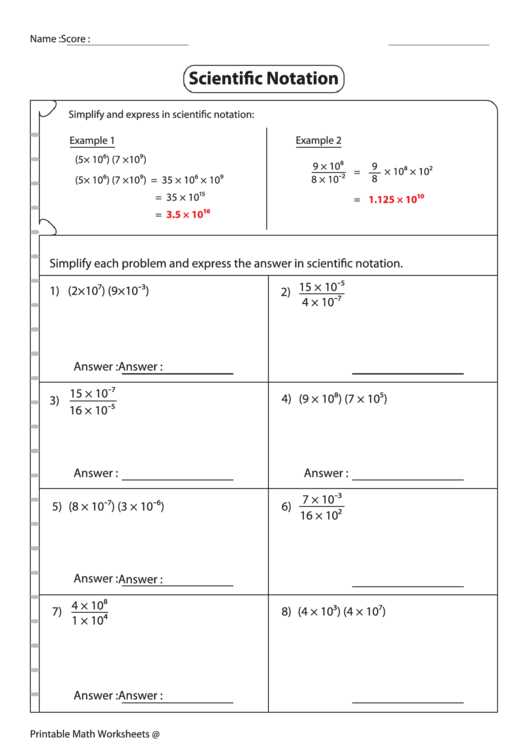
When multiplying numbers in scientific notation, you can simply multiply the decimal parts and add the exponents of the powers of 10. For example, if we have (2 x 10^3) x (3 x 10^2), we would multiply 2 x 3 to get 6, and add the exponents to get 10^5. Therefore, the result of the multiplication would be 6 x 10^5.
When dividing numbers in scientific notation, you can divide the decimal parts and subtract the exponents of the powers of 10. For example, if we have (6 x 10^5) ÷ (3 x 10^2), we would divide 6 by 3 to get 2, and subtract the exponents to get 10^3. Therefore, the result of the division would be 2 x 10^3.
Example:

Calculate the product of (2 x 10^4) and (3 x 10^3).
- Multiply the decimal parts: 2 x 3 = 6
- Add the exponents: 10^4 + 10^3 = 10^7
Therefore, the product of (2 x 10^4) and (3 x 10^3) is 6 x 10^7.
Remember that when multiplying or dividing numbers in scientific notation, it is important to keep track of the decimal parts and the exponents of the powers of 10. It can also be helpful to convert the numbers to standard decimal notation before performing the calculations, if necessary.
Word Problems Involving Scientific Notation

Word problems involving scientific notation require students to apply their understanding of scientific notation and use it to solve real-world scenarios. These problems often involve large or small numbers that are more conveniently expressed in scientific notation, which is a way to represent numbers that are very large or very small using a coefficient and a power of 10.
One common type of word problem involving scientific notation is converting between scientific notation and standard notation. For example, students may be asked to convert 3.4 x 10^7 into standard form, which would be 34,000,000. Conversely, they may be asked to convert 5,600,000 into scientific notation, which would be 5.6 x 10^6.
Another type of word problem involving scientific notation is performing calculations with numbers in scientific notation. This may include addition, subtraction, multiplication, or division of numbers expressed in scientific notation. For instance, students may need to add 2.3 x 10^5 and 4.5 x 10^4, which would result in 2.74 x 10^5. They may also need to multiply 6.8 x 10^3 by 3.2 x 10^2, which would equal 2.176 x 10^6.
Word problems involving scientific notation often require critical thinking and problem-solving skills, as students need to determine the appropriate operations to use and apply their knowledge of scientific notation to solve the problems. These types of problems can help students develop a deeper understanding of scientific notation and its applications in the real world.
Practice Worksheet with Answer Key
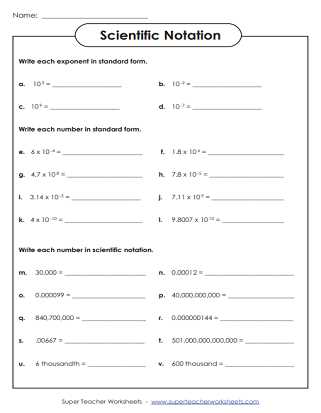
Looking to improve your skills in scientific notation? This practice worksheet with answer key is the perfect tool to help you sharpen your understanding and problem-solving abilities. Whether you’re a student studying math or a professional working in a scientific field, this worksheet provides the opportunity to reinforce your knowledge and build confidence.
Featuring a variety of word problems, this worksheet challenges you to work with numbers in scientific notation format. You’ll have the chance to practice converting numbers from standard to scientific notation and vice versa. Additionally, you’ll solve problems involving operations with numbers in scientific notation, including addition, subtraction, multiplication, and division.
The accompanying answer key allows you to check your solutions and identify areas for improvement. It provides step-by-step explanations for each problem, ensuring that you understand the reasoning behind the correct answer. This feedback will help you develop a strong foundation in scientific notation and equip you with the skills needed to tackle more advanced problems in the future.
By regularly using this practice worksheet, you’ll increase your fluency in working with numbers in scientific notation. It will become second nature to you, enabling you to solve complex problems efficiently and accurately. Whether you’re preparing for an upcoming exam or simply want to enhance your mathematical abilities, this practice worksheet with answer key is an invaluable resource.
Key Features:
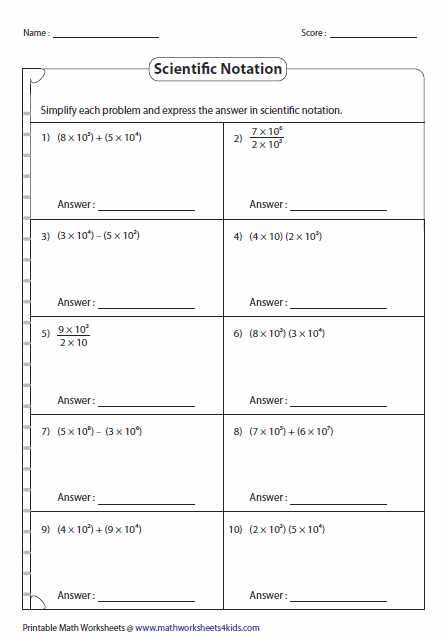
- Word problems in scientific notation format
- Converting numbers between standard and scientific notation
- Operations with numbers in scientific notation (addition, subtraction, multiplication, division)
- Detailed answer key with step-by-step explanations
- Opportunity to reinforce knowledge and build confidence in scientific notation
If you’re ready to take your skills in scientific notation to the next level, start using this practice worksheet with answer key today. With dedication and practice, you’ll become a master of scientific notation in no time.