Simplifying Scientific Notation: A Step-by-Step Guide
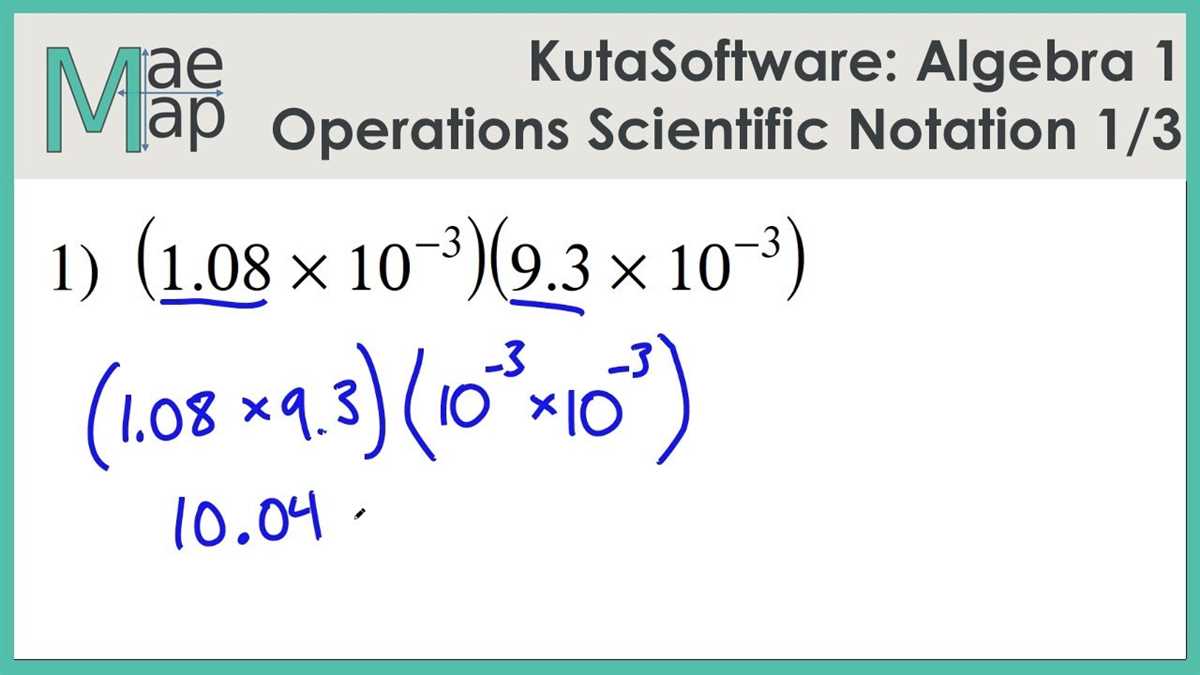
Scientific notation is a way to express very large or very small numbers in a more compact and manageable format. It is commonly used in scientific and mathematical calculations, as well as in various fields of study such as astronomy and chemistry. By expressing numbers in scientific notation, we can easily understand their magnitude and make calculations more efficient.
To simplify and write each answer in scientific notation, we follow a set of rules. First, we express the number as a decimal between 1 and 10, followed by a multiplication sign and a power of 10. This power of 10 indicates how many places the decimal point needs to be moved to get the original number.
For example, if we have a very large number like 500,000, we can write it as 5 x 10^5 in scientific notation. The decimal point has been moved 5 places to the left to get to the original number. On the other hand, if we have a very small number like 0.00002, we can express it as 2 x 10^-5. The decimal point has been moved 5 places to the right.
In scientific notation, the exponent of 10 can be positive or negative, depending on whether the number is very large or very small. By using scientific notation, we can simplify complex calculations and better understand the magnitude of numbers. It is an essential tool in scientific and mathematical disciplines and is widely used in various fields of study.
What is scientific notation?
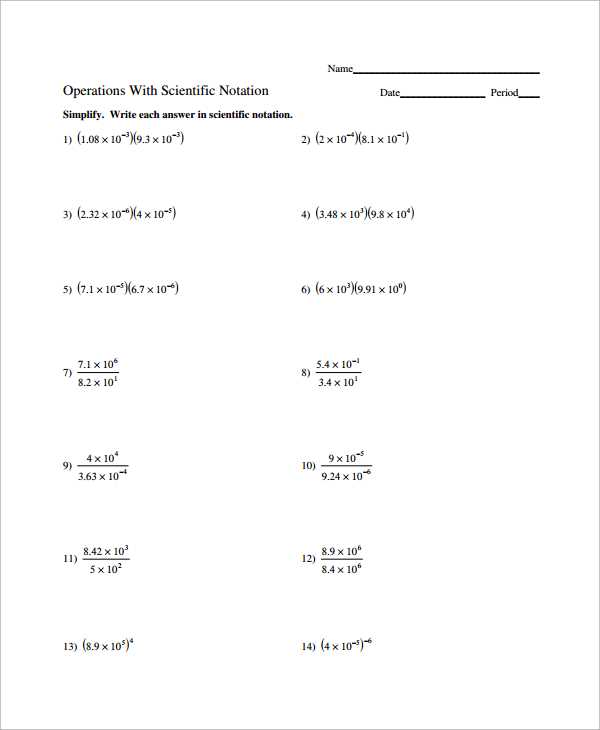
Scientific notation is a way to express very large or very small numbers in a compact and standardized form. It is commonly used in scientific and mathematical calculations, as well as in fields such as astronomy, physics, and chemistry. Scientific notation is based on powers of 10, and it allows us to write numbers in the form of a decimal coefficient multiplied by a power of 10.
The scientific notation format consists of two parts: the coefficient and the exponent. The coefficient is a decimal number between 1 and 10, while the exponent represents the power of 10 by which the coefficient is multiplied. The exponent can be positive if the number is very large, or negative if the number is very small. For example, the number 123,000,000 can be expressed in scientific notation as 1.23 x 10^8, where 1.23 is the coefficient and 8 is the exponent.
The use of scientific notation allows for easier and more concise representation of extremely large or small numbers. It simplifies calculations involving these numbers and provides a standardized format that is widely understood and accepted. In addition, scientific notation makes it easier to compare and analyze numbers that differ greatly in magnitude. It is a useful tool in scientific research and everyday life, helping us make sense of the vast numbers that exist in our universe.
How to write numbers in scientific notation
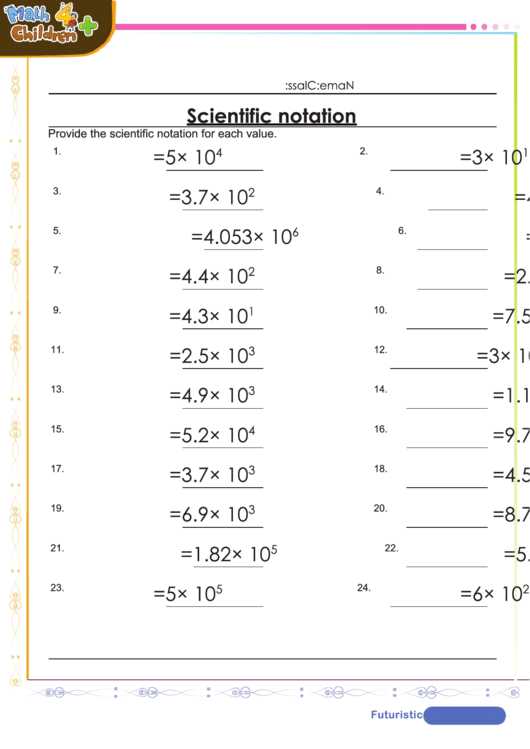
The scientific notation is a way to express very large or very small numbers in a more compact and convenient form. It is commonly used in scientific and mathematical calculations, as well as in representing data from various scientific fields.
To write a number in scientific notation, you need to express it as the product of a number between 1 and 10 (known as the coefficient) and a power of 10. The coefficient should have only one digit before the decimal point, and it can be either a whole number or a decimal number.
To convert a number to scientific notation, you need to consider the number of decimal places you need to move the decimal point to make it a number between 1 and 10. If you move the decimal point to the left, the power of 10 will be positive. If you move it to the right, the power of 10 will be negative. The absolute value of the power of 10 represents the number of decimal places you moved the decimal point.
For example, let’s take the number 345,000,000. To write it in scientific notation, we can move the decimal point to the left 8 places to get 3.45 and multiply it by 10^8. So, 345,000,000 is written as 3.45 x 10^8 in scientific notation.
Similarly, if we have a small number like 0.00000000218, we can move the decimal point to the right 9 places to get 2.18 and multiply it by 10^-9. So, 0.00000000218 can be written as 2.18 x 10^-9 in scientific notation.
- To write a number in scientific notation:
- Identify the coefficient (the number between 1 and 10)
- Count the decimal places and determine the power of 10
- Write the coefficient and the power of 10 using the exponent notation
Scientific notation is a powerful tool in expressing and working with large and small numbers. It allows scientists and mathematicians to perform calculations more easily and represent data in a more concise manner.
Steps to simplify writing each answer in scientific notation
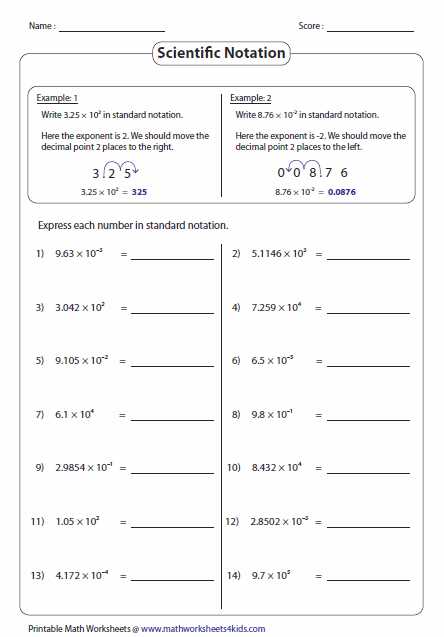
Scientific notation is a way to express very large or very small numbers in a concise and standardized format. To simplify writing each answer in scientific notation, follow these steps:
- Determine the order of magnitude: Identify the power of 10 that corresponds to the size of the number. If the number is larger than 0, count the number of digits to the left of the decimal point. If the number is smaller than 0, count the number of zeros to the right of the decimal point.
- Identify the significand: The significand is the base number that, when multiplied by the power of 10, gives the original number. It should be a decimal number between 1 and 10.
- Write the answer in scientific notation: Combine the significand and the power of 10 using the format a x 10^b, where a is the significand and b is the power of 10.
For example, let’s simplify the number 240,000,000 in scientific notation:
- The order of magnitude is 9, since there are 9 digits to the left of the decimal point.
- The significand is 2.4, since the number can be expressed as 2.4 x 10^9.
- The answer in scientific notation is 2.4 x 10^9.
Following these steps will ensure that you accurately and concisely express numbers in scientific notation, making them easier to work with in scientific and mathematical calculations.
Examples of writing answers in scientific notation
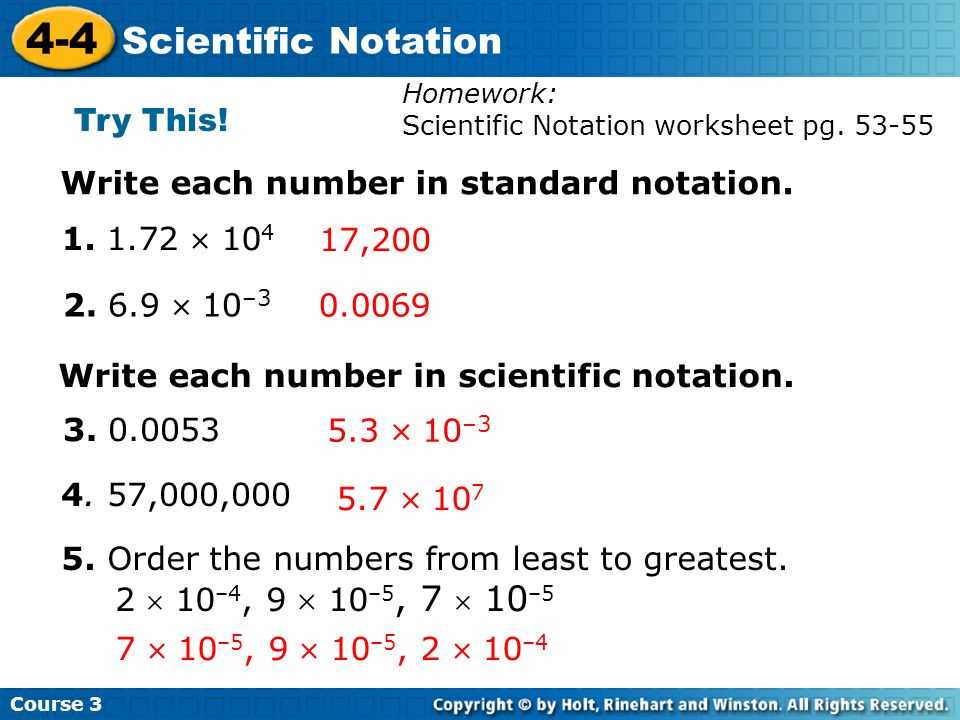
Scientific notation is a convenient way to express very large or very small numbers. It is particularly useful in scientific and mathematical calculations where precision and accuracy are important. In scientific notation, a number is expressed as a product of a decimal number between 1 and 10, and some power of 10. Here are some examples of writing answers in scientific notation:
1. Expressing a large number:
- Original number: 500,000
- Scientific notation: 5 x 10^5
In this example, the original number is 500,000. To express it in scientific notation, we can write it as 5 multiplied by 10 raised to the power of 5. This simplifies the representation of the number and makes it easier to work with in calculations.
2. Expressing a small number:
- Original number: 0.0000012
- Scientific notation: 1.2 x 10^-6
Here, the original number is a small decimal, 0.0000012. To write it in scientific notation, we move the decimal point 6 places to the right, and multiply it by 10 raised to the power of -6. This gives us a concise representation of the number.
3. Expressing a very large or small result of a calculation:
- Original number: 3.2 x 10^9
- Scientific notation: 3.2 x 10^9
In some cases, the answer to a calculation may already be in scientific notation. In such cases, we can simply write the result as it is without any further simplification.
These examples demonstrate how scientific notation simplifies the representation of numbers, making them more manageable and easier to work with in various calculations and scientific contexts.
Why is scientific notation important?
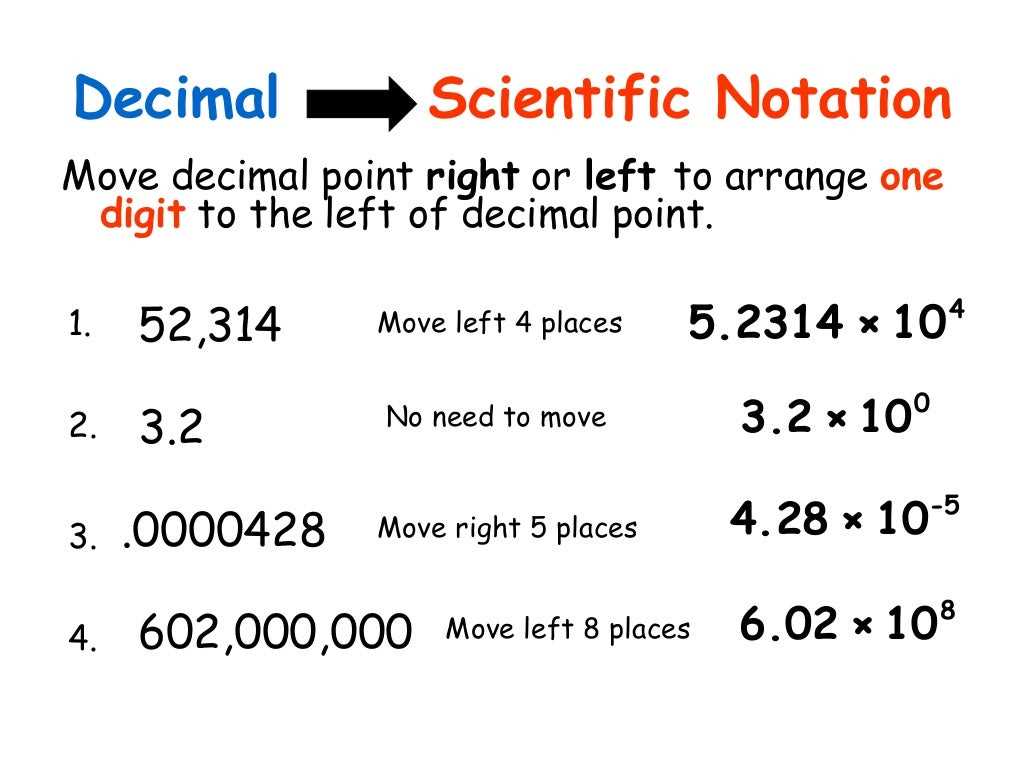
Scientific notation is a mathematical representation of numbers that makes it easier to work with extremely large or small numbers. It is important in various fields of study and practical applications because it allows scientists, mathematicians, and engineers to express these numbers in a concise and standardized format.
1. Ease of representation: Scientific notation simplifies the representation of very large or very small numbers. By expressing numbers in the form of a decimal coefficient multiplied by a power of 10, it becomes easier for scientists to perform calculations and compare values without dealing with an excessive number of zeros.
2. Clarity and precision: Scientific notation provides a clear and precise way to communicate the magnitude of a number. It allows for easier comprehension of numbers in scientific papers, research studies, and technical documents, ensuring accurate data interpretation and analysis.
3. Space-saving: Using scientific notation helps save space, especially in charts, graphs, and tables, where there may be limited space available for number representation. The compact nature of scientific notation allows for more efficient use of space and facilitates the clear presentation of data.
4. International standard: Scientific notation is an internationally recognized standard for expressing numbers in scientific and technical contexts. It ensures consistency and uniformity in numerical representation, enabling seamless collaboration and understanding among scientists, researchers, and engineers around the world.
5. Application across disciplines: Scientific notation is not limited to specific fields of study. It is widely used in various disciplines, including physics, chemistry, biology, astronomy, engineering, and economics. By adopting scientific notation, professionals from different backgrounds can easily communicate and exchange numerical information.
In conclusion, scientific notation plays a crucial role in simplifying the representation, enhancing clarity and precision, saving space, establishing an international standard, and enabling cross-disciplinary communication. Its importance extends beyond mathematics and science, making it an essential tool for anyone working with numbers in a professional capacity.