Unraveling the Mystery: Complex Numbers Worksheet Answer Key Made Simple

In the world of mathematics, complex numbers can often be a confusing topic for students to grasp. With their combination of real and imaginary components, simplifying complex numbers can be a daunting task. However, with the help of a worksheet and an answer key, students can gain a deeper understanding of this topic.
A simplifying complex numbers worksheet typically consists of a series of problems where students are required to simplify complex expressions. These problems may involve addition, subtraction, multiplication, and division of complex numbers. The answer key provides step-by-step solutions to each problem, allowing students to check their work and understand the process.
By using a worksheet and an answer key, students can practice simplifying complex numbers in a structured and organized way. They can work through a variety of problems, gaining confidence and familiarity with the process. This practice will help them become more proficient in working with complex numbers and build a solid foundation for further mathematical concepts.
Simplifying Complex Numbers Worksheet Answer Key
In the study of complex numbers, it is important to be able to simplify expressions involving these numbers. This allows us to work with complex numbers more effectively and to solve various mathematical problems. A simplification of a complex number can be done by combining like terms and performing basic arithmetic operations, such as addition, subtraction, multiplication, and division.
In the Simplifying Complex Numbers Worksheet Answer Key, you will find the simplified expressions for various complex numbers. The key provides step-by-step solutions and explanations for each problem, allowing you to follow along and understand the process of simplification. It also includes examples and practice problems to help you improve your skills.
The answer key covers topics such as simplifying expressions involving imaginary numbers, simplifying expressions with both real and imaginary parts, and simplifying complex numbers in exponential form. Each problem in the worksheet is specifically designed to challenge your understanding of complex numbers and to reinforce the concepts learned in class.
- Example: Simplify the complex number (3 + 2i) – (2 – i).
To simplify this expression, we can combine the real parts and the imaginary parts separately. For the real parts, we have 3 – 2 = 1. For the imaginary parts, we have 2i + i = 3i. Therefore, the simplified form of the expression is 1 + 3i.
By using the Simplifying Complex Numbers Worksheet Answer Key, you can practice simplifying complex numbers and gain confidence in your ability to work with these numbers. It is a valuable resource for students studying complex numbers in mathematics courses or for anyone interested in understanding and applying complex numbers in various fields.
Overview of Complex Numbers

Complex numbers are a fundamental concept in mathematics, widely used in various branches of science and engineering. They are numbers that can be expressed in the form a + bi, where a and b are real numbers, and i is the imaginary unit, defined as the square root of -1.
One of the key properties of complex numbers is their ability to represent both real and imaginary quantities. Real numbers can be thought of as the “ordinary” numbers, while imaginary numbers have the form bi, where b is a real number. The imaginary unit i allows for the representation of quantities that cannot be expressed using only real numbers, such as the square root of a negative number.
Complex numbers can be added, subtracted, multiplied, and divided, just like real numbers. In fact, complex numbers form a field, meaning that they satisfy all the axioms of a mathematical field. This makes complex numbers a powerful tool that can be used to solve a wide range of problems, especially in physics, electrical engineering, and signal processing.
When simplifying complex numbers, we can perform operations like combining like terms and using the distributive property. We can also simplify expressions by rationalizing the denominator or converting complex numbers from Cartesian form to polar form. By simplifying complex numbers, we can make calculations easier and gain a better understanding of the underlying mathematical concepts.
Basic Operations with Complex Numbers

In mathematics, complex numbers are numbers that extend the concept of real numbers. They are expressed in the form a + bi, where “a” and “b” are real numbers, and “i” is the imaginary unit equal to the square root of -1. Complex numbers have both a real part and an imaginary part.
To perform basic operations with complex numbers, we can apply the same rules as for real numbers. Addition and subtraction of complex numbers involve combining the real parts and the imaginary parts separately. Multiplication of complex numbers is done by distributing and combining like terms. For division, we multiply the numerator and denominator by the complex conjugate of the denominator, which allows us to eliminate the imaginary part in the denominator.
- Adding complex numbers: Add the real parts and add the imaginary parts separately.
- Subtracting complex numbers: Subtract the real parts and subtract the imaginary parts separately.
- Multiplying complex numbers: Distribute and combine like terms.
- Dividing complex numbers: Multiply the numerator and denominator by the complex conjugate of the denominator.
By understanding and applying these basic operations, we can simplify complex numbers and solve equations involving complex numbers. Practice and familiarity with these operations can help us simplify complex numbers efficiently and accurately.
Simplifying Complex Numbers Using the Conjugate
The conjugate can be helpful in simplifying complex expressions. To simplify a complex number using the conjugate, we multiply both the numerator and the denominator of the expression by the conjugate of the denominator. This method allows us to eliminate the imaginary part and simplify the expression to a real number.
Let’s consider an example to illustrate this simplification technique. Suppose we have the expression (2 + 3i) / (4 – 5i). To simplify this expression, we multiply both the numerator and the denominator by the conjugate of the denominator: (2 + 3i) * (4 + 5i) / (4 – 5i) * (4 + 5i). Expanding the numerator and denominator, we get (8 + 22i + 15i^2) / (16 + 20i – 20i – 25i^2), where i^2 is equal to -1.
The simplified expression can be further simplified by combining like terms and using the fact that i^2 is equal to -1. In this case, the simplified expression becomes (23 – 9i) / (41), which is a real number, as there is no imaginary part left. This demonstrates how using the conjugate can be an effective method for simplifying complex numbers.
Simplifying Complex Numbers in Exponential Form
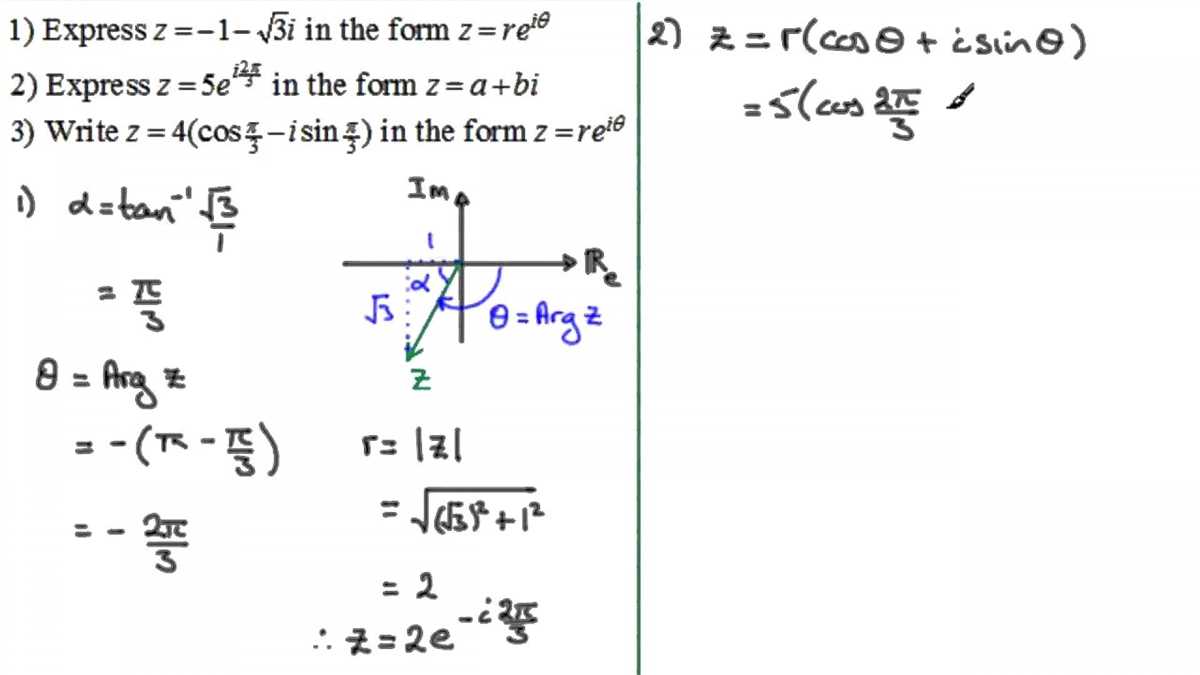
Simplifying complex numbers in exponential form is an important concept in mathematics. Complex numbers are numbers that are expressed as the sum of a real number and an imaginary number. They can be written in two forms: the standard form (a + bi) and the exponential form (reiθ).
In exponential form, a complex number is expressed as the product of its magnitude (r) and the exponential of its angle (θ). The magnitude represents the distance from the origin to the complex number, while the angle represents the direction or phase of the complex number.
To simplify a complex number in exponential form, we need to find its magnitude and angle. The magnitude can be calculated using the formula |z| = √(a2 + b2), where a and b are the real and imaginary parts of the complex number, respectively. The angle can be calculated using the formula θ = atan(b/a), where atan() is the arctangent function.
Once we have determined the magnitude and angle of the complex number, we can rewrite it in simplified exponential form as r(cos(θ) + isin(θ)), where r is the magnitude and θ is the angle. This form is often more compact and easier to work with than the standard form.
Simplifying Complex Numbers with Radicals
When working with complex numbers, it’s important to be able to simplify them to their simplest form. This often involves simplifying any radicals present in the complex number. Radicals, also known as square roots or cube roots, can make complex numbers more complicated to work with. However, with the right steps, it is possible to simplify complex numbers with radicals.
To simplify a complex number with a radical, you first want to isolate the radical term. If the complex number is in the form a + bi, where a represents the real part and bi represents the imaginary part, the radical will typically be found in the imaginary part. Once the radical is isolated, you can then simplify it using basic rules of radicals, such as combining like terms and factoring out perfect squares.
For example, if you have a complex number with a square root, you can simplify it by finding a perfect square that is a factor of the number under the radical. Then, you can rewrite the square root as the square of that perfect square. This simplifies the radical and makes the complex number easier to work with.
In some cases, simplifying a complex number with radicals may require more advanced techniques, such as rationalizing the denominator. This involves multiplying the numerator and denominator of the complex number by the conjugate of the radical term, which eliminates the radical in the denominator and makes the number easier to simplify.
Overall, simplifying complex numbers with radicals may require basic rules of radicals and more advanced techniques like rationalizing the denominator. With practice, you can become proficient at simplifying complex numbers and make them easier to work with in mathematical calculations.
Application Problems Involving Simplifying Complex Numbers
In this section, we will explore some application problems that involve simplifying complex numbers. These problems can be found in various fields such as physics, engineering, and finance.
1. Electrical Engineering
In electrical engineering, complex numbers are often used to represent electrical quantities such as voltage and current. For example, in an AC circuit, the voltage is represented by a complex number with a real part (representing the amplitude) and an imaginary part (representing the phase). By simplifying complex numbers, engineers can analyze and predict the behavior of electrical circuits.
2. Signal Processing
In signal processing, complex numbers are used to represent signals that vary with time. By simplifying complex numbers, signal processing engineers can analyze, filter, and modify these signals to extract useful information or remove unwanted noise.
3. Finance
In finance, complex numbers are used to model and analyze stock prices, interest rates, and other financial variables. By simplifying complex numbers, financial analysts can make predictions and assess the risk and return of various investment opportunities.
Conclusion
Simplifying complex numbers is an important skill that has various applications in different fields. Whether it’s in electrical engineering, signal processing, finance, or other areas, the ability to simplify complex numbers allows professionals to analyze, predict, and make informed decisions. It is a fundamental concept that is essential for understanding and solving complex problems in these disciplines.