Uncover the Answers to Common Questions About Specific Heat Capacity
Specific heat capacity is a fundamental concept in thermodynamics that measures the amount of heat required to raise the temperature of a substance by a certain amount. Understanding specific heat capacity is crucial in a variety of scientific fields, including physics, chemistry, and engineering.
For students and professionals alike, having access to specific heat capacity questions and answers in a PDF format can be incredibly beneficial. It allows for easy reference and study, ensuring that one can grasp the concepts and apply them effectively in real-world scenarios.
Specific heat capacity questions and answers PDFs typically cover a range of topics, including the definition and calculation of specific heat capacity, as well as the different units and formulas used. These resources often include worked examples and practice problems to help reinforce understanding and build problem-solving skills.
Whether you are a student preparing for an exam or a professional looking to refresh your knowledge, having a comprehensive collection of specific heat capacity questions and answers in PDF format can be an invaluable resource. It allows for convenient and efficient studying, helping you to master this essential concept in thermodynamics.
What is specific heat capacity?

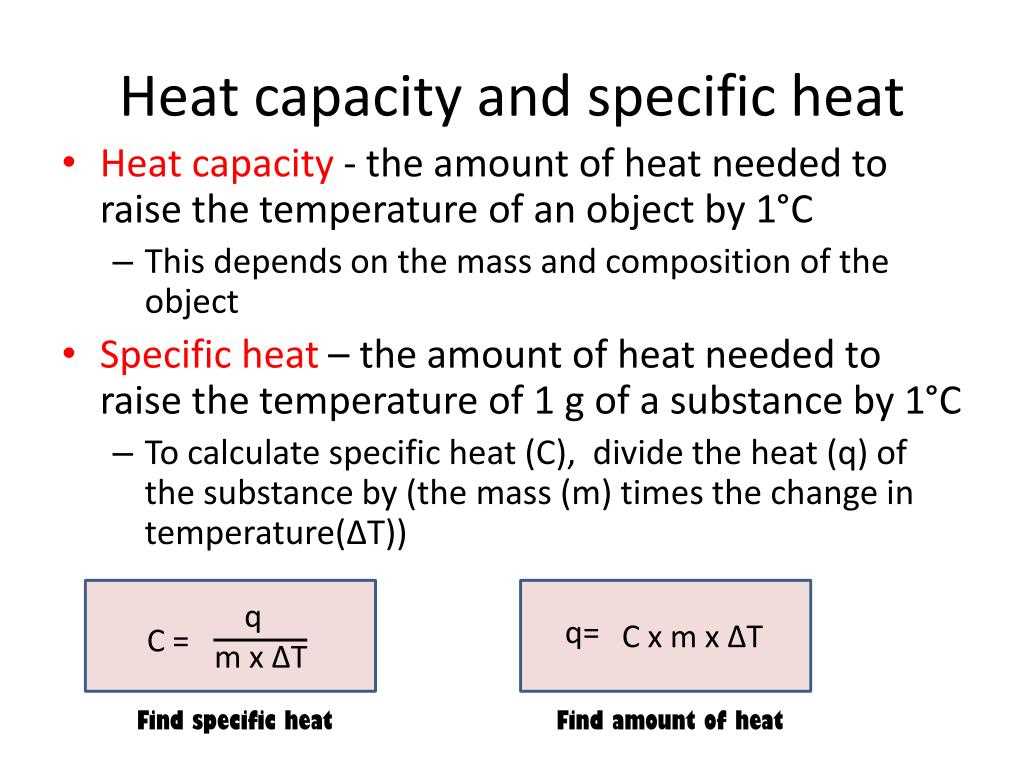
Specific heat capacity is a property of a substance that measures the amount of heat energy required to raise the temperature of a given amount of that substance by a certain amount. It is defined as the amount of heat energy required to raise the temperature of one unit mass of a substance by one unit degree Celsius or Kelvin.
The specific heat capacity of a substance depends on its chemical composition and physical structure. Different substances have different specific heat capacities, which can be measured experimentally. The units of specific heat capacity are joules per kilogram per degree Celsius (J/kg°C) or joules per gram per degree Celsius (J/g°C).
Specific heat capacity is an important concept in thermodynamics and heat transfer. It helps in understanding how heat energy is absorbed and released by substances and how it affects their temperature changes. It is also useful in calculating the amount of heat energy required for various processes, such as heating or cooling substances.
How is specific heat capacity measured?
Specific heat capacity is a property that describes how much heat energy is required to raise the temperature of a substance by one degree Celsius, per unit mass. It is an important characteristic of substances, as it helps determine their ability to store and release heat.
The most common method used to measure specific heat capacity is known as the method of mixtures. In this method, a known amount of the substance whose specific heat capacity is to be determined is heated to a known temperature. It is then quickly transferred to a known mass of water at a lower temperature. The heat lost by the substance is equal to the heat gained by the water, allowing the specific heat capacity of the substance to be calculated.
During the experiment, both the initial and final temperatures of the substance and water are recorded, as well as their masses. By applying the principle of conservation of energy, which states that energy cannot be created or destroyed, the specific heat capacity of the substance can be determined using the equation q = mcΔT, where q is the heat exchanged, m is the mass of the substance, c is its specific heat capacity, and ΔT is the change in temperature.
The specific heat capacity of a substance is typically expressed in units of Joules per gram per degree Celsius (J/g°C). Different substances have different specific heat capacities due to variations in their molecular structures and bonding. For example, metals tend to have lower specific heat capacities compared to liquids and gases.
The measurement of specific heat capacity is important in various fields, including thermodynamics, engineering, and chemistry. It helps determine the energy requirements for heating and cooling processes, as well as the thermal properties of materials used in construction and manufacturing.
Why is specific heat capacity important?
The concept of specific heat capacity plays a crucial role in understanding and predicting the behavior of materials when it comes to heat transfer. Specific heat capacity refers to the amount of heat energy required to raise the temperature of a unit mass of a substance by one degree Celsius. It is an important property because it helps us understand how materials respond to changes in temperature and how they store and release heat.
1. Energy transfer: Specific heat capacity is important in understanding how energy is transferred between substances. It allows us to calculate the amount of heat energy required or released during various processes like heating, cooling, or phase changes. This knowledge is vital in fields such as chemistry, physics, engineering, and thermodynamics.
2. Temperature control: Specific heat capacity also plays a crucial role in temperature control systems. By knowing the specific heat capacity of a substance, we can determine how much heat energy is required to achieve a desired temperature change. This information is essential for designing efficient heating and cooling systems in various industries, including HVAC (heating, ventilation, and air conditioning), manufacturing, and energy production.
3. Material selection: The specific heat capacity of a substance determines its ability to absorb and store heat energy. This property is important in selecting materials for applications where heat absorption and storage are desired, such as in thermal storage systems, solar panels, and batteries. Different materials have different specific heat capacities, and selecting the right material can significantly impact the overall performance and efficiency of these systems.
Overall, specific heat capacity is a fundamental property that helps us understand how materials respond to changes in temperature and how heat energy is transferred and stored. Its importance extends across various fields and applications, making it a vital concept to study and consider in scientific and engineering endeavors.
Applications of Specific Heat Capacity
The specific heat capacity is a crucial property of a substance and finds applications in various fields. Some of the main applications of specific heat capacity include:
- Thermal insulation: Understanding the specific heat capacity of materials helps in designing effective thermal insulation for buildings and other structures. Materials with high specific heat capacity can absorb a large amount of heat energy before their temperature rises, making them suitable for insulation.
- Temperature control: Specific heat capacity is used in designing cooling systems and temperature control devices. By knowing the specific heat capacity of different substances, engineers can determine the amount of heat energy required to change their temperature, and adjust cooling systems accordingly.
- Food industry: Specific heat capacity plays a vital role in food processing and preservation. It helps in determining the heating or cooling time required during cooking, freezing, or canning processes. Additionally, it helps in designing efficient packaging materials to maintain the desired temperature of food products.
- Climate science: Specific heat capacity of air and water is instrumental in understanding climate patterns and weather forecasting. It helps in analyzing the heat transfer between the Earth’s surface and the atmosphere, and in predicting changes in temperature due to climate change.
- Thermal power plants: Understanding specific heat capacity is critical in the design and operation of thermal power plants. It helps in calculating the amount of heat energy required to generate steam, and in optimizing the efficiency of power generation processes.
In conclusion, the applications of specific heat capacity are diverse and range from thermal insulation and temperature control to food processing and climate science. Its understanding is crucial in various industries for efficient design and operation of systems involving heat transfer and temperature control.
Factors affecting Specific Heat Capacity
1. Nature of the substance: The specific heat capacity of a substance depends on its molecular structure and properties. Different substances have different specific heat capacities, which is determined by the number and strength of the bonds between their atoms or molecules. For example, metals generally have lower specific heat capacities than nonmetals, as the metallic bonds are generally stronger and require more energy to raise the temperature.
2. Temperature: The specific heat capacity of a substance may vary with temperature. In general, the specific heat capacity of most substances increases with an increase in temperature. This is due to the increased molecular vibrations and interactions at higher temperatures, requiring more energy to raise the temperature of the substance.
3. Pressure: Pressure can also affect the specific heat capacity of a substance. In some cases, an increase in pressure can lead to an increase in the specific heat capacity, as it can affect the molecular interactions and behavior of the substance. However, this effect is usually small and may not significantly impact the overall specific heat capacity.
4. Phase changes: The specific heat capacity can also vary during phase changes. For example, during the process of melting or evaporation, the specific heat capacity remains constant at a certain value, known as the latent heat of fusion or vaporization. This is because the energy added or removed during these processes is used to break or form the intermolecular bonds, rather than increase the temperature of the substance.
5. Impurities: The presence of impurities in a substance can affect its specific heat capacity. Impurities can disrupt the molecular structure and interactions, leading to changes in the specific heat capacity. Additionally, impurities may also have their own specific heat capacities, which can influence the overall specific heat capacity of the mixture or compound.
Overall, specific heat capacity is influenced by various factors, including the nature of the substance, temperature, pressure, phase changes, and the presence of impurities. Understanding these factors is important in various applications, such as thermal engineering, material sciences, and energy transfer.
Frequently Asked Questions about Specific Heat Capacity
Here are some common questions and answers about specific heat capacity:
What is specific heat capacity?
Specific heat capacity is the amount of heat energy required to raise the temperature of a substance by a certain amount. It is a property that is unique to each substance and is measured in units of energy per mass and temperature (such as J/kg°C or cal/g°C).
How is specific heat capacity different from heat capacity?
Specific heat capacity is the amount of heat energy required to raise the temperature of a unit mass of a substance, while heat capacity is the amount of heat energy required to raise the temperature of an entire object or system. The specific heat capacity depends on the substance’s mass, while the heat capacity depends on both the substance’s mass and its size or amount.
What factors affect the specific heat capacity of a substance?
The specific heat capacity of a substance is affected by its molecular structure, mass, and composition. Substances with more complex molecular structures tend to have higher specific heat capacities, as they require more energy to increase the internal energy of the molecules. The specific heat capacity also tends to be higher for substances with higher masses and those with greater amounts of certain elements, such as water.
Why is specific heat capacity important?
Specific heat capacity is important in various scientific and engineering applications. It can help determine the amount of heat required or released in a chemical reaction, optimize the design of thermal systems such as heating and cooling systems, and understand the behavior of substances under different temperature changes. It is also crucial for understanding climate processes, as specific heat capacity plays a role in the absorption and storage of heat in the Earth’s atmosphere and oceans.
How is specific heat capacity measured?
Specific heat capacity is typically measured through experiments that involve heating or cooling a known mass of a substance and measuring the resulting temperature change. The heat energy supplied or released is calculated using the equation Q = mcΔT, where Q is the heat energy, m is the mass of the substance, c is the specific heat capacity, and ΔT is the temperature change.
Can the specific heat capacity of a substance change?
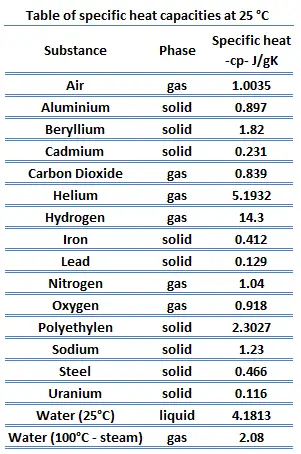
The specific heat capacity of a substance is considered to be constant under normal conditions. However, it can vary with changes in temperature for some substances. This phenomenon is known as the temperature dependence of specific heat capacity. In such cases, the specific heat capacity may be expressed as a function of temperature or measured at specific temperature ranges.
Where can I find specific heat capacity values for different substances?

Specific heat capacity values for many substances can be found in reference books, scientific databases, or online resources. These values are typically given at standard conditions or for specific temperature ranges. It is important to ensure that the units of measurement are consistent when comparing or using specific heat capacity values from different sources.
In summary
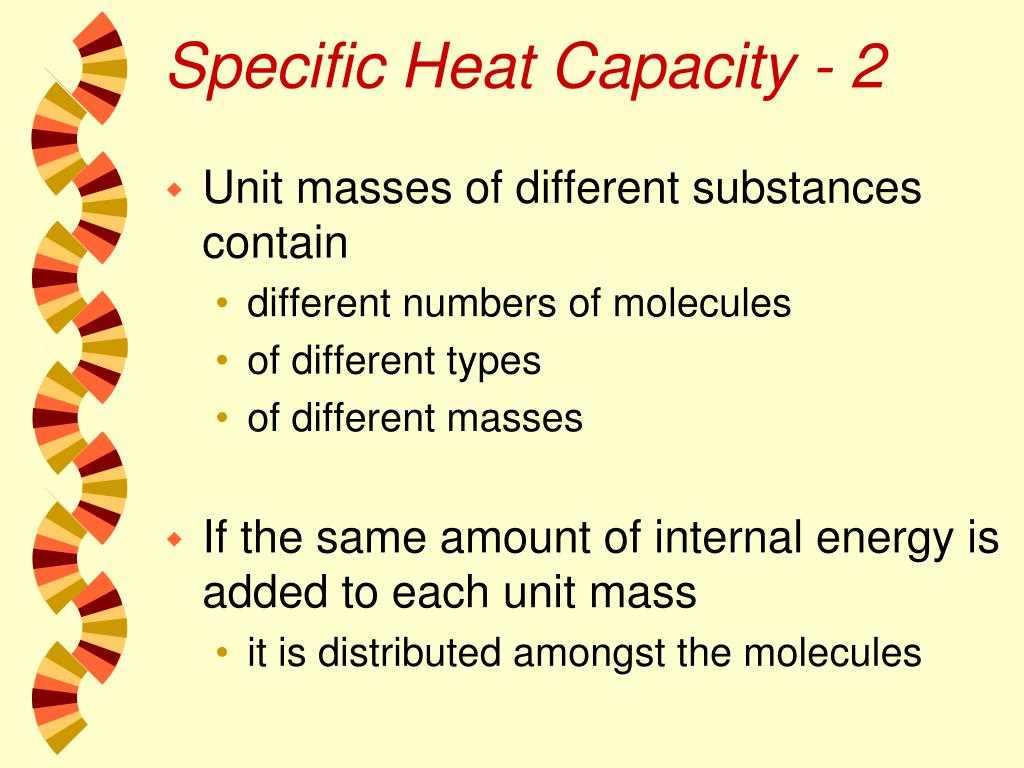
Specific heat capacity is a property that measures the amount of heat energy required to raise the temperature of a substance. It is different from heat capacity and is influenced by factors such as molecular structure, mass, and composition. Specific heat capacity plays a crucial role in various scientific and engineering applications and is measured through experiments. Although it is generally considered constant, it can vary with temperature for some substances. Specific heat capacity values can be found in reference materials or online resources.