The Importance of the St. Louis University Mental Status Exam in Assessing Cognitive Function

Mental status exam (MSE) is a standardized assessment tool used by mental health professionals to evaluate an individual’s cognitive and emotional functioning. The St Louis University Mental Status Exam, also known as the SLUMS exam, is a brief and practical tool specifically developed for screening cognitive impairment in older adults.
The SLUMS exam consists of various cognitive tasks and questions that assess different domains of mental functioning, including orientation, memory, attention, language, and executive functions. It can help healthcare providers identify signs of cognitive decline or dementia in older adults, and provide a basis for further diagnostic evaluation.
The exam typically takes around 15 minutes to administer and includes tasks such as recalling a list of words, performing simple calculations, naming objects, and following instructions. It also includes questions about personal information, such as the date and current location, to assess orientation.
The SLUMS exam is considered an effective screening tool for cognitive impairment, particularly in older adults. It can help healthcare professionals detect cognitive decline early on, allowing for timely intervention and support. However, it is important to note that the SLUMS exam is not a diagnostic tool and should be used in conjunction with other comprehensive assessments for a thorough evaluation of cognitive functioning.
What is St Louis University Mental Status Exam?
The St Louis University Mental Status Exam, also known as SLUMS, is a cognitive screening tool used to assess an individual’s mental status and identify potential cognitive impairments and dementia. It was developed by the Department of Neurology at St Louis University and is designed to provide a quick and reliable evaluation of cognitive function.
The SLUMS exam consists of a series of questions and tasks that assess different cognitive domains, including orientation, attention, memory, language, and visuospatial ability. It takes approximately 10-15 minutes to administer and can be used in a variety of settings, such as primary care clinics, hospitals, and nursing homes.
During the exam, the examiner asks the individual questions related to their personal and contextual information, such as the date, current location, and details about their daily routine. They also assess the individual’s ability to recall and retain information, to follow instructions, to perform simple calculations, and to complete visuospatial tasks.
The SLUMS exam provides a score that indicates the individual’s level of cognitive impairment. A score below a certain threshold suggests the presence of cognitive impairment or potential dementia and may warrant further evaluation and intervention. It is important to note that the SLUMS exam is not a diagnostic tool, but rather a screening tool that helps identify individuals who may benefit from further cognitive assessment and management.
Overview
The St. Louis University Mental Status Exam (SLUMS) is a brief screening tool designed for the assessment of cognitive impairment in older adults. It is particularly useful in primary care settings where there is limited time available for a comprehensive cognitive assessment. The SLUMS is based on the Mini-Mental State Examination (MMSE), but has been modified to improve its sensitivity in detecting mild cognitive impairment (MCI) and early dementia.
The SLUMS consists of 11 questions that assess various cognitive domains including orientation, attention, memory, language, and visuospatial ability. Each question is scored, with a total possible score of 30. A score of 20 or below suggests the presence of cognitive impairment, while scores between 21 and 26 indicate possible MCI, and scores of 27 or above are considered within the normal range. It should be noted that the SLUMS is not a diagnostic tool, but rather a screening tool that helps identify individuals who may require further evaluation.
The SLUMS has several advantages over the MMSE. It takes less time to administer (approximately 10 minutes) and does not require any special equipment or training. It also has a higher sensitivity in detecting MCI, which is an important clinical concern as early intervention and treatment can potentially slow the progression of cognitive decline. Additionally, the SLUMS includes questions that assess visuospatial ability, which is an important domain often affected in dementia.
Overall, the St. Louis University Mental Status Exam is a valuable screening tool for cognitive impairment in older adults, particularly in primary care settings. Its brevity, ease of administration, and improved sensitivity make it a useful tool for identifying individuals who may benefit from further evaluation and intervention. However, it should be noted that a comprehensive diagnostic assessment is necessary to confirm a diagnosis of dementia or other cognitive disorders.
History and Development
The St. Louis University Mental Status (SLUMS) examination is a screening tool that is used to assess cognitive function in older adults. It was developed by Dr. Norma J. Keller and her colleagues at the St. Louis University School of Medicine in Missouri. The SLUMS examination was created as an alternative to the Mini-Mental State Examination (MMSE), which is widely used but has limitations in assessing mild cognitive impairment.
Dr. Keller and her team recognized the need for a more comprehensive and sensitive cognitive screening tool, especially for individuals with mild cognitive impairment who may still score within the normal range on the MMSE. The SLUMS examination was designed to address these limitations and provide a more accurate assessment of cognitive function.
The development of the SLUMS examination involved a thorough review of existing cognitive assessment tools and an extensive literature review on cognitive impairment and mild cognitive impairment. Dr. Keller and her team conducted multiple pilot studies to refine the assessment and improve its validity and reliability.
The SLUMS examination consists of 30 items, including questions on orientation, attention, memory, language, visual-spatial abilities, and executive functions. It also includes a brief neurological examination. The examination takes approximately 15-20 minutes to administer and is scored out of a total of 30 points.
The SLUMS examination has been widely adopted in clinical and research settings as a tool for identifying cognitive impairment and monitoring changes in cognitive function over time. Its sensitivity and specificity in detecting mild cognitive impairment have been found to be superior to the MMSE.
Purpose of the Exam

The St. Louis University Mental Status Exam, also known as the SLUMS exam, is a cognitive screening tool used to assess a person’s mental status and determine if further evaluation is needed. It is commonly used by healthcare professionals, particularly in geriatric care, to identify cognitive impairment and dementia in patients.
The primary purpose of the SLUMS exam is to evaluate an individual’s cognitive abilities and identify any potential deficits or impairments. It assesses various domains of cognitive function, including orientation, attention, memory, language, and visuospatial skills. By examining these areas, healthcare professionals can gain a comprehensive understanding of an individual’s cognitive status and make appropriate recommendations for further evaluation or treatment.
The SLUMS exam is particularly useful in detecting mild cognitive impairment and early signs of dementia, such as Alzheimer’s disease. It can help differentiate between normal age-related cognitive changes and more serious cognitive decline. The exam also allows for the monitoring of cognitive function over time, enabling healthcare professionals to track changes and intervene as necessary.
The SLUMS exam consists of a series of questions and tasks that evaluate different aspects of cognitive function. These include recalling a list of words, copying a complex figure, performing calculations, and answering questions about time and place. The results are scored and compared to established norms to determine the individual’s cognitive status.
In summary, the St. Louis University Mental Status Exam serves as a valuable tool in assessing cognitive function and identifying potential cognitive impairments. By conducting this exam, healthcare professionals can make informed decisions regarding further evaluation, treatment, and support for patients experiencing cognitive decline.
Components of the Exam
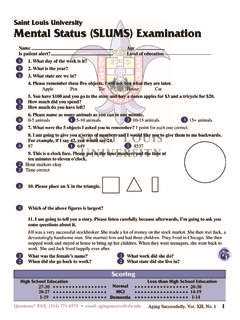
The mental status exam (MSE) is a crucial assessment tool used by mental health professionals to evaluate an individual’s current cognitive and emotional functioning. It involves a systematic evaluation of various components, providing valuable information for diagnosis, treatment planning, and monitoring progress.
1. Appearance and Behavior: The examiner observes the individual’s physical appearance, demeanor, and overall behavior. This includes assessing for any signs of distress, agitation, psychomotor retardation, or abnormal movements.
2. Orientation: The individual’s orientation to time (awareness of the current date, year, season), place (knowledge of their location), and person (awareness of their own identity) is assessed. This provides information about the individual’s perception and awareness of their immediate surroundings.
3. Memory: Both short-term and long-term memory are evaluated. The examiner may ask the individual to recall recent events, details from their personal history, or information provided earlier during the exam. It helps assess the individual’s ability to encode, store, and retrieve information.
4. Language and Communication: The examiner examines the individual’s speech fluency, coherence, and content. They may engage in conversation to assess language comprehension, expressive abilities, and any signs of aphasia or other language impairments. Additionally, the examiner evaluates the individual’s thought processes, looking for any signs of disorganized thinking or abnormal thought content.
5. Mood and Affect: The individual’s emotional state and outward expression of emotions are assessed. The examiner evaluates the individual’s subjective experience of mood (e.g., sadness, anger, anxiety) as well as their observable affect (e.g., flat, grandiose, labile). This helps identify any mood disorders or abnormalities in emotional regulation.
6. Cognition: The individual’s cognitive abilities, such as attention, concentration, abstract reasoning, and problem-solving skills, are evaluated. The examiner may administer specific tasks or tests to assess these areas. This component helps determine the individual’s level of cognitive functioning and any impairments that may be present.
7. Insight and Judgment: The examiner explores the individual’s awareness and understanding of their own thoughts, emotions, and behaviors. Insight refers to the individual’s ability to recognize and interpret their psychological experiences, while judgment assesses their ability to make appropriate decisions and solve problems. These components help evaluate the individual’s level of self-awareness and decision-making abilities.
- In conclusion, the mental status exam encompasses multiple components that provide a comprehensive assessment of an individual’s cognitive and emotional functioning. By evaluating appearance and behavior, orientation, memory, language and communication, mood and affect, cognition, insight and judgment, mental health professionals can gather essential information for the diagnosis and treatment of mental disorders.
Administration and Scoring

The administration and scoring of the St. Louis University Mental Status (SLUMS) exam involves several steps. The examiner should explain the purpose and process of the exam to the patient, ensuring they understand their rights and giving them an opportunity to ask questions. The examiner should also obtain informed consent from the patient before proceeding.
To start the exam, the examiner should first administer the nine-item orientation section. This includes questions about the date, day of the week, month, year, day of the week, season, state, county, and city. The patient is then scored on their ability to correctly answer these questions, with one point given for each correct response.
Next, the examiner moves on to the memory and attention sections. The memory section involves the examiner reading a list of five words and then asking the patient to recall them after a specified delay. The attention section tests the patient’s ability to perform simple mathematical calculations. The patient is again scored on their performance in these sections.
The final sections of the SLUMS exam assess the patient’s language skills, visuospatial abilities, and executive functions. The examiner asks the patient to name three objects, follow a command, draw a clock face, and complete a verbal fluency task. Each task is scored based on the patient’s performance.
Overall, the SLUMS exam provides a comprehensive assessment of a patient’s cognitive abilities. The scoring system allows for a quantifiable measure of cognitive impairment, with a total score of 27 or below indicating cognitive impairment. It is important for the examiner to carefully follow the administration and scoring guidelines to ensure accurate results.
Limitations and Criticisms
The St. Louis University Mental Status Exam (SLUMS) has gained popularity as a screening tool for cognitive impairment and dementia. However, like any assessment tool, it has certain limitations and potential criticisms that should be considered.
One limitation of the SLUMS is that it may not be sensitive enough to detect mild cognitive impairment. This could result in false negative results, where individuals with early-stage cognitive decline are deemed to have normal cognitive functioning.
Another criticism of the SLUMS is its reliance on verbal recall and recognition tasks, making it less suitable for individuals with language or hearing impairments. This limits its utility among a wide range of population groups and undermines its inclusiveness.
Furthermore, the SLUMS may not adequately capture certain cognitive domains such as executive function or cognitive processing speed. This could limit its ability to provide a comprehensive assessment of cognitive functioning.
Additionally, the SLUMS has been found to have lower reliability and validity compared to other well-established cognitive assessment tools, such as the Mini-Mental State Examination (MMSE). This raises concerns about the accuracy and consistency of its results.
Lastly, the SLUMS may be prone to examiner bias and subjective interpretation. The scoring of certain items, such as the ability to draw a clock or perform calculations, can be open to interpretation and subjective judgment, which could introduce variability in the results.
In summary, while the St. Louis University Mental Status Exam (SLUMS) has its merits as a cognitive screening tool, it is not without limitations and potential criticisms. Care should be taken to consider these limitations when using the SLUMS in clinical practice or research, and alternative assessment tools should be considered for a more comprehensive evaluation of cognitive functioning.