Mastering Surface Area and Volume: A Test to Challenge Your Knowledge

Welcome to our comprehensive surface area and volume unit test. This test will assess your understanding of calculating surface area and volume for different geometric shapes. It will cover a range of topics, including cubes, rectangular prisms, cylinders, cones, and spheres.
The test will consist of multiple-choice questions, where you will be asked to calculate the surface area or volume of a given shape. You will also be tested on your ability to apply these concepts in real-life scenarios, such as finding the volume of a fish tank or the surface area of a gift box.
Preparation for this test is crucial. Make sure you thoroughly go through the formulas and steps for finding the surface area and volume of each shape. Practice solving problems and use different strategies to approach each question. Remember to label your answers with the appropriate units.
What is surface area?
Surface area refers to the total area of the outside surface of a three-dimensional object. It can be thought of as the sum of all the areas of the individual faces or surfaces that make up the object. Surface area is an important concept in geometry and is used to calculate various properties of objects, such as their volume or the amount of material needed to construct them.
In order to calculate the surface area of an object, it is necessary to know the dimensions of each of its faces or surfaces. For example, a cube has six equal square faces, so the surface area can be calculated by multiplying the length of one side by itself and then multiplying the result by six. Similarly, a cylinder has two circular bases and a curved surface, so the surface area can be calculated by adding the areas of the bases and the curved surface.
Surface area is an important concept in real-world applications as well. For example, when designing a building, knowing the surface area of its walls can help determine the amount of paint or wallpaper needed. In manufacturing, the surface area of an object can affect the cost of materials and production. Understanding surface area is therefore essential for a wide range of fields and industries.
How to Calculate Surface Area of Common Shapes
The surface area of an object refers to the total area that is exposed on its outer surface. Calculating the surface area of common shapes can be a useful skill in various fields, including architecture, engineering, and manufacturing. Here are formulas and step-by-step instructions for finding the surface area of some common shapes:
1. Rectangular Prism:
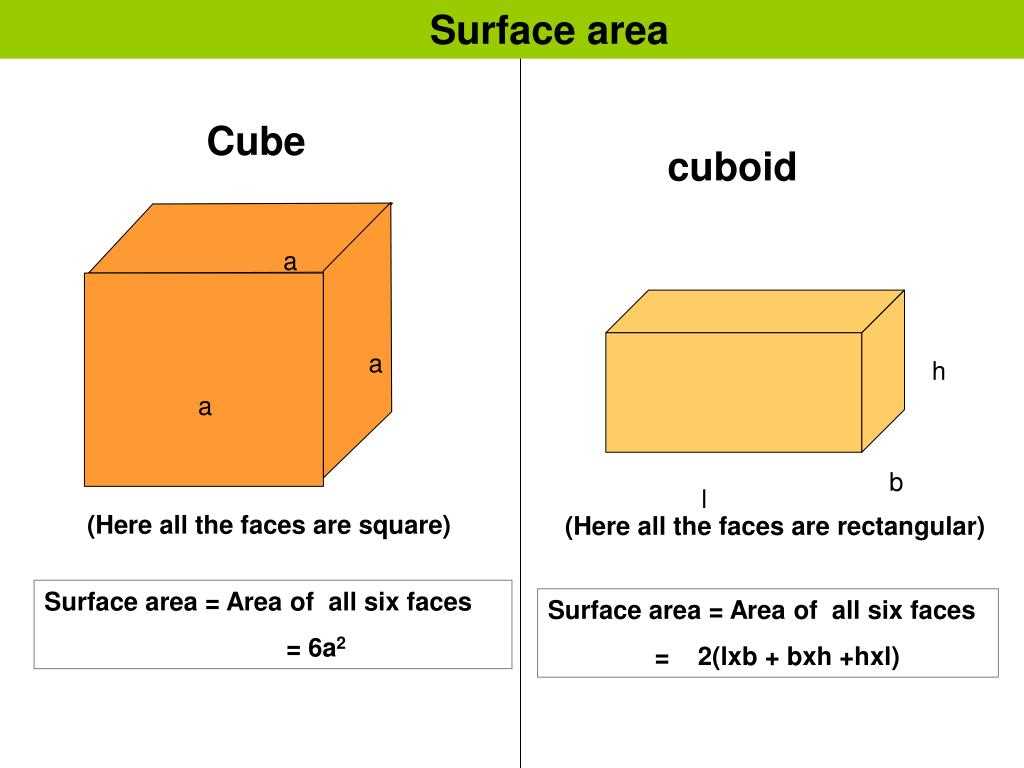
To calculate the surface area of a rectangular prism, add together the areas of all six faces. The formula is:
Surface Area = 2lw + 2lh + 2wh
- l represents the length of the prism.
- w represents the width of the prism.
- h represents the height of the prism.
2. Cylinder:

To find the surface area of a cylinder, sum the areas of the two circular bases and the lateral surface area. The formula is:
Surface Area = 2πr12 + 2πr1h
- r represents the radius of the base.
- h represents the height of the cylinder.
3. Sphere:
The surface area of a sphere can be found using the formula:
Surface Area = 4πr2
- r represents the radius of the sphere.
4. Cone:
To calculate the surface area of a cone, add together the area of the base and the lateral surface area. The formula is:
Surface Area = πr1(r1 + l)
- r represents the radius of the base.
- l represents the slant height of the cone.
By applying these formulas and following the step-by-step instructions, you can calculate the surface area of common shapes accurately and efficiently. Understanding the surface area of objects is crucial in many real-world applications and can help you solve problems related to measurements, construction, and design.
What is volume?
Volume is a fundamental concept in mathematics and geometry that measures the amount of space occupied by a three-dimensional object. It is expressed in cubic units, such as cubic centimeters (cm³) or cubic meters (m³).
To calculate the volume of a solid, different formulas are used depending on the shape of the object. For example, the volume of a rectangular prism can be found by multiplying the length, width, and height of the prism. The formula for volume also varies for other common shapes like cylinders, cones, and spheres.
The volume of an object represents the amount of space it takes up, regardless of its shape. It is different from surface area, which measures the outer area of an object. For example, a small, dense object may have a small volume but a large surface area, while a large, hollow object may have a large volume but a relatively smaller surface area.
Understanding volume is important in various fields, including architecture, engineering, and physics. It is used to calculate the capacity of containers, determine the amount of material needed for construction projects, and analyze fluid flow in pipes and conduits.
In conclusion, volume is a crucial concept in mathematics and geometry that quantifies the amount of space occupied by a three-dimensional object. It is measured in cubic units and can be calculated using specific formulas depending on the shape of the object. Volume plays a significant role in various real-world applications and is essential for understanding and solving problems related to spatial measurements and calculations.
How to calculate the volume of common shapes
Calculating the volume of various shapes is an important skill in geometry and applied mathematics. Understanding how to find the volume allows us to determine the amount of space occupied by an object or shape. In this article, we will explore the methods for calculating the volume of some common shapes.
Cube:
A cube is a three-dimensional shape that has equal sides. To calculate the volume of a cube, you simply need to measure the length of one side and then raise it to the power of three. The formula for finding the volume of a cube is V = a^3, where “V” represents volume and “a” represents the length of one side.
Rectangular prism:
A rectangular prism is a solid shape that has six rectangular faces. To find the volume of a rectangular prism, you need to know its length, width, and height. The formula for finding the volume of a rectangular prism is V = lwh, where “V” represents volume, “l” represents the length, “w” represents the width, and “h” represents the height.
Cylinder:
A cylinder is a solid shape with two circular bases and a curved surface connecting the bases. To find the volume of a cylinder, you need to know the radius of the base and the height of the cylinder. The formula for finding the volume of a cylinder is V = πr^2h, where “V” represents volume, “π” represents pi (approximately 3.14), “r” represents the radius of the base, and “h” represents the height.
Sphere:
A sphere is a perfectly round three-dimensional shape. To find the volume of a sphere, you need to know its radius. The formula for finding the volume of a sphere is V = (4/3)πr^3, where “V” represents volume, “π” represents pi (approximately 3.14), and “r” represents the radius.
- To calculate the volume of a common shape, such as a cube or rectangular prism, you need to know the measurement of its sides or dimensions.
- For more complex shapes, such as cylinders or spheres, you will need to know additional measurements such as the height or radius.
- Remember to use the correct formula for each specific shape in order to calculate the volume accurately.
By understanding how to calculate the volume of common shapes, you can apply this knowledge to solve real-world problems, such as packing objects in a box or determining the capacity of a container.
Real-world applications of surface area and volume
Surface area and volume are two important concepts in mathematics that have numerous real-world applications. They are used in various fields such as architecture, engineering, manufacturing, and even everyday life.
Architecture: Architects use surface area and volume calculations to design and plan buildings. They need to determine the surface area of walls, floors, and ceilings to estimate the amount of materials required, such as paint, tiles, or wallpaper. They also calculate the volume of rooms to ensure that they are spacious enough for their intended purpose.
Engineering: Engineers often use surface area and volume calculations in their designs and constructions. For example, when designing a storage tank or a pipeline system, they need to calculate the surface area to determine the amount of material needed for insulation or coating. They also calculate the volume to determine the capacity or flow rate of the system.
Manufacturing: Surface area and volume calculations are crucial in manufacturing processes. For instance, when producing cans or containers, manufacturers need to determine the surface area to estimate the amount of material, such as metal or plastic, required for each unit. They also calculate the volume to ensure that the product can hold the desired amount of contents.
Everyday life: Surface area and volume concepts are also applicable in our daily lives. For example, when buying paint for a room, we estimate the surface area of the walls to determine the quantity needed. Similarly, when cooking, we calculate the volume of ingredients to get the desired measurements for recipes.
In conclusion, surface area and volume have various real-world applications. They are essential in fields like architecture, engineering, manufacturing, and even in our everyday activities. Understanding these concepts allows us to make informed decisions and optimize our resources efficiently.
Tips and Tricks for Solving Surface Area and Volume Problems
When it comes to solving surface area and volume problems, there are several strategies and formulas that can be helpful. By understanding these tips and tricks, you can approach these types of problems with confidence and accuracy.
1. Understand the Formulas
In order to solve surface area and volume problems, it is crucial to have a strong understanding of the formulas involved. Familiarize yourself with the formulas for calculating the surface area and volume of common shapes, such as cubes, rectangular prisms, cylinders, and spheres. This will enable you to quickly and accurately apply the appropriate formula to the given problem.
2. Break Down Complex Shapes
Some problems may involve complex shapes that cannot be easily solved using a single formula. In these cases, it can be helpful to break down the shape into simpler components. For example, if you have a composite figure made up of multiple shapes, calculate the surface area or volume of each individual shape and then sum them up. This approach can make the problem more manageable and reduce the chances of error.
3. Visualize the Problem
Visualizing the problem can often provide valuable insights and help you formulate a solution strategy. Sketching the shape, labeling the dimensions, and visualizing how the shape would look in different orientations can aid in understanding the problem and determining the appropriate approach. Utilize graph paper or drawing software to create accurate visual representations of the shapes involved.
4. Practice with Real-Life Examples
Surface area and volume problems are not limited to textbook exercises. By applying these concepts to real-life examples, such as calculating the volume of a swimming pool or the surface area of a gift box, you can strengthen your understanding and improve your problem-solving skills. Seek out opportunities to practice these concepts in everyday life to reinforce your knowledge.
By following these tips and tricks, you can enhance your ability to solve surface area and volume problems effectively. Remember to understand the formulas, break down complex shapes, visualize the problem, and practice with real-life examples. With consistent practice and a solid foundation of knowledge, you can master these concepts and confidently tackle any surface area and volume problem that comes your way.