Exploring the Properties of Quadrilaterals through Interactive Testing
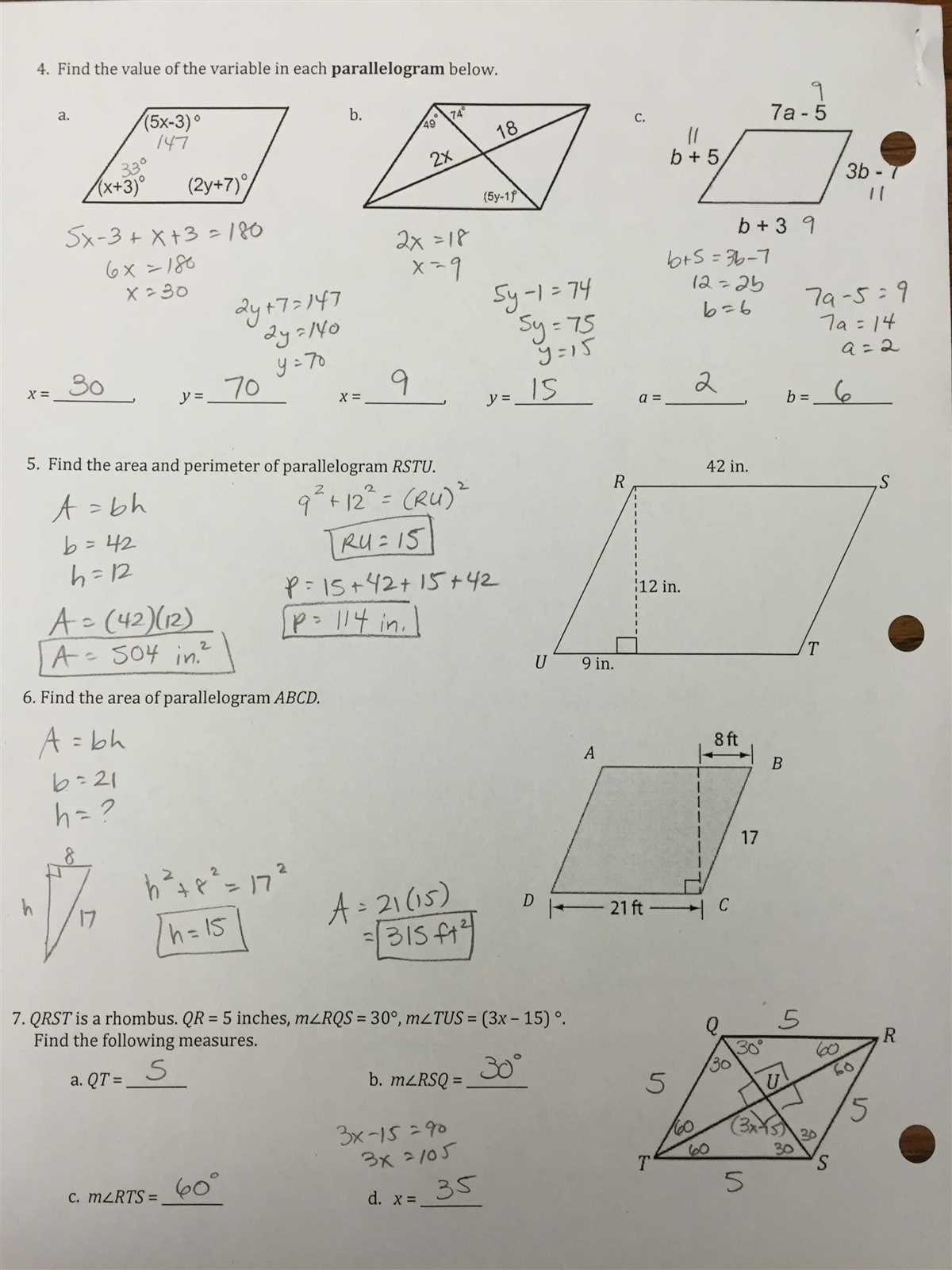
If you are studying geometry, you may have come across the concept of quadrilaterals. A quadrilateral is a polygon with four sides and four angles. While there are different types of quadrilaterals, such as squares, rectangles, rhombuses, and trapezoids, it is essential to understand their properties and characteristics.
This test on quadrilaterals will assess your knowledge of different types of quadrilaterals and their properties. It will challenge you to identify the correct names of different quadrilaterals based on their descriptions and characteristics. Additionally, it will test your understanding of the relationships between different types of quadrilaterals.
Through this test, you will be able to assess your understanding of quadrilaterals and identify areas where you might need further study. Whether you are preparing for a geometry exam or simply want to test your knowledge for personal growth, this quiz will provide you with a valuable learning experience.
Properties of Quadrilaterals
A quadrilateral is a polygon with four sides. There are various types of quadrilaterals, each with its own unique set of properties. Understanding these properties can help us identify and classify quadrilaterals based on their characteristics.
1. Parallelogram: A parallelogram is a quadrilateral in which opposite sides are parallel and equal in length. Additionally, opposite angles are also equal.
2. Rectangle: A rectangle is a special type of parallelogram in which all angles are right angles. It is a quadrilateral with four right angles.
3. Square: A square is an even more special type of rectangle in which all sides are equal in length. It is a quadrilateral with four right angles and four equal sides.
4. Rhombus: A rhombus is a quadrilateral with all sides equal in length. Its opposite angles are equal, but they don’t necessarily have to be right angles.
5. Trapezoid: A trapezoid is a quadrilateral with at least one pair of parallel sides. The non-parallel sides are called legs, while the parallel sides are called bases.
6. Kite: A kite is a quadrilateral with two pairs of adjacent sides that are equal in length. It has one pair of opposite angles that are equal.
- A parallelogram has opposite sides parallel and equal in length.
- A rectangle has all angles equal to 90 degrees.
- A square has all sides equal in length and all angles equal to 90 degrees.
- A rhombus has all sides equal in length, but its angles may not be right angles.
- A trapezoid has at least one pair of parallel sides.
- A kite has two pairs of adjacent sides that are equal in length.
These properties allow us to classify quadrilaterals and solve problems involving their dimensions and angles. By understanding the properties of quadrilaterals, we can better analyze and work with these geometric shapes.
Definition of Quadrilaterals
A quadrilateral is a polygon with four sides. It is also known as a four-sided polygon. The word “quadrilateral” is derived from the Latin words “quadri” meaning four and “latus” meaning side.
There are different types of quadrilaterals, each defined by the specific properties of its sides and angles. Some common types of quadrilaterals include rectangles, squares, parallelograms, trapezoids, and rhombuses.
Rectangle: A rectangle is a quadrilateral with four right angles. Its opposite sides are equal in length, and all four angles measure 90 degrees.
Square: A square is a special type of rectangle where all four sides are equal in length. It also has four right angles.
Parallelogram: A parallelogram is a quadrilateral with opposite sides that are parallel. Its opposite angles are also equal in measure.
Trapezoid: A trapezoid is a quadrilateral with at least one pair of parallel sides. The other two sides are non-parallel and may or may not be equal in length.
Rhombus: A rhombus is a quadrilateral with all four sides equal in length. Its opposite angles are equal in measure, but they do not have to be right angles.
In summary, quadrilaterals are four-sided polygons that can have various configurations and properties. Understanding the different types of quadrilaterals and their defining characteristics is essential in geometry and other mathematical applications.
Classification of Quadrilaterals
Quadrilaterals, or four-sided polygons, can be classified into different categories based on their properties and characteristics. The classification is primarily determined by the angles and lengths of the sides. Understanding the different types of quadrilaterals is essential in geometry as it helps identify and analyze their properties and relationships.
One way to classify quadrilaterals is by the measure of their angles. A parallelogram is a quadrilateral with opposite sides that are parallel and equal in length. The opposite angles in a parallelogram are also equal. A rectangle, a specific type of parallelogram, has four right angles. A square is a special rectangle where all four sides are equal in length, and all four angles are right angles. Another type of quadrilateral is a rhombus, which has opposite sides that are parallel and equal in length, but all four angles are equal and not necessarily right angles.
Another way to classify quadrilaterals is by the lengths of their sides. A trapezoid is a quadrilateral with one pair of opposite sides parallel, but the other two sides are not. The sides that are not parallel are called the legs of the trapezoid. If a trapezoid has two sides that are equal in length, it is called an isosceles trapezoid. A kite is a quadrilateral with two pairs of adjacent sides that are equal in length. The diagonals of a kite are perpendicular to each other, forming four right angles.
In summary, quadrilaterals can be classified into various types based on their angles and side lengths. Some common types include parallelograms, rectangles, squares, rhombuses, trapezoids, and kites. Understanding the properties and relationships of these different types of quadrilaterals is crucial in geometry and other related fields.
Properties of Parallelograms
A parallelogram is a special type of quadrilateral that has several unique properties. These properties make it different from other quadrilaterals and help us identify and work with parallelograms in geometry.
1. Opposite sides are parallel: One of the defining characteristics of a parallelogram is that its opposite sides are parallel. This means that if we extend the sides of the parallelogram, they will never intersect.
2. Opposite sides are equal in length: Another property of parallelograms is that its opposite sides are always equal in length. This means that if we measure the length of one side, we can be sure that the opposite side will have the same measurement.
3. Opposite angles are equal: In a parallelogram, the opposite angles (angles that are across from each other) are equal in measure. This means that if we know the measurement of one angle, we can determine the measurement of the opposite angle.
4. Consecutive angles are supplementary: The consecutive angles (angles that are next to each other) in a parallelogram are supplementary, which means that their measures add up to 180 degrees. This property allows us to find the measure of one angle if we know the measurement of the other angle.
5. Diagonals bisect each other: The diagonals of a parallelogram bisect each other, which means they divide each other into two equal parts. This property can be helpful in finding lengths or angles within the parallelogram.
By understanding and applying these properties of parallelograms, we can solve various geometry problems involving these quadrilaterals and contribute to a better understanding of their characteristics.
Properties of Rectangles
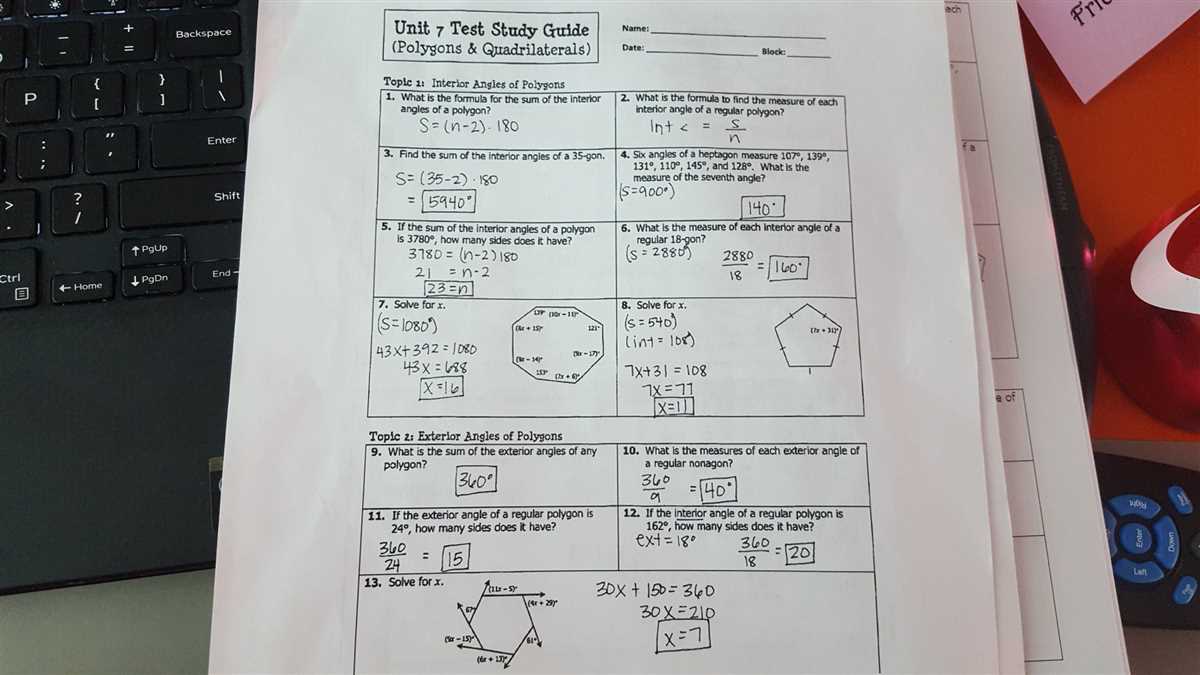
A rectangle is a type of quadrilateral that has several unique properties. In order for a quadrilateral to be considered a rectangle, it must have four right angles. These right angles make the opposite sides of the rectangle parallel to each other. This means that the opposite sides of a rectangle are equal in length.
One of the key properties of rectangles is that their diagonals are equal in length. The diagonals of a rectangle bisect each other at their midpoint, creating four congruent right triangles. This property can be useful in various geometric calculations and constructions.
Properties of Rectangles:
- Four right angles
- Opposite sides are parallel and equal in length
- Diagonals are equal in length and bisect each other at their midpoint
- Each interior angle measures 90 degrees
- The sum of all interior angles is 360 degrees
Rectangles are commonly encountered in daily life, such as in the shape of doors, windows, and bookshelves. Their properties make them useful in various fields such as architecture, construction, and engineering. By understanding the properties of rectangles, one can better understand and utilize their applications in real-world scenarios.
Properties of Rhombuses
A rhombus is a special type of quadrilateral that possesses unique properties and characteristics. Known for its symmetry and equal length of sides, a rhombus is defined by several key attributes.
Equal Side Lengths: One of the defining properties of a rhombus is that all four sides are equal in length. This means that the opposite sides of the rhombus are parallel and congruent to each other.
Opposite Angles: Another important property of a rhombus is that the opposite angles are congruent. This means that the angles formed by the intersection of the diagonals of a rhombus are equal in measure.
Diagonals: The diagonals of a rhombus have distinctive properties as well. The diagonals bisect each other at right angles, dividing the rhombus into four congruent right triangles. In addition, the diagonals of a rhombus are perpendicular bisectors of each other, meaning they intersect at a 90-degree angle and divide each other into two equal segments.
Symmetry: A rhombus is a symmetric shape, meaning that it can be folded along its diagonals to create two congruent halves. This symmetry can be seen in the equal length of sides and congruent opposite angles.
Area and Perimeter: The area of a rhombus can be calculated by multiplying the lengths of its diagonals and dividing by 2. Similarly, the perimeter of a rhombus can be found by multiplying the length of one side by 4.
In summary, a rhombus is characterized by its equal side lengths, congruent opposite angles, perpendicular diagonals, and symmetry. These properties make the rhombus a unique and fascinating quadrilateral in geometry.
Properties of Trapezoids
A trapezoid is a quadrilateral with at least one pair of parallel sides. In a trapezoid, the parallel sides are called bases, while the non-parallel sides are called legs. Trapezoids have various properties that are worth understanding to solve problems involving these shapes.
Summary of properties:

- A trapezoid has exactly one pair of parallel sides.
- The angles on each side of the non-parallel sides are supplementary.
- The diagonals of a trapezoid intersect at a point called the midpoint.
- The area of a trapezoid can be calculated using the formula: Area = ((b1 + b2) * h) / 2, where b1 and b2 are the lengths of the bases, and h is the height.
Understanding these properties is essential when working with trapezoids. It enables us to identify and classify different types of trapezoids, calculate their areas, and solve various geometry problems involving these shapes.
Trapezoids find application in real-life scenarios such as designing buildings, creating artwork, and constructing bridges. By studying their properties, we can better understand and appreciate their role in the world around us.