Mastering the Mechanics: Examining Review Questions and Finding the Answers

Mechanics is a branch of physics that focuses on the motion of objects and the forces that act upon them. It involves the study of how objects move, why they move, and the factors that affect their motion. In Topic 2 of mechanics, we explore various review questions and their corresponding answers to help deepen our understanding of this fascinating subject.
One of the questions we may encounter in Topic 2 is: “What are the different types of forces?” Forces can be classified into several types, including gravitational force, electromagnetic force, and contact forces such as friction and tension. Gravitational force, for example, is the force that attracts objects towards each other due to their masses. It is responsible for keeping us grounded on the Earth and is also responsible for the motion of planets in the solar system.
Another question that may come up is: “What is Newton’s First Law of Motion?” Newton’s First Law of Motion, also known as the law of inertia, states that an object at rest will remain at rest, and an object in motion will continue moving at a constant velocity, unless acted upon by an external force. This law helps explain why we need seat belts in vehicles to prevent us from being thrown forward in the event of a sudden stop or change in direction.
These review questions and their answers in Topic 2 of mechanics serve as a valuable tool for reinforcing our understanding of the fundamental principles and concepts in this field. By revisiting and practicing these questions, we can enhance our problem-solving skills and develop a deeper appreciation for the laws that govern motion and forces.
Topic 2 Mechanics Review Questions Answers
In this article, we will provide answers to the review questions related to mechanics as part of Topic 2. Mechanics is the branch of physics that deals with the motion of objects and the forces acting on them.
1. What is Newton’s first law of motion?
Newton’s first law of motion states that an object at rest will stay at rest, and an object in motion will continue moving with a constant velocity unless acted upon by an external force. It is also known as the law of inertia.
2. What is the formula for force?
The formula for force is force (F) equals mass (m) multiplied by acceleration (a), expressed as F = ma. Force is a vector quantity, meaning it has both magnitude and direction.
3. What is the difference between weight and mass?
Weight is the force exerted on an object due to gravity, while mass is the measure of the amount of matter in an object. Weight depends on the gravitational pull, while mass remains constant regardless of location.
4. What is the concept of conservation of momentum?
The concept of conservation of momentum states that the total momentum of a system of objects remains constant if no external forces act upon it. In other words, the total momentum before a collision or interaction is equal to the total momentum after the collision or interaction.
5. What is the difference between elastic and inelastic collisions?
In an elastic collision, both kinetic energy and momentum are conserved. The objects involved bounce back with the same speed and direction as before the collision. In an inelastic collision, only momentum is conserved, while kinetic energy may be lost as heat, sound, or deformation.
6. What is torque?
Torque is the measure of the ability of a force to cause rotational motion. It depends on the magnitude of the force, the distance from the axis of rotation, and the angle between the force and the lever arm.
7. What is the relationship between distance, displacement, and speed?
Distance is the total path traveled, while displacement is the change in position from the starting point. Speed is the rate at which an object covers a distance, calculated as the distance divided by the time taken.
8. What are the three laws of motion proposed by Newton?
The three laws of motion proposed by Newton are:
- Newton’s first law of motion: An object at rest will stay at rest, and an object in motion will continue moving with a constant velocity unless acted upon by an external force.
- Newton’s second law of motion: The acceleration of an object is directly proportional to the net force acting on it and inversely proportional to its mass, expressed as F = ma.
- Newton’s third law of motion: For every action, there is an equal and opposite reaction.
These laws form the foundation of classical mechanics and are widely used to analyze the motion of objects.
Overview
Mechanics is the branch of physics that deals with the motion and forces affecting objects. In this overview, we will review some key concepts and principles of mechanics, including Newton’s laws of motion, projectile motion, and energy conservation.
Newton’s laws of motion are fundamental principles that describe how objects move when acted upon by forces. The first law states that an object at rest will stay at rest, and an object in motion will continue to move at a constant velocity, unless acted upon by an external force. The second law relates the force applied to an object to its acceleration, where force equals mass times acceleration. The third law states that every action has an equal and opposite reaction.
Projectile motion refers to the motion of objects that are launched into the air and follow a curved path under the influence of gravity. The key factors that determine the trajectory of a projectile are its initial velocity, launch angle, and the acceleration due to gravity. By analyzing these factors, we can predict the range, maximum height, and time of flight of a projectile.
Energy conservation is another important concept in mechanics. According to the law of conservation of energy, energy cannot be created or destroyed, but it can be transformed from one form to another. In mechanical systems, energy is typically transformed between kinetic energy (energy of motion) and potential energy (stored energy due to position or configuration).
In summary, mechanics is the study of motion and forces, governed by Newton’s laws of motion. It involves analyzing projectile motion and understanding energy conservation. These concepts and principles provide the foundation for understanding how objects move and interact in the physical world.
Types of Forces

Forces are fundamental to understanding how objects interact with each other and move. In physics, a force is a push or pull exerted on an object. Different types of forces are responsible for different interactions and behaviors.
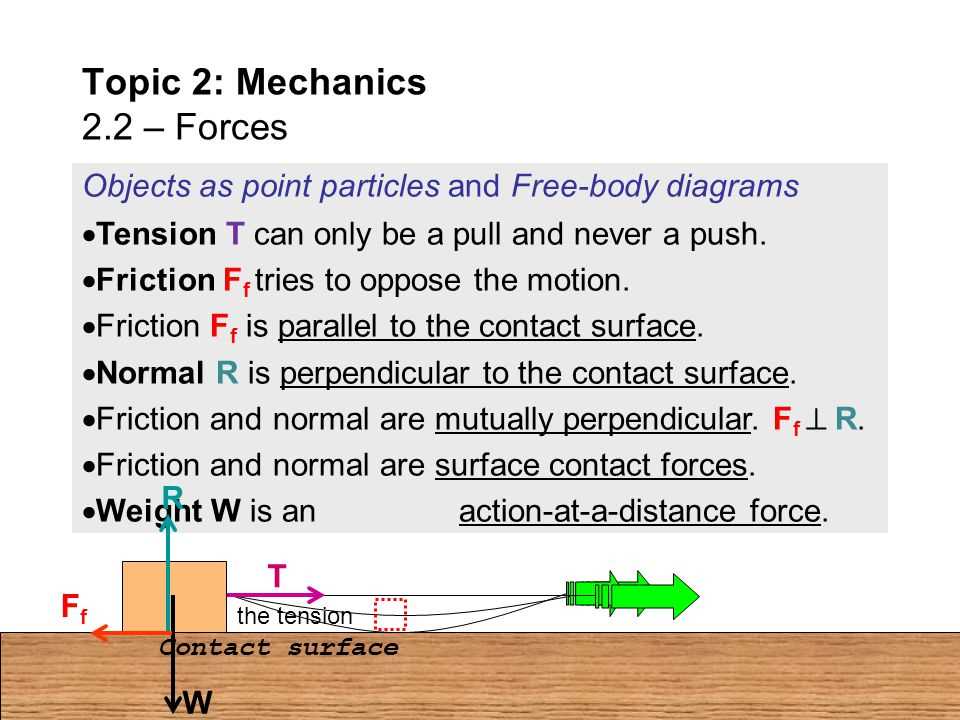
Contact Forces: Contact forces are forces that act only when two objects are in physical contact with each other. Examples of contact forces include pushing, pulling, friction, and normal force. When you push a cart, the force you exert on it is a contact force. Friction is a contact force that opposes the motion of an object.
Non-Contact Forces: Non-contact forces are forces that act from a distance, without any physical contact between the objects. Examples of non-contact forces include gravitational force, magnetic force, and electrostatic force. The force of gravity, for example, acts between all objects with mass and is responsible for holding us on the surface of the Earth.
Applied Forces: Applied forces are forces that are directly applied to an object by a person or another object. For example, when you push a book across a table, you are applying a force to the book.
Tension Forces: Tension forces occur when an object is being pulled by a string, rope, or cable. A common example of tension force is when you pull a door open by its handle.
Spring Forces: Spring forces are forces exerted by a stretched or compressed spring. When you compress a spring, it exerts a force that tries to return it to its original shape. Similarly, when you stretch a spring, it exerts a force that tries to bring it back to its original length.
Motion and Newton’s Laws
Motion is a fundamental concept in physics that deals with the movement of objects. It can be described in terms of displacement, velocity, and acceleration. Displacement is the change in position of an object, velocity is the rate of change of displacement, and acceleration is the rate of change of velocity. Newton’s laws of motion provide a mathematical description of how objects move.
Newton’s first law of motion states that an object at rest will stay at rest, and an object in motion will stay in motion, unless acted upon by an external force. This is sometimes referred to as the law of inertia. In other words, an object will continue to do what it’s doing unless something causes it to do otherwise.
Newton’s second law of motion states that the acceleration of an object is directly proportional to the net force applied to it and inversely proportional to its mass. This can be mathematically expressed as F = ma, where F is the net force, m is the mass of the object, and a is the acceleration. This law allows us to determine how an object will accelerate given a certain force applied to it.
Newton’s third law of motion states that for every action, there is an equal and opposite reaction. This means that whenever one object exerts a force on another object, the second object exerts a force of equal magnitude in the opposite direction on the first object. This law is often demonstrated through examples such as a person pushing against a wall, where the wall exerts an equal and opposite force back on the person.
In summary, motion is described in terms of displacement, velocity, and acceleration. Newton’s laws of motion provide a mathematical description of how objects move. The first law states that objects will continue to do what they’re doing unless something causes them to do otherwise. The second law relates force, mass, and acceleration. The third law states that every action has an equal and opposite reaction.
Work, Energy, and Power

The concepts of work, energy, and power are fundamental to understanding the dynamics of mechanical systems. In physics, work is defined as the product of force and displacement. It represents the transfer of energy when a force acts on an object and causes it to move. Work is typically measured in joules (J) and can be positive (when the force and displacement are in the same direction) or negative (when they are in opposite directions).
Energy is the ability to do work. It comes in various forms, such as kinetic energy, potential energy, and thermal energy. Kinetic energy is the energy of motion and is given by the equation KE = 1/2mv^2, where m is the mass of the object and v is its velocity. Potential energy is the energy stored in an object due to its position or configuration. It can be gravitational potential energy, elastic potential energy, or chemical potential energy. Thermal energy is the internal energy of an object due to the motion of its molecules.
Power, on the other hand, is the rate at which work is done or energy is transferred. It is measured in watts (W) and is defined as the work done or energy transferred per unit time. Power is given by the equation P = W/t, where P is power, W is work, and t is time. Power can also be calculated as the product of force and velocity, P = Fv.
In summary, work is the transfer of energy, energy is the ability to do work, and power is the rate at which work is done or energy is transferred. These concepts are essential in understanding and analyzing the mechanics of systems and can be applied in various fields, including engineering, physics, and everyday life.
Momentum and Collisions
Momentum is a fundamental concept in physics that describes the quantity of motion an object has. It is defined as the product of an object’s mass and its velocity. The momentum of an object can be calculated using the equation:
Momentum (p) = mass (m) × velocity (v)
Collisions occur when two or more objects come into contact with each other and exchange energy and momentum. There are two types of collisions: elastic and inelastic. In an elastic collision, both momentum and kinetic energy are conserved. This means that the total momentum before the collision is equal to the total momentum after the collision, and the total kinetic energy before the collision is equal to the total kinetic energy after the collision. In an inelastic collision, only momentum is conserved, but kinetic energy is not.
During a collision, the objects involved experience a change in momentum. This change in momentum can be calculated using the equation:
Change in momentum (Δp) = final momentum – initial momentum
Newton’s third law of motion states that for every action, there is an equal and opposite reaction. This principle applies to collisions as well. When two objects collide, the force exerted on one object is equal in magnitude but opposite in direction to the force exerted on the other object.
Understanding momentum and collisions is important in the study of physics, as it helps to explain the behavior and interactions of objects in motion. Whether it is a collision between billiard balls on a table or the impact of a car crash, the principles of momentum and collisions provide a framework for analyzing and understanding these events.
Circular Motion
Circular motion is the movement of an object along a circular path. It involves constant change in direction, but not necessarily in speed. Objects in circular motion experience centripetal acceleration, which points towards the center of the circle and is perpendicular to the velocity of the object.
Circular motion can be described using various concepts and formulas. The period of an object in circular motion is the time it takes to complete one full revolution. It is inversely proportional to the angular velocity of the object. The frequency of the motion is the number of revolutions per unit time.
In circular motion, the centripetal force is responsible for keeping the object on its curved path. It is equal to the mass of the object multiplied by the centripetal acceleration. If the object is attached to a string or a rod, tension or normal force can provide the required centripetal force.
Some important formulas for circular motion include:
- Centripetal acceleration: (a_c = frac{v^2}{r}), where (a_c) is the centripetal acceleration, (v) is the velocity of the object, and (r) is the radius of the circular path.
- Centripetal force: (F_c = m cdot a_c), where (F_c) is the centripetal force, (m) is the mass of the object, and (a_c) is the centripetal acceleration.
- Period: (T = frac{2pi}{omega}), where (T) is the period of the motion and (omega) is the angular velocity.
- Frequency: (f = frac{1}{T}), where (f) is the frequency of the motion and (T) is the period.
In summary, circular motion involves constant change in direction, centripetal acceleration, and a centripetal force that keeps the object on its curved path. Understanding the concepts and formulas associated with circular motion helps in analyzing and solving problems related to this type of motion.