Mastering Congruent Triangles: A Comprehensive Study Guide for the Unit 4 Test
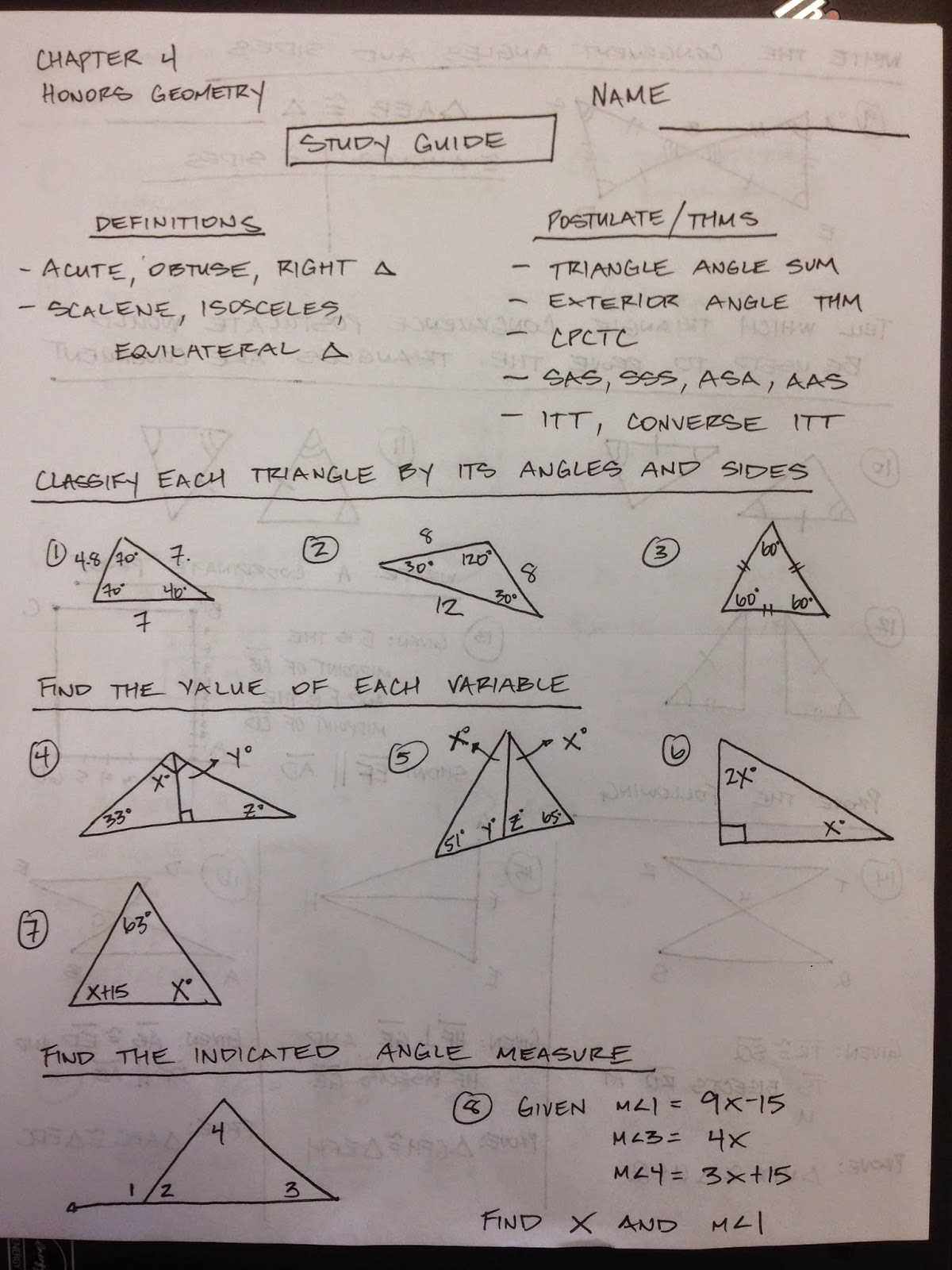
Welcome to the study guide for the Unit 4 test on congruent triangles! In this guide, we will cover all the important concepts and topics that you need to know in order to succeed on the test. Congruent triangles are an essential part of geometry, as they allow us to prove that two triangles are identical in size and shape. This is particularly useful in various geometric proofs and calculations.
First, let’s start with the definition of congruent triangles. Two triangles are said to be congruent if their corresponding sides and angles are equal. This means that if we can pair up all the sides and angles of two triangles and find that they are equal in measure, then the triangles are congruent. There are several postulates and theorems that we can use to prove congruency, such as SSS (Side-Side-Side), SAS (Side-Angle-Side), and ASA (Angle-Side-Angle). These tools will play a crucial role in our study of congruent triangles.
Next, we will examine the properties of congruent triangles. One important property is that if two triangles are congruent, then all their corresponding parts are congruent as well. This means that if two triangles are identical in size and shape, then every side and angle of one triangle will be equal to its corresponding side and angle in the other triangle. This property allows us to make precise and accurate measurements and calculations involving congruent triangles.
Why are Congruent Triangles Important?
Congruent triangles are an important concept in geometry because they provide a way to prove that two geometric figures are exactly the same shape and size. When two triangles are congruent, it means that all corresponding sides and angles are equal, and they can be superimposed on each other perfectly. This property allows mathematicians and engineers to make accurate measurements and calculations in various fields.
One of the main applications of congruent triangles is in construction and engineering. By knowing that two triangles are congruent, engineers can ensure that structures such as bridges, buildings, and roads are built accurately and symmetrically. This helps to prevent any potential issues or flaws in the structure that could compromise its stability and safety.
In addition to construction, congruent triangles are also important in navigation and land surveying. Land surveyors use the principles of congruent triangles to measure distances and angles accurately. By using a theodolite and trigonometry, they can calculate the size and location of land features, which is crucial for mapping and planning purposes. Similarly, navigators use the principles of congruent triangles to determine their position and plot a course when traveling on land or at sea.
Overall, congruent triangles play a crucial role in geometry and various practical applications. They provide a foundation for accurate measurement and calculation, ensuring that structures are built correctly and that navigation and surveying tasks are carried out with precision.
Understanding the concept of congruence
In geometry, the concept of congruence is fundamental to understanding the relationships between different shapes and figures. Congruence refers to the idea that two objects are identical in shape and size. When two figures are congruent, all corresponding sides and angles are equal.
There are several methods to determine congruence, including the side-side-side (SSS) criterion, where if all three sides of two triangles are equal, then the triangles are congruent. Another criterion is the side-angle-side (SAS) criterion, which states that if two sides and the included angle of one triangle are equal to two sides and the included angle of another triangle, then the triangles are congruent.
Congruent triangles have several important properties:
- Corresponding sides and angles are equal.
- Congruent triangles have the same shape and size, which means they can be superimposed on each other.
- If two triangles are congruent, then their corresponding vertices, angles, sides, and medians are also congruent.
- Congruent triangles can be used to prove the congruence of other triangles or parts of triangles.
Understanding the concept of congruence is crucial in geometry as it allows mathematicians and learners to analyze and compare different shapes and figures. It provides a foundation for proving various geometric theorems and solving problems related to the properties of triangles and other polygons. By recognizing congruent triangles, mathematicians can make deductions and draw conclusions about the relationships between different parts of a figure.
Overall, the concept of congruence is central to the study of geometry and enables mathematicians to explore the similarities and relationships between different shapes and figures.
Key properties of congruent triangles
The concept of congruent triangles is an important topic in geometry. Congruent triangles have the same shape and size, and their corresponding sides and angles are equal. This means that if two triangles are congruent, their corresponding sides and angles can be matched up perfectly.
There are several key properties of congruent triangles that help us identify and prove their congruence. These include the Side-Side-Side (SSS) criterion, the Side-Angle-Side (SAS) criterion, the Angle-Side-Angle (ASA) criterion, and the Hypotenuse-Leg (HL) criterion.
- Side-Side-Side (SSS) criterion: This criterion states that if the three sides of one triangle are congruent to the corresponding three sides of another triangle, then the triangles are congruent.
- Side-Angle-Side (SAS) criterion: This criterion states that if two sides and the included angle of one triangle are congruent to the corresponding two sides and the included angle of another triangle, then the triangles are congruent.
- Angle-Side-Angle (ASA) criterion: This criterion states that if two angles and the included side of one triangle are congruent to the corresponding two angles and the included side of another triangle, then the triangles are congruent.
- Hypotenuse-Leg (HL) criterion: This criterion applies specifically to right triangles. It states that if the hypotenuse and one leg of one right triangle are congruent to the hypotenuse and one leg of another right triangle, then the triangles are congruent.
These key properties of congruent triangles provide us with a set of rules and conditions to determine when two triangles are congruent. By using these criteria, we can solve geometric problems, prove theorems, and establish relationships between different parts of congruent triangles.
Methods for Proving Triangle Congruence
There are several methods for proving that two triangles are congruent. These methods involve using different combinations of angles and sides to establish congruence. One method is the Side-Angle-Side (SAS) postulate, which states that if two sides and the included angle of one triangle are congruent to two sides and the included angle of another triangle, then the two triangles are congruent. This method is useful when you have two triangles with a shared side.
Another method is the Angle-Side-Angle (ASA) postulate, which states that if two angles and the included side of one triangle are congruent to two angles and the included side of another triangle, then the two triangles are congruent. This method is useful when you have two triangles with a shared angle. It’s important to note that the included side is the side between the two given angles.
The Side-Side-Side (SSS) postulate states that if three sides of one triangle are congruent to three sides of another triangle, then the two triangles are congruent. This method is useful when you have two triangles with no shared angles or sides. Additionally, the Angle-Angle-Side (AAS) postulate states that if two angles and a non-included side of one triangle are congruent to two angles and the corresponding non-included side of another triangle, then the two triangles are congruent.
Finally, the Hypotenuse-Leg (HL) theorem is a variation of the SAS postulate and is specifically used for right triangles. It states that if the hypotenuse and a leg of one right triangle are congruent to the hypotenuse and corresponding leg of another right triangle, then the two right triangles are congruent. This method is useful when you are working with right triangles.
- Side-Angle-Side (SAS) postulate: two sides and the included angle
- Angle-Side-Angle (ASA) postulate: two angles and the included side
- Side-Side-Side (SSS) postulate: three congruent sides
- Angle-Angle-Side (AAS) postulate: two angles and a non-included side
- Hypotenuse-Leg (HL) theorem: hypotenuse and a leg of right triangles
These methods provide a systematic way to prove triangle congruence and are essential in various geometric proofs and constructions.
Side-Side-Side (SSS) Postulate
The Side-Side-Side (SSS) Postulate is a way to prove that two triangles are congruent. This postulate states that if all three sides of one triangle are congruent to the corresponding sides of another triangle, then the two triangles are congruent.
To use the SSS Postulate, you must show that all three pairs of corresponding sides are congruent. This can be done by measuring the lengths of the sides or by using other theorems or postulates to prove their congruence.
- Here are the steps to use the SSS Postulate to prove triangle congruence:
The SSS Postulate is a powerful tool in geometry because it allows us to prove that two triangles are congruent based solely on the lengths of their sides. This postulate can be used in various geometric proofs and helps to establish the equality of triangles in different contexts.
Side-Angle-Side (SAS) Postulate
The Side-Angle-Side (SAS) Postulate is a rule in geometry that states: If two sides and the included angle of one triangle are congruent to two sides and the included angle of another triangle, then the two triangles are congruent. In other words, if we have two triangles with the same length of two sides and the same angle between those sides, then we can conclude that the two triangles are congruent.
The SAS Postulate is useful when we need to prove that two triangles are congruent. By establishing that the corresponding sides and angles in two triangles are congruent, we can confidently state that the two triangles are identical in shape and size.
When using the SAS Postulate to prove congruence, we typically break down the proof into three steps:
- Step 1: Show that the two sides of one triangle are congruent to the corresponding sides of the other triangle.
- Step 2: Establish that the angle between the two congruent sides is also congruent.
- Step 3: Conclude that the two triangles are congruent.
Overall, the Side-Angle-Side (SAS) Postulate is a powerful tool in geometry that allows us to prove congruence between triangles by comparing the length of two sides and the angle between them. By following the steps outlined in the postulate, we can confidently determine that two triangles are congruent and use this information to solve various geometric problems.
Angle-Side-Angle (ASA) Postulate

The Angle-Side-Angle (ASA) postulate is one of the ways to prove that two triangles are congruent. According to this postulate, if two angles and the included side of one triangle are congruent to two angles and the included side of another triangle, then the triangles are congruent.
This postulate can be used to prove congruence between triangles in different situations. For example, if we have two triangles where two angles and the included side are congruent, we can conclude that the two triangles are congruent. By knowing that two angles are congruent, we can deduce that the third angle must also be congruent, as the sum of the angles in a triangle is always 180 degrees.
We can apply the ASA postulate in various geometric problems, such as proving congruence in triangles or using congruent triangles to prove other properties or theorems. Understanding and applying the ASA postulate is important in geometry, as it allows us to establish and prove relationships between triangles and other geometric figures.
Hypotenuse-Leg (HL) Theorem

The Hypotenuse-Leg (HL) theorem is a theorem used to prove that two right triangles are congruent. This theorem states that if the hypotenuse and one leg of a right triangle are congruent to the hypotenuse and one leg of another right triangle, then the two triangles are congruent.
Mathematically, the HL theorem can be stated as:
If in two right triangles, the hypotenuse and one leg of one triangle are congruent to the hypotenuse and one leg of another triangle, then the two triangles are congruent.
The HL theorem is a useful tool in proving the congruence of right triangles. It can be used in various geometric problems and proofs. By identifying that the hypotenuse and one leg of two right triangles are congruent, we can conclude that the remaining sides and angles of the two triangles are also congruent.
Overall, the Hypotenuse-Leg (HL) theorem is an important concept in the study of congruent triangles. It allows us to determine the congruence of right triangles based on the lengths of their sides. By applying this theorem, we can solve a wide range of geometry problems and prove various congruence statements.
Q&A:
What is the Hypotenuse-Leg (HL) Theorem?
The Hypotenuse-Leg (HL) Theorem states that if the hypotenuse and one leg of one right triangle are congruent to the hypotenuse and one leg of another right triangle, then the two triangles are congruent.
How can the Hypotenuse-Leg (HL) Theorem be used to prove congruence between triangles?
To prove congruence between two triangles using the Hypotenuse-Leg (HL) Theorem, you need to show that their hypotenuses and one pair of corresponding legs are congruent.
Can the Hypotenuse-Leg (HL) Theorem be used to prove congruence for non-right triangles?
No, the Hypotenuse-Leg (HL) Theorem is specifically used to prove congruence for right triangles.
What are the conditions for using the Hypotenuse-Leg (HL) Theorem?
The conditions for using the Hypotenuse-Leg (HL) Theorem are that both triangles must be right triangles and their hypotenuse and one leg must be congruent.
Can the order of the hypotenuse and leg in the Hypotenuse-Leg (HL) Theorem be switched?
No, the order of the hypotenuse and leg cannot be switched in the Hypotenuse-Leg (HL) Theorem. The hypotenuse must be matched with the hypotenuse, and the leg must be matched with the leg in order to prove congruence.
What is the Hypotenuse-Leg (HL) Theorem?
The Hypotenuse-Leg (HL) Theorem states that if the hypotenuse and one leg of a right triangle are congruent to the hypotenuse and one leg of another right triangle, then the two triangles are congruent.
How is the Hypotenuse-Leg (HL) Theorem used?
The Hypotenuse-Leg (HL) Theorem is used to prove that two right triangles are congruent based on the lengths of their hypotenuse and one leg. If the hypotenuse and one leg of two right triangles are equal, then the two triangles are guaranteed to be congruent.