Mastering Quadratic Equations: Your Ultimate Study Guide for Unit 4 Test
Preparing for a math test can be a daunting task, especially when it comes to solving quadratic equations. However, with the right study guide, you can take on this challenge and ace your test with flying colors. In this unit 4 test study guide, we will cover the essential concepts and strategies for solving quadratic equations, ensuring that you have a solid understanding of this important topic.
Quadratic equations are polynomial equations of degree 2, meaning they contain terms with a variable raised to the power of 2. Solving these equations involves finding the values of the variable that make the equation true. There are several methods for solving quadratic equations, including factoring, completing the square, and using the quadratic formula. Each method has its advantages and may be more suitable for different types of equations.
One of the key concepts to understand when solving quadratic equations is the discriminant. The discriminant is a value that can help determine the nature of the solutions to a quadratic equation. It is calculated using the coefficients of the equation and can tell us whether the equation has two real solutions, one real solution, or no real solutions. Understanding how to interpret the discriminant is essential when solving quadratic equations.
What is a quadratic equation?
A quadratic equation is a second-degree polynomial equation in one variable. It can be written in the form of ax^2 + bx + c = 0, where a, b, and c are constants, and x represents the variable. Quadratic equations are important in algebra and have applications in various fields, such as physics and engineering.
In a quadratic equation, the highest power of the variable is 2, which gives it a parabolic shape when graphed. The solutions to a quadratic equation, also known as roots or zeros, are the values of x that make the equation true. Depending on the discriminant, the solutions can be real or complex numbers.
To solve a quadratic equation, several methods can be used, including factoring, completing the square, or using the quadratic formula. Factoring involves rewriting the equation as a product of two binomials, while completing the square transforms the equation into a perfect square trinomial. The quadratic formula provides a general formula for finding the roots of any quadratic equation.
Quadratic equations have many applications in real life, such as determining the trajectory of a projectile, finding the maximum or minimum value of a function, or solving problems involving areas and volumes. They are fundamental in understanding and solving problems that involve quadratic relationships.
Definition and characteristics of a quadratic equation

A quadratic equation is a mathematical expression of the form ax^2 + bx + c = 0, where a, b, and c are constants. The highest power of the variable x in a quadratic equation is 2, hence the name quadratic. Quadratic equations can have one, two, or no real solutions.
One of the key characteristics of a quadratic equation is that it can be graphed as a parabola. The graph of a quadratic equation is a U-shaped curve that opens either upwards or downwards, depending on the sign of the coefficient a. If a > 0, the parabola opens upwards, and if a < 0, the parabola opens downwards.
Another important property of quadratic equations is that they can be solved using various methods, such as factoring, completing the square, or using the quadratic formula. These methods allow us to find the values of x that satisfy the equation.
In quadratic equations, the discriminant, which is defined as b^2 – 4ac, plays a crucial role in determining the nature of the solutions. If the discriminant is greater than zero, the equation has two distinct real solutions. If the discriminant equals zero, the equation has one real solution, known as a double root. And if the discriminant is less than zero, the equation has no real solutions, only complex roots.
Quadratic equations are widely used in various fields of mathematics, physics, and engineering. They are especially useful in modeling real-life phenomena, such as the motion of projectiles, the trajectories of objects, and the growth of population.
Methods for solving quadratic equations

In mathematics, a quadratic equation is a polynomial equation of the second degree. It can be written in the standard form ax² + bx + c = 0, where a, b, and c are constants, and x is the variable. Solving quadratic equations is an important skill in algebra and has numerous applications in science, engineering, and finance. There are several methods available for solving quadratic equations.
1. Factoring:
One of the most commonly used methods for solving quadratic equations is factoring. In this method, we look for factors of the quadratic equation that when multiplied together, give us the original equation. By setting each factor equal to zero, we can find the solutions. Factoring works best when the quadratic equation is easily factorable, such as when the constant term is a perfect square or when the equation has a common factor.
2. Quadratic formula:
Another method for solving quadratic equations is by using the quadratic formula, which is derived from completing the square. The quadratic formula states that the solutions to the equation ax² + bx + c = 0 are given by x = (-b ± √(b² – 4ac))/(2a). This formula works for all quadratic equations, regardless of whether they are factorable or not. It provides an efficient way to find the solutions, especially when factoring is not possible.
3. Completing the square:
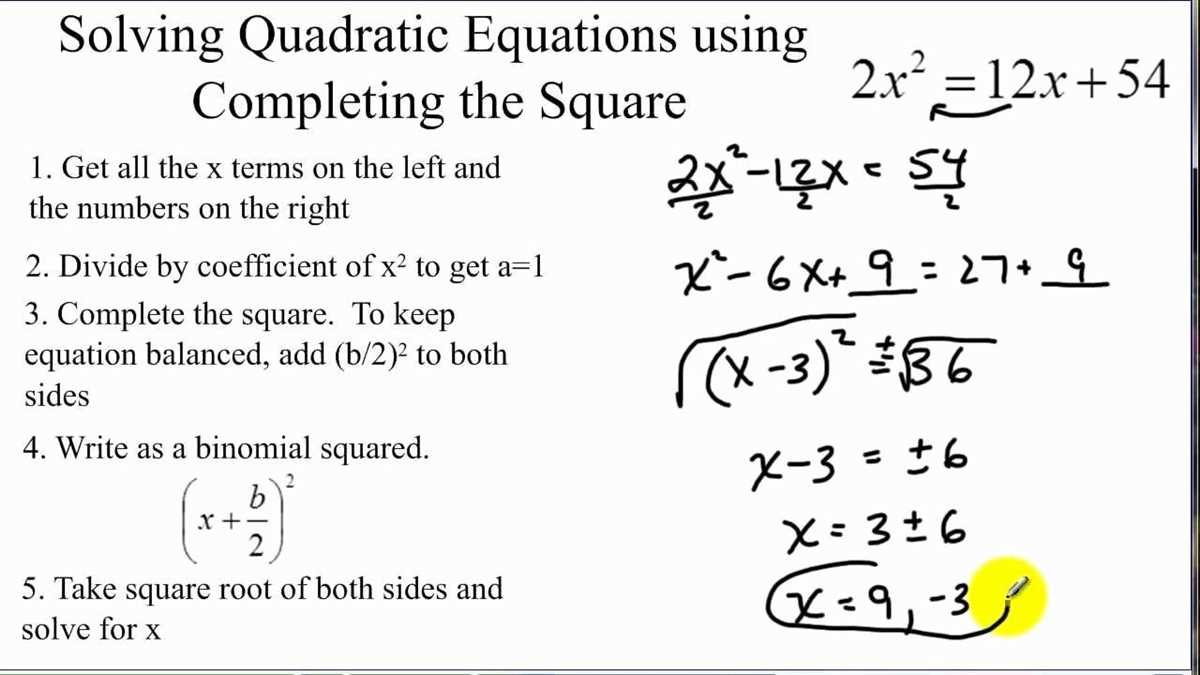
Completing the square is a method used to rewrite a quadratic equation in a form that is easily factorable or solvable. This method involves adding or subtracting a constant term to both sides of the equation to create a perfect square trinomial. By rearranging the equation and taking the square root of both sides, we can find the solutions. Completing the square is particularly useful when the quadratic equation does not factor easily, but it requires careful algebraic manipulation.
These are three of the main methods used for solving quadratic equations. Depending on the nature of the equation and the available information, one method may be more suitable than the others. It is important to have a good understanding of all three methods and to practice applying them to different types of quadratic equations.
Factoring method
The factoring method is a useful technique for solving quadratic equations. It involves factoring the quadratic equation into two binomial factors and setting each factor equal to zero to find the solutions. The factoring method can be used when the quadratic equation is in standard form, which is ax^2 + bx + c = 0, where a, b, and c are constants.
To use the factoring method, you need to identify the factors of the quadratic equation. This can be done by looking for common factors, finding the product of the leading coefficient (a) and the constant term (c), and determining the sum or difference of the middle term (bx).
Once you have factored the quadratic equation, you can set each factor equal to zero and solve for the variable. The solutions obtained from factoring are called the roots or x-intercepts of the quadratic equation.
The factoring method is often used when the quadratic equation is easily factorable. However, it may not always be possible to factor the equation, especially if the equation has complex roots or irrational solutions. In such cases, other methods such as the quadratic formula or completing the square may be used to solve the quadratic equation.
In conclusion, the factoring method is a useful technique for solving quadratic equations. It involves factoring the equation into two binomial factors and setting each factor equal to zero. The factoring method is most effective when the equation is easily factorable, but other methods can be used for more complex equations.
Quadratic Formula
The quadratic formula is a mathematical formula used to find the solutions or roots of a quadratic equation. It is often used when a quadratic equation cannot be easily factored or when other methods, such as completing the square, are not desirable. The quadratic formula is derived from the quadratic equation, which is in the form ax^2 + bx + c = 0, where a, b, and c are constants and x represents the variable.
The quadratic formula states that the solutions to the quadratic equation are given by the formula:
x = (-b ± √(b^2 – 4ac)) / 2a
where ± represents two possible solutions, and √(b^2 – 4ac) is the square root of the discriminant of the quadratic equation. The discriminant is a value that can be used to determine the nature of the solutions. If the discriminant is greater than zero, the quadratic equation has two distinct real solutions. If the discriminant is equal to zero, the quadratic equation has one real solution (a repeated root). And if the discriminant is less than zero, the quadratic equation has two complex conjugate solutions.
The quadratic formula is a powerful tool in solving quadratic equations, as it provides a straightforward method to find the solutions. However, it is important to note that the formula may not always yield real solutions, especially when the discriminant is negative. In such cases, the solutions will involve complex numbers.
Example: Solve the quadratic equation 2x^2 – 7x + 3 = 0 using the quadratic formula.
We can identify the values of a, b, and c in the equation: a = 2, b = -7, and c = 3. Plugging these values into the quadratic formula, we have:
x = (-(-7) ± √((-7)^2 – 4(2)(3))) / (2(2))
x = (7 ± √(49 – 24)) / 4
x = (7 ± √25) / 4
Now we can simplify further:
x = (7 ± 5) / 4
This gives us two possible solutions: x = 3/2 or x = 3.5
By using the quadratic formula, we were able to find the solutions to the given quadratic equation.
Completing the square
In mathematics, completing the square is a technique used to manipulate a quadratic equation into a perfect square trinomial by adding or subtracting a constant term. This allows us to solve the quadratic equation using the zero-product property. Completing the square is particularly useful when solving quadratic equations that cannot be easily factored or when solving quadratic equations derived from real-world applications.
To complete the square, we follow a specific set of steps. First, we ensure that the quadratic equation is in the standard form, which is ax^2 + bx + c = 0. If necessary, we rearrange the equation so that the coefficient of x^2 is 1. Then, we take half of the coefficient of x (b/2) and square it to get (b/2)^2. This value is added or subtracted to both sides of the equation to create a perfect square trinomial on the left side.
Once the quadratic equation is in the form (x + a)^2 = b, we can take the square root of both sides to solve for x. However, it’s important to consider the sign of the constant term. If the constant term is positive, we take both the positive and negative square roots. If the constant term is negative, we know that there are no real solutions.
Completing the square is a powerful technique that allows us to solve quadratic equations in a systematic and logical manner. It is an essential tool in Algebra and can be used in various mathematical applications such as graphing parabolas and solving optimization problems.
Tips for solving quadratic equations efficiently
Quadratic equations can be challenging to solve, but with the right strategies, you can approach them efficiently and effectively. Here are some tips to help you navigate through the process:
1. Identify the type of the quadratic equation

Quadratic equations can come in different forms, such as standard form (ax^2 + bx + c = 0), vertex form (a(x-h)^2 + k = 0), or factored form ((x – a)(x – b) = 0). It is important to identify the type of equation you are dealing with in order to choose the appropriate method for solving it.
2. Use factoring whenever possible
Factoring is one of the most efficient methods for solving quadratic equations. Look for common factors or patterns that can be factored out, and then apply the zero-product property to determine the solutions. Factoring can simplify the equation and make it easier to solve.
3. Apply the quadratic formula

If factoring is not possible or difficult to apply, you can always rely on the quadratic formula. The quadratic formula is a powerful tool that can be used to find the solutions of any quadratic equation. Remember to plug in the values of a, b, and c into the formula and simplify the expression to find the solutions.
4. Complete the square as a last resort
If factoring and the quadratic formula are not feasible options, you can resort to completing the square. This method involves manipulating the equation to transform it into a perfect square trinomial, which can then be easily solved. However, completing the square can be time-consuming and requires attention to detail, so it should be used as a last resort.
By following these tips and gaining a good understanding of the different methods for solving quadratic equations, you can approach them efficiently and confidently. Remember to practice regularly and seek help when needed to improve your problem-solving skills.
Identifying the form of the equation
When it comes to solving quadratic equations, it is crucial to first identify the form of the equation. Quadratic equations can be written in standard form, vertex form, or factored form, and understanding the form of the equation is essential for determining the correct method of solving.
One common form of a quadratic equation is the standard form, which is written as ax^2 + bx + c = 0. In this form, the coefficients a, b, and c represent the values of the quadratic equation. The standard form is often used when solving quadratic equations using the quadratic formula or by factoring.
Another form of a quadratic equation is the vertex form, which is written as y = a(x – h)^2 + k. In this form, the values of a, h, and k represent the characteristics of the parabola. The vertex form is useful when determining the vertex of a parabola or finding the maximum or minimum value.
Lastly, a quadratic equation can also be written in factored form, which is expressed as y = a(x – r)(x – s). In this form, the values of a, r, and s represent the roots or x-intercepts of the quadratic equation. The factored form is helpful when solving quadratic equations by factoring or finding the x-intercepts.
In conclusion, identifying the form of the quadratic equation is crucial when solving. Whether it is in standard form, vertex form, or factored form, understanding the equation’s form allows for the appropriate method to be used for finding the solution. By recognizing the form, you can effectively solve and manipulate quadratic equations.