Cracking the Code: Uncovering Vertex Form of Parabolas with Worksheet Answers

Understanding the vertex form of parabolas is essential in graphing and analyzing quadratic equations. The vertex form of a parabola represents the parabola’s vertex and allows us to easily identify its key features, such as its vertex and axis of symmetry. This form of the equation can also help us find the maximum or minimum points of a parabola.
In this worksheet, you will find answers to various problems involving the vertex form of parabolas. Each problem will provide a quadratic equation in vertex form, and you will be asked to identify the vertex, axis of symmetry, and whether the parabola opens upward or downward. You will also have the opportunity to graph the parabola and find the maximum or minimum points, if applicable.
By solving these problems, you will strengthen your understanding of the vertex form of parabolas and improve your ability to graph and analyze quadratic equations. This knowledge will be valuable in various mathematical applications, such as physics, engineering, and finance. So grab a pencil and get ready to dive into the world of parabolas!
Understanding the Vertex Form of Parabolas
By analyzing the equation in vertex form, we can immediately determine the vertex of the parabola. The values of h and k correspond to the x-coordinate and y-coordinate of the vertex, respectively. For example, in the equation y = 2(x – 3)^2 + 4, the vertex is located at (3, 4). This allows us to plot the vertex on the coordinate plane and understand the basic shape of the parabola.
The coefficient “a” in the vertex form of a parabola determines the direction and scale of the graph. If “a” is positive, the parabola opens upwards, and if “a” is negative, the parabola opens downwards. The absolute value of “a” determines the steepness of the parabola. For example, an equation like y = -2(x – 3)^2 + 4 represents a parabola that opens downwards and is narrower than the previous example.
In addition to understanding the shape of the parabola, the vertex form also provides information about the axis of symmetry and y-intercept. The axis of symmetry is a vertical line passing through the vertex and is given by the equation x = h. The y-intercept is the point where the parabola intersects the y-axis, which can be found by substituting x = 0 into the equation and solving for y.
Overall, the vertex form of parabolas is a powerful tool for analyzing and graphing parabolas. It allows us to easily determine the important characteristics of the parabola, such as the vertex, axis of symmetry, and y-intercept. By understanding the meaning of each term in the equation, we can gain insights into the behavior and shape of the parabola.
What is the vertex form of a parabola?
In this form, the variable “a” determines the direction and width of the parabolic curve. If “a” is positive, the parabola opens upwards, and if “a” is negative, it opens downwards. The values of “h” and “k” represent the horizontal and vertical shifts of the vertex, respectively.
To graph a parabola using the vertex form, start by identifying the vertex coordinates. Then, plot the vertex on the coordinate plane. Next, use the value of “a” to determine the direction and width of the parabola, and plot a few additional points on either side of the vertex accordingly. Lastly, connect the points to create a smooth curve that represents the parabola.
The vertex form of a parabola is often used in algebraic calculations and graphing exercises, as it provides a clear and concise representation of the parabolic equation. Understanding how to convert between different forms of a parabola equation, such as the standard form and the vertex form, is an important skill in working with parabolic functions.
How to Identify the Vertex
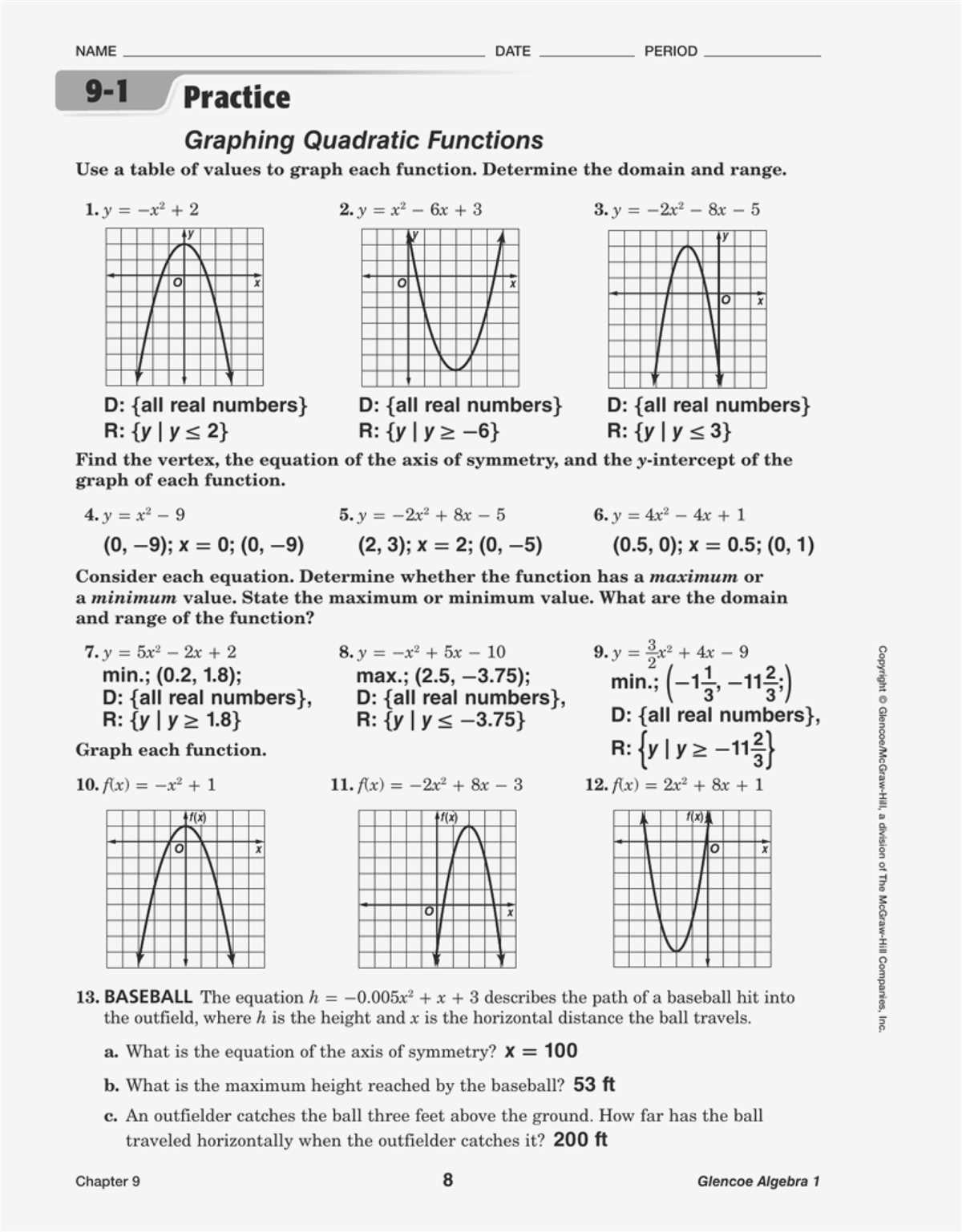
When working with the vertex form of parabolas, understanding how to identify the vertex is crucial. The vertex is the point on the parabola where the graph reaches its highest (or lowest) point. It is often represented as (h, k) in the equation y = a(x-h)^2 + k. Identifying the vertex can help us understand important features of the parabola, such as its direction and location.
To find the vertex, we can use several strategies. One of the most common methods is to look at the equation in vertex form and directly identify the values of h and k. The value of h represents the horizontal shift of the parabola, while k represents the vertical shift. By substituting these values into the equation, we can easily find the coordinates of the vertex.
Another approach is to use the axis of symmetry, which is a vertical line that divides the parabola into two equal halves. The equation of the axis of symmetry can be found by taking the x-coordinate of the vertex, which is -h. By knowing the equation of the axis of symmetry, we can then determine the y-coordinate of the vertex by substituting the value of -h into the equation.
It is important to remember that the vertex is an essential piece of information when dealing with parabolas. It provides valuable insights into the shape and position of the graph. By understanding the methods for identifying the vertex, we can confidently analyze and interpret parabolic equations in the vertex form.
What information do you need to identify the vertex?

In order to identify the vertex of a parabola in vertex form, you need to have the equation of the parabola in the form y = a(x-h)^2 + k, where (h, k) represents the coordinates of the vertex.
The coefficient ‘a’ determines the direction and scale of the parabola, while the values of ‘h’ and ‘k’ represent the horizontal and vertical translations of the parabola. To find the vertex, you need to know the values of ‘h’ and ‘k’.
- Vertex (h, k): The vertex represents the highest or lowest point of the parabola. It is located at the coordinates (h, k), where ‘h’ represents the horizontal shift and ‘k’ represents the vertical shift.
- Axis of symmetry: The axis of symmetry is the vertical line passing through the vertex. It is given by the equation x = h.
- x-intercepts: The x-intercepts, also known as roots or zeros, are the points where the graph of the parabola intersects the x-axis. To find the x-intercepts, set y = 0 and solve for x.
- y-intercept: The y-intercept is the point where the graph of the parabola intersects the y-axis. To find the y-intercept, set x = 0 and solve for y.
By knowing the values of ‘h’ and ‘k’, you can easily identify the vertex of a parabola in vertex form. The vertex is essential for analyzing the shape and behavior of the parabola, as well as for solving real-life problems involving quadratic functions.
Converting Standard Form to Vertex Form
Converting a quadratic equation from standard form to vertex form allows us to easily identify the vertex of the parabola and provides valuable information about its concavity.
The standard form of a quadratic equation is written as y = ax^2 + bx + c. In this form, it may be difficult to determine the vertex of the parabola. However, by completing the square, we can transform the equation into vertex form, which is written as y = a(x – h)^2 + k. In this expression, the values of h and k represent the x-coordinate and y-coordinate of the vertex, respectively.
To convert from standard form to vertex form, follow these steps:
- Identify the values of a, b, and c in the standard form equation.
- Use the formula h = -b/2a to find the x-coordinate of the vertex.
- Substitute the value of h into the equation to find the y-coordinate of the vertex.
- Rewrite the equation in vertex form, using the values of a, h, and k.
Converting a quadratic equation from standard form to vertex form provides a clearer representation of the parabola and simplifies the process of finding the vertex. It is a useful technique in solving quadratic equations and analyzing their properties.
Step-by-step guide on converting standard form to vertex form
In algebra, the vertex form of a parabola is a useful way to represent quadratic equations. Converting a quadratic equation from standard form to vertex form allows us to easily determine the vertex and other important properties of the parabola. Here is a step-by-step guide on how to achieve this conversion:
- Identify the coefficients: In standard form, a quadratic equation is written as y = ax^2 + bx + c. Identify the values of a, b, and c in the equation.
- Find the x-coordinate of the vertex: The x-coordinate of the vertex can be found using the formula x = -b/2a. Substitute the values of a and b to find the x-coordinate.
- Calculate the y-value of the vertex: Substitute the x-coordinate obtained in the previous step into the original equation to find the corresponding y-value of the vertex.
- Write the vertex form equation: The vertex form of a parabola is written as y = a(x – h)^2 + k, where (h, k) represents the coordinates of the vertex. Substitute the values of a, h, and k into the equation to obtain the vertex form.
- Simplify the equation: Simplify the equation obtained in the previous step by expanding and combining like terms. This will give you the final vertex form equation.
By following these steps, you can easily convert a quadratic equation from standard form to vertex form and gain valuable insights about the parabola, such as its vertex, axis of symmetry, and the direction it opens. This conversion can be especially useful when solving optimization problems or graphing quadratic functions.
Working with Worksheet Answers

Worksheet answers are an essential tool for students to check their understanding and progress in various subjects, including mathematics. They provide a way for students to verify their work and identify any mistakes they may have made. When it comes to working with worksheet answers, there are several important points to consider.
1. Checking Answers:
The primary purpose of worksheet answers is to allow students to check their answers and determine if they are correct. This step is crucial in the learning process as it helps students identify any misconceptions or errors they may have made. By comparing their solutions with the provided answers, students can self-assess their understanding of the topic and make necessary corrections if needed.
2. Identifying Mistakes:
Worksheet answers also serve as a valuable tool for identifying mistakes. When students encounter a discrepancy between their answers and the provided solutions, they have an opportunity to carefully analyze their calculations and reasoning. This process encourages students to reflect on their work, identify errors, and develop problem-solving skills.
3. Learning from Mistakes:
Mistakes are a natural part of the learning process. By understanding their mistakes and learning from them, students can improve their understanding of the topic. Worksheet answers provide students with the chance to learn from their mistakes and reinforce their knowledge. They can also ask their teachers or peers for guidance if they are struggling to understand why their answer is incorrect.
- Overall, working with worksheet answers is essential for students’ learning and growth. It allows them to verify their answers, identify mistakes, and learn from them. It is important for educators to provide clear explanations and guidance alongside the answers, enabling students to improve their understanding and skills in the subject.
How to Solve Parabola Problems Using the Vertex Form Worksheet Answers
When solving parabola problems, the vertex form of a parabola is a helpful tool. By using the vertex form of a parabola, you can easily determine the coordinates of the vertex, the axis of symmetry, and the direction of opening of the parabola.
The vertex form of a parabola is given by the equation:
y = a(x – h)^2 + k
In this equation, (h, k) represents the coordinates of the vertex, and the value of a determines the direction of opening of the parabola. If a is positive, the parabola opens upwards, and if a is negative, the parabola opens downwards.
To solve parabola problems using the vertex form worksheet answers, follow these steps:
- Identify the values of a, h, and k from the given equation in the vertex form.
- Use the values of h and k to determine the coordinates of the vertex.
- Identify the axis of symmetry by using the value of h.
- Determine the direction of opening of the parabola by looking at the value of a.
- Using the coordinates of the vertex, plot the vertex on a graph.
- Using the axis of symmetry and the direction of opening, plot additional points to sketch the parabola.
By following these steps, you can easily solve parabola problems using the vertex form worksheet answers. It allows you to quickly understand the key characteristics of the parabola, such as its vertex, axis of symmetry, and direction of opening.
Remember to practice solving various parabola problems using the vertex form worksheet answers to improve your understanding and proficiency. With time and practice, you will become more comfortable with solving parabola problems and utilizing the vertex form of a parabola.
Q&A:
What is the vertex form of a parabola equation?
The vertex form of a parabola equation is y = a(x – h)^2 + k, where (h, k) represents the vertex of the parabola.
How do you find the vertex of a parabola given its equation in vertex form?
To find the vertex of a parabola given its equation in vertex form, you can directly read the values of h and k from the equation. The vertex is located at the point (h, k).
What does the “a” value represent in the vertex form of a parabola equation?
The “a” value in the vertex form of a parabola equation determines the direction and stretch/compression factor of the parabola. If “a” is positive, the parabola opens upwards. If “a” is negative, the parabola opens downwards.
How can the vertex form of a parabola equation help solve problems?
The vertex form of a parabola equation helps solve problems by providing a clear representation of the vertex and the direction of the parabola. It allows you to easily identify key information about the parabola, such as the vertex, axis of symmetry, and whether the parabola opens upwards or downwards.
Are there any advantages to using the vertex form of a parabola equation when solving problems?
Yes, there are several advantages to using the vertex form of a parabola equation when solving problems. It allows for easy visualization of the vertex and direction of the parabola, simplifies calculations involving the vertex and axis of symmetry, and provides a straightforward way to determine key features of the parabola, such as the y-intercept and x-intercepts.
What is the vertex form of a parabola?
The vertex form of a parabola is given by the equation y = a(x – h)^2 + k , where (h, k) represents the vertex of the parabola.