The Key to Understanding Trig: A Comprehensive Introduction (Answer Key Included)
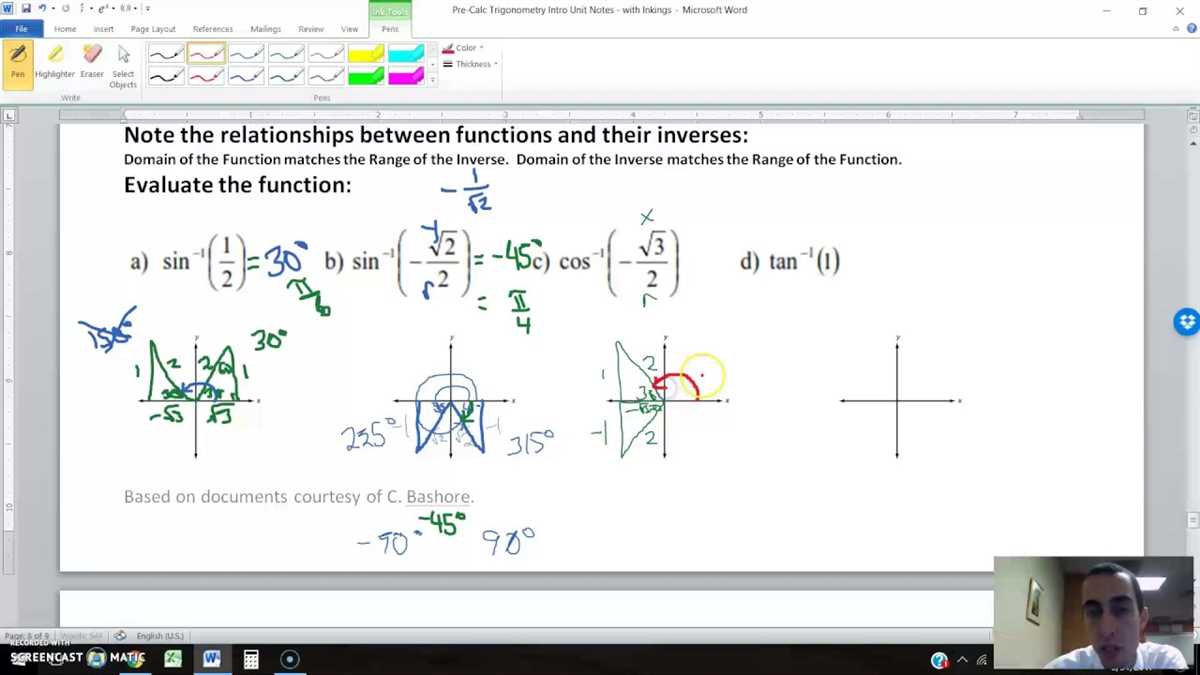
Introduction: Trigonometry is a branch of mathematics that deals with the relationships between the angles and sides of triangles. It is widely used in various fields such as physics, engineering, and computer graphics. In this article, we will explore the answer key for the 9.1 Introduction to Trig, focusing on fundamental concepts and applications.
Overview of 9.1 Introduction to Trig: This section introduces students to key trigonometric concepts, including the definitions of sine, cosine, and tangent. The lesson also covers how to use the unit circle to find the values of these trigonometric functions for various angles. Additionally, students learn about the primary trigonometric ratios and their reciprocal functions.
Answer Key: The answer key for the 9.1 Introduction to Trig provides solutions to the various exercises and problems presented in the lesson. It allows students to check their work and ensure they are understanding the material correctly. The answer key also provides detailed explanations, steps, and calculations for each problem, helping students grasp the concepts and formulas used in trigonometry.
Benefits of the Answer Key: The answer key serves as a valuable learning tool for students studying trigonometry. By having access to the correct answers and explanations, students can identify and correct any mistakes or misunderstandings they may have. It also allows them to practice problem-solving skills and build confidence in their abilities.
Understanding Trigonometry: A Comprehensive Guide
Trigonometry is a branch of mathematics that deals with the relationships between the angles and sides of triangles. It is a fundamental concept in mathematics and has applications in various fields such as physics, engineering, and architecture. In this comprehensive guide, we will delve into the basics of trigonometry, exploring key concepts and providing practical examples to enhance your understanding.
Key Concepts:
- Right Triangles: Trigonometry primarily focuses on right triangles, which have one angle measuring 90 degrees. Understanding the properties of right triangles, such as the Pythagorean theorem and the trigonometric ratios, is essential in trigonometry.
- Trigonometric Ratios: Trigonometry introduces three main ratios: sine, cosine, and tangent, which relate the angles of a right triangle to the lengths of its sides. These ratios are fundamental in solving trigonometric problems and can be represented using the common acronym SOH-CAH-TOA.
- Unit Circle: The unit circle is a tool used in trigonometry to represent the angles and trigonometric functions. It is a circle with a radius of 1 unit, centered at the origin of a coordinate plane. The unit circle provides a visual representation of the trigonometric ratios for all angles.
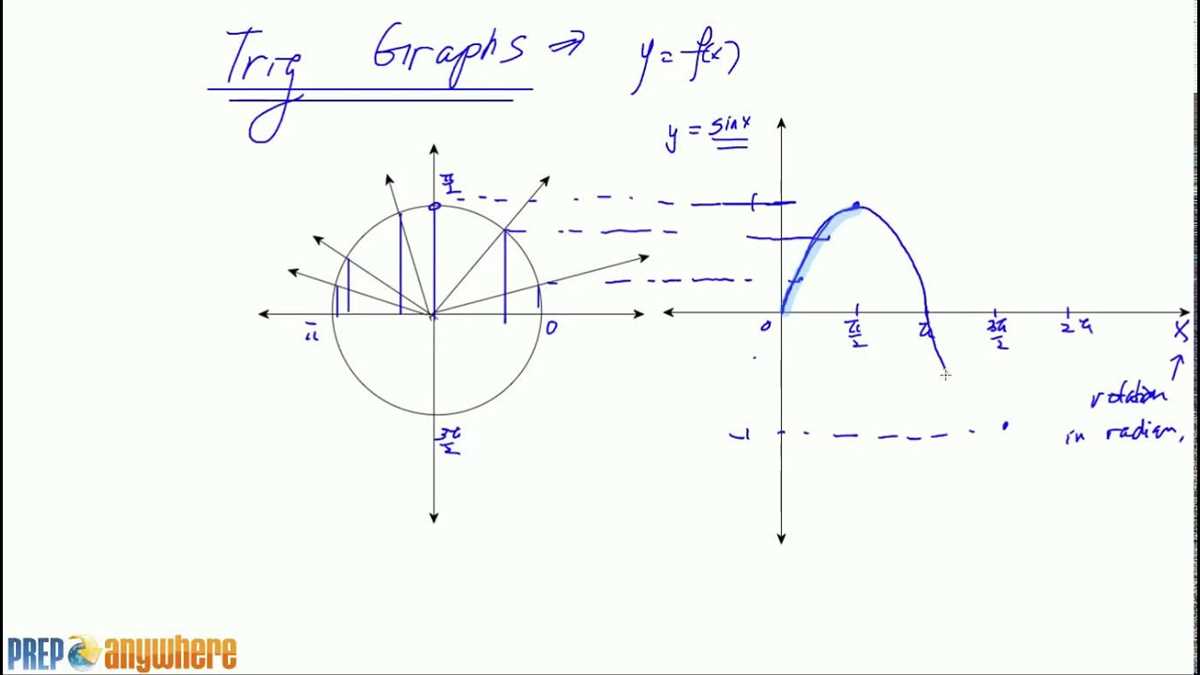
- Graphing Trigonometric Functions: Trigonometric functions can be graphed to visualize the relationship between angles and their corresponding trigonometric values. The graphs of sine, cosine, and tangent functions exhibit periodic patterns and have specific characteristics based on the properties of a unit circle.
By understanding these key concepts and practicing with various trigonometric problems, you will develop a solid foundation in trigonometry. This comprehensive guide aims to provide you with the necessary knowledge and skills to confidently apply trigonometry in real-world scenarios and solve complex mathematical problems. Whether you are a student studying trigonometry for the first time or someone looking to refresh their knowledge, this guide will serve as a valuable resource.
Explore the Basics of Trig: Definitions and Concepts
In mathematics, trigonometry is a branch that deals with the relationships between the sides and angles of triangles. It has a wide range of real-world applications, including engineering, physics, and navigation. Understanding the basics of trigonometry is essential for solving complex problems involving angles and distances.
One of the fundamental concepts in trigonometry is the unit circle. The unit circle is a circle with a radius of 1 unit, centered at the origin of a coordinate plane. It provides a visual representation of the trigonometric functions sine and cosine. By analyzing the points on the unit circle, we can determine the values of these functions for different angles.
Trigonometry also introduces three main trigonometric ratios: sine, cosine, and tangent. These ratios are defined based on the sides of a right triangle. The sine of an angle is equal to the ratio of the length of the side opposite the angle to the hypotenuse. The cosine of an angle is equal to the ratio of the length of the adjacent side to the hypotenuse. The tangent of an angle is equal to the ratio of the length of the side opposite the angle to the length of the adjacent side.
Other key trigonometric concepts include the Pythagorean identity, which relates the sine and cosine functions, and the inverse trigonometric functions, which allow us to find angles based on given trigonometric values. Trigonometry also involves the use of trigonometric identities and equations to solve complex problems.
In conclusion, trigonometry is a branch of mathematics that deals with the relationships between triangles and angles. By understanding the definitions and concepts of trigonometry, we can apply this knowledge to solve real-world problems in various fields. Whether you’re studying trigonometry for academic purposes or looking to apply it in practical situations, mastering the basics is essential for success.
Mastering Trigonometric Functions: Sin, Cos, and Tan
Trigonometric functions are fundamental mathematical concepts that are used extensively in various fields such as physics, engineering, and geometry. Among these functions, sine (sin), cosine (cos), and tangent (tan) play a crucial role in solving trigonometric equations and analyzing geometric relationships.
The sine function (sin) relates the ratio of the side opposite a given angle to the hypotenuse in a right triangle. It can be expressed as sin(theta) = opposite/hypotenuse. The cosine function (cos) relates the ratio of the adjacent side to the hypotenuse in a right triangle. It can be expressed as cos(theta) = adjacent/hypotenuse. Lastly, the tangent function (tan) relates the ratio of the opposite side to the adjacent side in a right triangle. It can be expressed as tan(theta) = opposite/adjacent.
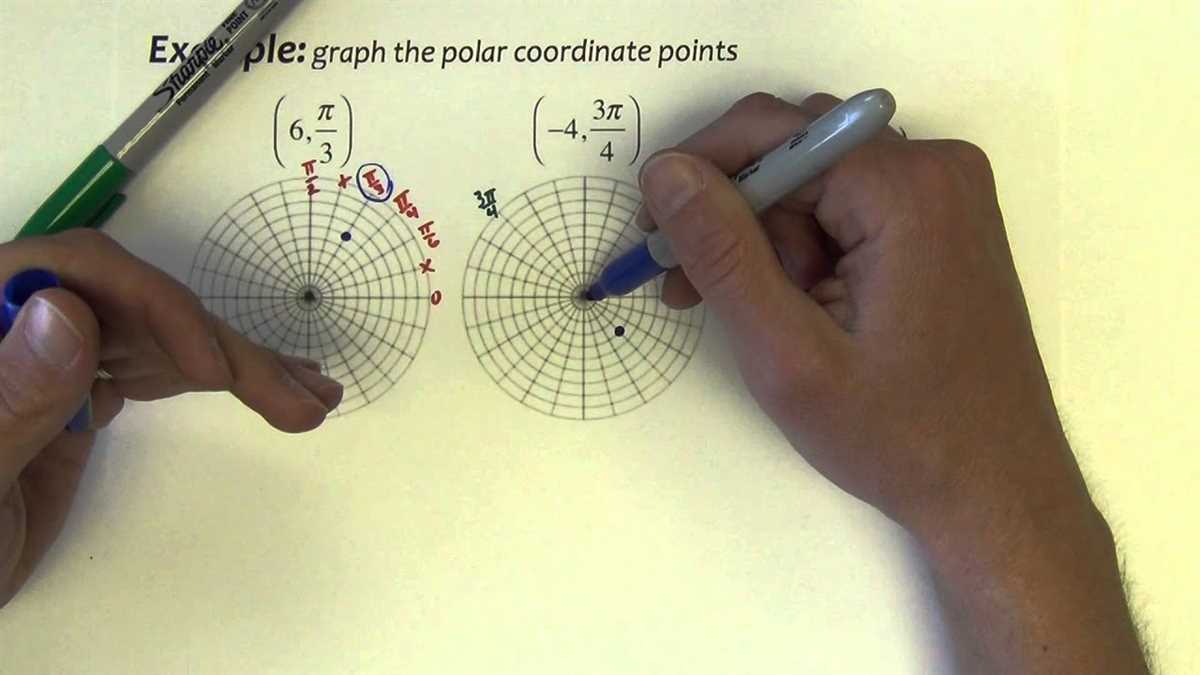
To understand these functions better, it is essential to visualize them on the unit circle. The unit circle is a circle with a radius of 1 unit and is centered at the origin of a coordinate plane. The values of sin, cos, and tan for a particular angle can be determined by examining the coordinates of the point where the angle intersects the unit circle.
- For example, if the angle is 30 degrees, the point of intersection on the unit circle is located at (1/2, √3/2). Therefore, sin(30 degrees) = √3/2, cos(30 degrees) = 1/2, and tan(30 degrees) = √3.
- In a similar manner, the trigonometric functions for other angles can be determined, allowing us to solve complex trigonometric equations and analyze various geometric properties.
Mastering trigonometric functions, particularly sine, cosine, and tangent, is essential for tackling advanced mathematical problems and applications. By understanding the concepts behind these functions and their relationships with angles and triangles, we can navigate through complex mathematical scenarios with confidence and precision.
Solving Trig Equations: Step-by-Step Instructions
Trigonometric equations can be challenging to solve, but with a step-by-step approach, it becomes much more manageable. These equations involve trigonometric functions like sine, cosine, and tangent, and the goal is to find values of the variable that make the equation true.
1. Start by identifying the trigonometric function involved in the equation. It could be sine, cosine, tangent, or any other trigonometric function.
2. Use algebraic techniques to isolate the trigonometric function on one side of the equation. This may involve applying inverse trigonometric functions or dividing both sides by a trigonometric function.
3. Apply any applicable trigonometric identities or properties to simplify the equation further. These identities may include the Pythagorean identities or the definitions of the trigonometric functions.
4. Determine the values of the variable that satisfy the equation. This may involve finding the solutions within a given interval or finding all possible solutions.
5. Check your solutions by substituting them back into the original equation. Ensure that the values make the equation true.
Overall, solving trigonometric equations requires a combination of algebraic manipulation and trigonometric identities. By following these step-by-step instructions, you can effectively solve trigonometric equations and find the values of the variable that satisfy them.
Trigonometric Identities and Formulas: Key Tools for Problem-Solving

Trigonometric identities and formulas are essential tools in solving problems involving angles, triangles, and periodic functions. They provide a way to relate different trigonometric functions and simplify complex expressions. By understanding and applying these identities, mathematicians and scientists can analyze and solve a wide range of problems.
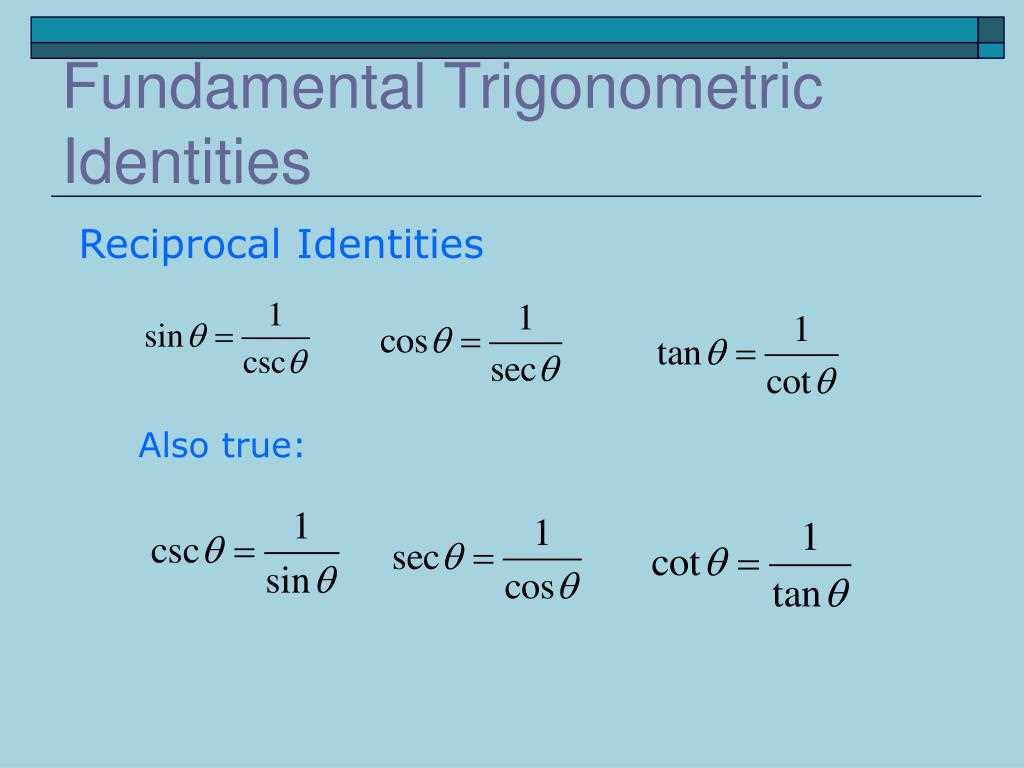
One of the key identities is the Pythagorean identity: sin²θ + cos²θ = 1. This identity relates the sine and cosine functions of an angle and is based on the Pythagorean theorem. It is often used to simplify expressions and prove other trigonometric identities. Another important identity is the reciprocal identity, which states that csc θ = 1/sin θ, sec θ = 1/cos θ, and cot θ = 1/tan θ. These identities help in finding the values of trigonometric functions when the values of sine, cosine, or tangent are known.
Trigonometric identities also provide a way to simplify trigonometric expressions. For example, the sum and difference identities allow us to express the sine, cosine, and tangent of the sum or difference of two angles in terms of the sine, cosine, and tangent of the individual angles. These identities are often used to simplify complex trigonometric equations or expressions, making them easier to solve. The product-to-sum and sum-to-product identities are another set of formulas that allow us to express the product or sum of trigonometric functions in terms of the trigonometric functions of the individual angles.
In addition to identities, trigonometric formulas are also crucial in problem-solving. For example, the law of sines and the law of cosines are fundamental formulas in solving triangles. The law of sines relates the lengths of the sides of a triangle to the sines of the opposite angles, while the law of cosines relates the lengths of the sides to the cosine of one of the angles. These formulas can be used to find missing side lengths or angles in a triangle.
Trigonometric identities and formulas are powerful tools that enable mathematicians and scientists to analyze and solve a diverse range of problems. Whether it’s finding missing angles or side lengths in a triangle, simplifying trigonometric expressions, or solving complex trigonometric equations, these tools provide the necessary framework to solve problems efficiently and accurately.
Practical Applications of Trigonometry: Real-Life Examples
Trigonometry, a branch of mathematics that deals with relationships between the sides and angles of triangles, has numerous practical applications in various fields. From engineering and architecture to navigation and astronomy, trigonometry plays a crucial role in solving real-life problems. Here are a few examples of how trigonometry is used in different domains:
1. Engineering and Architecture
Trigonometry is extensively used in engineering and architecture to design and construct structures with precise angles and measurements. Engineers and architects rely on trigonometric principles to accurately calculate angles, distances, and heights. For example, trigonometry is used to determine the optimal slope of a roof, the angles of support beams, and the stability of structures.
2. Navigation and GPS
Trigonometry is essential for navigation and global positioning systems (GPS). GPS devices use trigonometric functions to calculate the position of an object or person on the Earth’s surface based on signals received from satellites. Trigonometry enables precise location tracking, route planning, and distance calculations for both land and air navigation.
3. Astronomy
Astronomers rely on trigonometry to study celestial bodies and understand the universe. Trigonometric functions help determine the distances between stars, planets, and galaxies, as well as the angles of celestial objects. Trigonometry is also used in astrophysics to analyze the motion and trajectory of celestial bodies.
4. Surveying and Mapping
Surveyors use trigonometry to measure and map land areas, determining distances, angles, and elevations. Trigonometric formulas are employed to calculate the height of mountains, the lengths of rivers, and the boundaries of properties. Trigonometry enables accurate land surveys and the creation of detailed maps.
5. Physics and Engineering Mechanics
Trigonometry is essential for solving physics problems involving triangles and angles. Engineers and physicists use trigonometric principles to analyze the forces acting on objects, determine the trajectories of projectiles, and study the motion of waves and vibrations. Trigonometry is fundamental in understanding and explaining the laws of motion and the behavior of physical systems.
In conclusion, trigonometry has a wide range of practical applications in various fields. It is instrumental in engineering, architecture, navigation, astronomy, surveying, mapping, physics, and many other disciplines. The ability to apply trigonometric principles allows professionals to solve complex real-life problems with precision and accuracy.