Mastering Java 8: Top Interview Questions and Answers
Java 8, released in March 2014, introduced many new features and enhancements to the Java programming language. These changes have greatly improved the efficiency and functionality of Java programs, making it a popular choice for developing enterprise-level applications.
When preparing for a Java 8 interview, it’s important to have a thorough understanding of these new features and how they can be used in various scenarios. This article will provide a list of common Java 8 interview questions and their corresponding answers, to help you prepare for your next job interview.
Some of the key topics covered in these questions include lambda expressions, functional interfaces, stream API, method references, and default methods in interfaces. Each question will give you an opportunity to showcase your knowledge of these features and demonstrate your ability to apply them to solve real-world programming problems.
Main features of Java 8
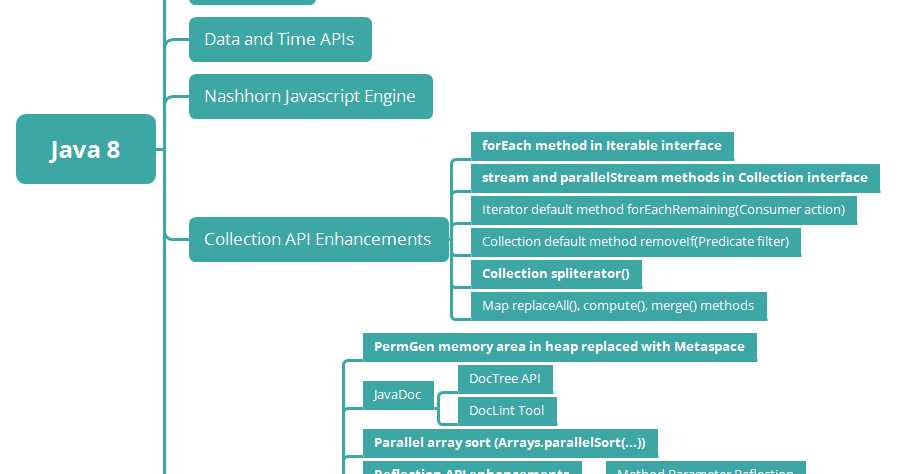
Java 8, released in March 2014, introduced several important features and enhancements to the Java programming language. Some of the main features of Java 8 include:
- Lambda expressions: Java 8 introduced lambda expressions, which allow you to treat functionality as a method argument or code as data. This feature simplifies the coding and makes your code more concise and readable.
- Stream API: The Stream API in Java 8 provides a functional programming approach to processing collections of objects. It allows you to perform complex operations on collections using a pipeline of stream operations, such as filtering, mapping, and reducing.
- Functional interfaces: Java 8 introduced the @FunctionalInterface annotation, which allows you to declare functional interfaces. Functional interfaces have a single abstract method and can be used with lambda expressions and method references.
- Date and time API: Java 8 introduced a new, comprehensive date and time API, known as the java.time package. This API provides classes for representing dates, times, durations, and intervals, and it also includes a rich set of methods for manipulating and formatting date and time values.
- Optional class: The Optional class in Java 8 allows you to represent an optional value that may or may not be present. It helps to avoid null pointer exceptions and provides a more expressive way of handling absent values.
These are just a few of the main features introduced in Java 8. Overall, Java 8 brought significant improvements to the language, making it more modern and facilitating the development of cleaner and more concise code.
What is a lambda expression in Java 8?
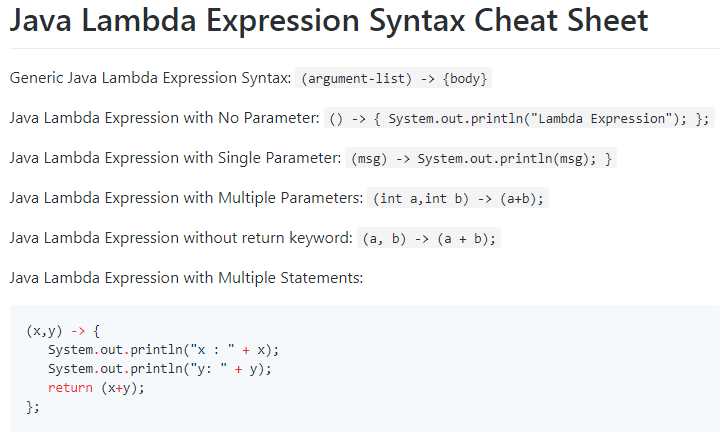
A lambda expression is a new feature introduced in Java 8 that allows you to write concise and more readable code by providing a way to represent anonymous functions. It is a way to pass functionality as an argument to a method or construct simple classes without the need to define a separate class.
A lambda expression consists of two parts: the parameter list and the body. The parameter list specifies the types and names of the parameters, while the body contains the code that is executed when the lambda expression is called. The syntax for a lambda expression is (parameters) -> expression or (parameters) -> { statements }.
Lambda expressions are mainly used to implement functional interfaces, which are interfaces that have only one abstract method. They enable you to write more concise and expressive code, especially when working with collections and streams. With lambda expressions, you can eliminate the need for anonymous inner classes, making the code more readable and reducing the amount of boilerplate code.
For example, in Java 7, if you wanted to sort a list of strings in descending order, you would need to write a comparator using an anonymous inner class. In Java 8, you can achieve the same result using a lambda expression:
List<String> names = Arrays.asList("John", "Mary", "Adam");
Collections.sort(names, (String a, String b) -> b.compareTo(a));
In this example, the lambda expression (String a, String b) -> b.compareTo(a) is used as the comparator to sort the list in descending order. This code is much shorter and more readable compared to the traditional approach using an anonymous inner class.
What is the difference between functional interfaces and normal interfaces in Java 8?
A functional interface is an interface in Java 8 that contains a single abstract method. This means that functional interfaces can be used as lambdas or method references in functional programming. They are also known as Single Abstract Method (SAM) interfaces.
In contrast, a normal interface in Java 8 can contain multiple abstract methods. These methods can have different implementations in different classes that implement the interface. Normal interfaces are typically used for defining a set of related methods that need to be implemented by multiple classes.
Functional interfaces in Java 8 play a crucial role in enabling the use of lambdas and method references. They provide a simplified and concise way of defining behavior that can be passed as an argument to a method or assigned to a variable. Normal interfaces, on the other hand, are more general and can be used for a wider range of purposes.
The distinguishing characteristic of a functional interface is the presence of a single abstract method, which makes it eligible to be used with lambda expressions or method references. This allows for more concise and readable code when implementing functional programming concepts in Java 8.
In summary, functional interfaces and normal interfaces in Java 8 differ in the number of abstract methods they can contain. Functional interfaces have only one abstract method and are used for functional programming, while normal interfaces can have multiple abstract methods and are used for a wider range of purposes.
What is the Stream API in Java 8 and how does it work?
The Stream API is one of the major features introduced in Java 8 that allows for efficient and functional-style processing of collections of data. It provides a high-level abstraction for manipulating and traversing data in a declarative manner.
A stream in Java 8 represents a sequence of elements from a source, such as a collection or an I/O channel. It supports various operations, both intermediate and terminal, that can be chained together to perform complex data processing tasks.
Intermediate operations are operations that transform a stream into another stream. Examples of intermediate operations include filtering elements based on a predicate, mapping elements to a new value, or sorting elements.
Terminal operations are operations that produce a result or a side-effect, such as collecting elements into a collection, calculating the sum or average of a numeric stream, or printing elements to the console.
The Stream API takes advantage of the concept of functional programming by allowing operations to be performed on streams in a declarative and immutable manner. This means that the original data source remains untouched, and the operations are executed on a separate stream, keeping the code clean and easier to reason about.
Additionally, the Stream API provides support for parallel processing through parallel streams, which can speed up the execution of certain operations by performing them concurrently on multiple threads.
How is the Optional class used in Java 8?
The Optional class in Java 8 is a container object that may or may not contain a non-null value. It is used to represent the presence or absence of a value, instead of using null references. Optional is intended to provide a more expressive and safer way of handling situations where a value may or may not be present.
One of the main advantages of using the Optional class is that it helps to avoid null pointer exceptions. Instead of checking whether a value is null or not, you can use Optional’s methods such as isPresent() or ifPresent() to safely handle the presence or absence of a value. This makes the code more readable and less error-prone.
The Optional class provides methods to perform various operations on the contained value, such as getting the value with get(), checking if the value is present with isPresent(), providing a default value with orElse(), or throwing an exception if the value is absent with orElseThrow(). All these methods help to handle different scenarios in a concise and readable manner.
Additionally, the Optional class can be combined with other Java 8 features such as Stream API and functional interfaces, allowing for powerful and expressive code. For example, Optional can be used in stream operations to filter or transform values, or in functional interfaces to handle optional parameters.
Conclusion

In Java 8, the new date and time APIs were introduced to overcome the limitations of the old java.util.Date and java.util.Calendar classes. The new APIs provide a more intuitive and flexible way to work with dates and times.
The core classes in the new date and time APIs are LocalDate, LocalTime, and LocalDateTime, which represent dates, times, and combined date-time values respectively. These classes are immutable and provide various methods for manipulating and formatting dates and times.
Additionally, the java.time package includes other useful classes and interfaces such as Period, Duration, and DateTimeFormatter, which allow for more complex operations and formatting options.
Overall, the new date and time APIs in Java 8 provide a more efficient and robust solution for handling dates and times, making it easier for developers to work with temporal data in their Java applications.