How to Round an Answer to One Decimal Place: A Step-by-Step Guide

When it comes to dealing with numbers, precision is key. Whether you are calculating a complex mathematical equation or simply determining the weight of an object, having the correct number of decimal places can make a big difference. One common way to ensure accuracy in calculations is to round the answer to one decimal place. This means that instead of having a number with numerous decimal points, you would have a rounded number that is easier to work with.
Rounding to one decimal place is a useful technique in many fields and can be particularly helpful in finance, engineering, and statistics. In finance, for example, rounding can be used to simplify complicated financial calculations such as interest rates or investment returns. In engineering, rounding can help with measurements and specifications, ensuring that designs and constructions are accurate. In statistics, rounding can be used to present data in a more understandable format, making it easier for analysts to interpret and draw conclusions.
There are different rules for rounding numbers to one decimal place depending on the value of the digit in the second decimal place. If the digit is 5 or greater, the number is rounded up. For example, if the original number is 3.55, it would be rounded to 3.6. If the digit is less than 5, the number is rounded down. For example, if the original number is 3.44, it would be rounded to 3.4. This technique is commonly used in mathematical calculations, scientific research, and everyday life to ensure accuracy and simplify calculations.
Why It’s Important to Round Answers to One Decimal Place
When working with numbers and calculations, it is essential to have accurate and precise results. Rounding answers to one decimal place is an important practice that helps simplify calculations, improve readability, and maintain consistency in data analysis and reporting. By rounding numbers, we can express them in a more manageable and understandable form without losing significant precision.
Rounding numbers:
- Enhances readability: Rounding answers to one decimal place makes numbers more digestible and easier to interpret. This is particularly important in situations where large amounts of data are involved or when presenting information to an audience with varying mathematical backgrounds. Clear and well-rounded numbers facilitate understanding and enhance communication.
- Simplifies calculations: Using rounded numbers simplifies calculations by reducing the number of decimal places to consider. This not only saves time but also minimizes the chances of errors during manual computations. When performing complex calculations, rounding can help avoid overwhelming long numbers and make the process more manageable.
- Maintains consistency: Rounding answers to a consistent number of decimal places ensures uniformity and comparability across calculations. This is crucial when analyzing data, conducting statistical analysis, or making predictions. Consistent rounding practices improve the reliability and accuracy of subsequent calculations or analyses based on the rounded numbers.
Considerations when rounding:
- Always refer to the specified resolution: Round answers to the specified precision or decimal place mentioned in the problem or data requirements. This ensures compliance with guidelines or standards and prevents confusion or misinterpretation.
- Take into account the significance of the remaining decimal places: Consider the context and significance of the remaining decimal places when rounding numbers. If the remaining decimal places contain valuable information or impact subsequent calculations, it may be necessary to round differently or preserve more decimal places.
- Apply appropriate rounding rules: Follow established rounding rules, such as rounding up for numbers greater than or equal to five and rounding down for numbers less than five. This helps maintain fairness and consistency in rounding practices.
- Document rounding procedures: When working with complex calculations or analyses, document the rounding procedures followed to ensure transparency and reproducibility. This documentation can aid in capturing any potential sources of error, allowing for validation and verification of the results.
Rounding answers to one decimal place plays a crucial role in maintaining accuracy, facilitating analysis, and improving communication in mathematical and statistical contexts. By adopting consistent rounding practices and considering the significance of decimal places, we can ensure reliable and precise results that are easy to understand and work with.
The Definition and Importance of Rounding

Rounding is a mathematical process that involves approximating a number to a certain degree of accuracy. It is commonly used to simplify complex calculations or to make numbers easier to work with. Rounding involves reducing the number of decimal places or significant figures in a number, and adjusting it to the closest value that fits the desired level of accuracy.
In mathematics, rounding is typically performed by examining the digit to the right of the rounding position. If this digit is less than 5, the number is rounded down, and if it is 5 or greater, the number is rounded up. For example, when rounding 3.6 to the nearest whole number, it would be rounded to 4, as the digit to the right of the rounding position is 6. Rounding can also be performed to a specific decimal place, such as rounding 3.14159 to three decimal places, resulting in 3.142.
Rounding is important in various fields and everyday life. In finance, rounding is used to simplify calculations of interest rates, mortgage payments, and financial projections. In engineering and science, rounding helps to make measurements and calculations more manageable and avoids unnecessary precision. In statistics, rounding is used to present data in a more understandable and concise format. Additionally, rounding is frequently used in everyday situations, such as when calculating tips, estimating distances, or approximating quantities.
However, it is important to note that rounding can introduce a small degree of error in calculations. Depending on the level of accuracy required, this error may or may not be significant. Therefore, it’s essential to consider the context and purpose of rounding when applying it to mathematical or real-world problems. By understanding how rounding works and its importance, individuals can make informed decisions about when and how to use it effectively.
Benefits of Rounding Answers to One Decimal Place
If you are working with numbers and calculations, you may find it beneficial to round your answers to one decimal place. Rounding can simplify your calculations, provide a clearer representation of your data, and make your results more manageable for practical use.
1. Simplification of calculations

Rounding your answers to one decimal place simplifies your calculations by reducing the number of digits you need to work with. This can make mental math and manual calculations much easier, especially when dealing with complex equations or large sets of numbers. Rounding allows you to focus on the most important information without getting overwhelmed by excessive decimal places.
2. Clearer representation of data
By rounding your answers, you are able to present data in a more concise and understandable format. Decimal places beyond one can often be insignificant or irrelevant in many real-world situations. Rounding allows you to highlight the main trends or patterns in your data, providing a clearer picture of what the numbers are indicating. Additionally, rounding can prevent misleading interpretations that might occur when dealing with excessively precise numbers.
3. Practical usability

Rounding answers to one decimal place makes your results more practical and usable in real-world scenarios. In fields such as finance, engineering, and statistics, using a limited number of decimal places can help in making informed decisions based on rounded values. This approach acknowledges the inherent uncertainty in measurements and calculations, allowing for more realistic and feasible solutions to problems.
In summary, rounding answers to one decimal place offers several benefits, including simplification of calculations, clearer representation of data, and practical usability. By using this approach, you can enhance the accuracy, efficiency, and practicality of your numerical analysis and applications.
Examples of Rounding Answers to One Decimal Place

Rounding answers to one decimal place is a common practice in various mathematical calculations and real-life applications. It helps simplify numbers and makes them easier to work with. Here are some examples of situations where rounding answers to one decimal place is useful:
1. Measuring distances or lengths:
When measuring distances or lengths, it is often unnecessary to express the exact measurement. For example, if you measure a distance of 2.345 meters, rounding it to one decimal place would give you 2.3 meters, which is still a reasonably accurate representation.
2. Calculating average scores:
In situations where average scores or ratings are calculated, rounding the final result to one decimal place can provide a more concise representation. For instance, if the average score is calculated to be 6.758, rounding it to 6.8 would make it easier to interpret and compare with other scores.
3. Estimating time:

When estimating time, rounding to one decimal place can help provide a general idea without the need for exact precision. For example, if a task is estimated to take 3.837 hours, rounding it to 3.8 hours would give a more practical estimate.
4. Financial calculations:
In financial calculations, rounding to one decimal place is often used to simplify calculations and make results more manageable. For instance, when calculating interest rates or loan repayments, rounding to one decimal place can help provide a clearer understanding of the final amount.
In conclusion, rounding answers to one decimal place is a useful technique in various scenarios. It allows for simplification, improves readability, and provides a practical representation of values. By rounding off numbers, we can work with more manageable figures while still maintaining a reasonable level of accuracy.
How to Round Numbers to One Decimal Place

When working with numbers, it is often necessary to round them to a specific decimal place. One common requirement is to round numbers to one decimal place. This can be done using a few simple rules and techniques. In this article, we will explore how to round numbers to one decimal place.
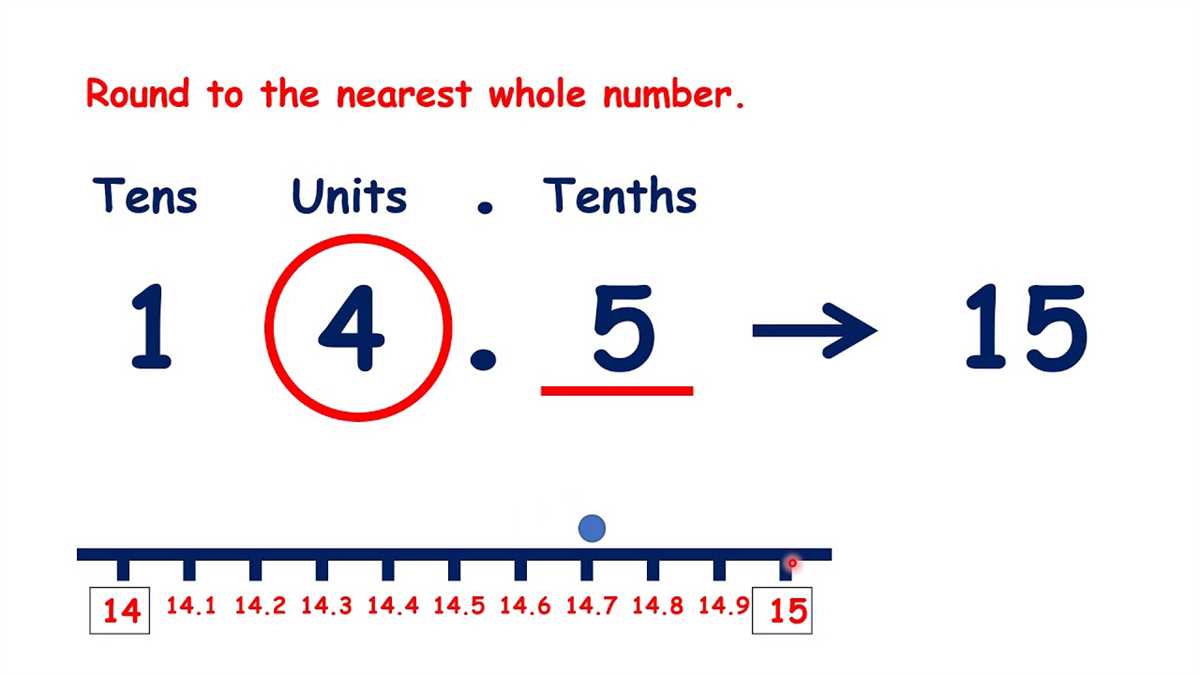
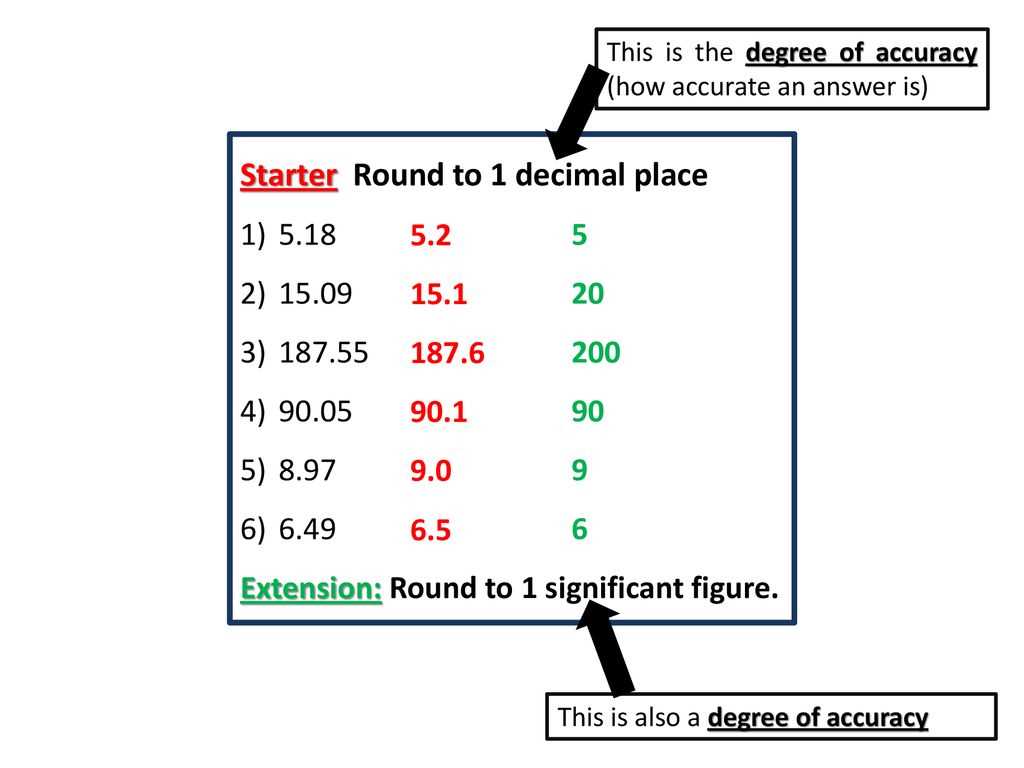
To round a number to one decimal place, start by identifying the digit in the second decimal place. If this digit is 5 or greater, round the number up by increasing the digit in the first decimal place by 1. If the digit is 4 or lower, round the number down by leaving the digit in the first decimal place as it is. If the digit in the second decimal place is exactly 5, round the number up if the digit in the first decimal place is odd, and round the number down if the digit in the first decimal place is even.
To illustrate this, let’s consider the number 3.84. In this case, the digit in the second decimal place is 4, which is lower than 5. Therefore, when rounding to one decimal place, we leave the digit in the first decimal place as it is. So, 3.84 rounded to one decimal place is 3.8.
Alternatively, let’s take the number 6.95. Here, the digit in the second decimal place is 5, which means we need to apply the rounding rule for the digit in the first decimal place. Since the digit in the first decimal place, 9, is odd, we round the number up to 7.0.
Overall, rounding numbers to one decimal place is a straightforward process. By following the rules and techniques mentioned above, you can quickly and accurately round numbers to one decimal place in any mathematical or statistical analysis.
Common Mistakes to Avoid When Rounding to One Decimal Place
Rounding numbers to one decimal place is a common practice in many fields, including mathematics, science, finance, and engineering. While it may seem straightforward, there are several mistakes that people often make when rounding numbers. These mistakes can lead to inaccurate calculations and potentially significant errors. It is important to be aware of these pitfalls and avoid them to ensure the accuracy of your rounded numbers.
1. Rounding without considering the next digit
One of the most common mistakes is rounding a number without considering the next digit. When rounding to one decimal place, it is crucial to look at the digit immediately after the desired decimal place. If this digit is 5 or greater, the preceding digit should be rounded up. Conversely, if the digit is less than 5, the preceding digit should remain the same. Failure to consider the next digit can result in rounded numbers that are not accurate.
2. Rounding too early in calculations
Another mistake to avoid is rounding too early in calculations. Rounding should typically be done at the final step of a calculation, after all other operations have been performed. Rounding prematurely can introduce cumulative errors and inaccuracies in subsequent calculations. It is important to maintain the precision of numbers throughout the calculations and round only at the end to ensure the most accurate results.
3. Rounding to a specific decimal place instead of a significant figure
Often, people mistakenly round a number to a specific decimal place instead of rounding to the appropriate significant figure. Significant figures represent the precision or uncertainty in a measurement or calculation. When rounding to one decimal place, it is important to consider the significant figure of the original number. If the digit immediately following the desired decimal place is a significant figure, it should be rounded. Otherwise, it should be dropped. Rounding to the appropriate significant figure ensures that the rounded number is consistent with the precision of the original measurement or calculation.
4. Ignoring rounding rules for negative numbers
When rounding negative numbers to one decimal place, it is essential to follow the rounding rules. If the number is negative and the digit immediately following the desired decimal place is 5 or greater, the preceding digit should be rounded up. Conversely, if the digit is less than 5, the preceding digit should stay the same. Ignoring these rules for negative numbers can lead to incorrect rounding and inaccuracies in calculations.
Avoiding these common mistakes will help you round numbers to one decimal place accurately and ensure the precision of your calculations. Remember to consider the next digit, round at the appropriate step, round to significant figures, and follow the rounding rules for negative numbers. By being mindful of these pitfalls, you can confidently round numbers and maintain the integrity of your calculations.